Reseñas proporcionadas por Syndetics
Library Journal Review
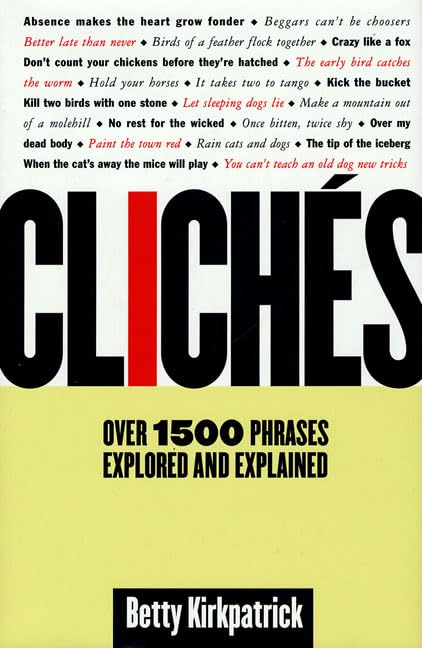
Kirkpatrick, the editor of the Bloomsbury Thesaurus (Bloomsbury, 1993) and the latest edition of Roget's Thesaurus (Little, Brown, 1996), has turned her lexical attention to the cliché. In this dictionary, she examines and categorizes more than 1500 clichés, using her own classification system. Arranging entries alphabetically, she moves from "absence makes the heart grow fonder" to "zero hour." Kirkpatrick offers an explanation of each cliché's meaning, uses it in a sentence, places it in historical context, and explains who is most likely to use it (e.g., the young or the old, doctors or sports announcers). Thus, the reader can learn that "every effort is being made" is a hackneyed phrase most often used by officials to "reassure people who fear that very little is being done" and that it originated in the 20th century. An interesting introduction exploring the idea of the cliché and how it has been treated over time adds a touch of scholarship to this general-reader dictionary. It will be handy in almost any reference collection and is therefore recommended for all libraries.Neal Wyatt, Chesterfield Cty. P.L., Va. (c) Copyright 2010. Library Journals LLC, a wholly owned subsidiary of Media Source, Inc. No redistribution permitted.
Booklist Review
The English language has always been flexible in the words, phrases, or terminology that it uses. It has borrowed (occasionally, stolen outright) from most other languages and adopted from the less "couth" versions of itself. The plethora of dictionaries, thesauri, phrase books, and quotation collections attest to the vibrancy of the language and its ongoing evolution. These two publications concentrate on the uncouth aspect of the language, looking at cliches and slang, respectively. Kirkpatrick, an editor of Roget's Thesaurus, has collected more than 1,500 phrases in Cliches. After a cliche-laden introduction that discusses the controversy over the definition of cliches and the terrible reputation they have acquired, Kirkpatrick offers an alphabetic listing of such gems as lock, stock and barrel; over the moon; thanks but no thanks; and we must have lunch sometime. The author pigeonholes each clicheinto one or more of 14 categories, such as proverb or hackneyed phrase, followed by a brief note on the usage and derivation of the term. Dunn, an author of travel guides, makes the claim that Idiom Savant, a collection of slang and jargon, is the first book to be largely researched on the Internet. He asked people from a variety of news groups to e-mail him their group's "lingo." He has categorized the terms into five broad groups: work, show business, crime and punishment, sports and recreation, and amusement and lifestyles. The result is a wide variety of words and sayings, along with the meanings that various groups might have for them. For example, television game-show producers refer to the silent, frightened contestant as bambi, police officers call their bulletproof vests corsets, and karaoke singers call the person, often inebriated, who joins in on every tune a barber (as in The Barber of Seville). Both these works offer the user a fresh look at words and phrases that earn derision from those who would try to limit the English language. The authors have approached their topics with a positive attitude, neither damning nor praising the use of the various terms they define. Cliches supplements older titles such as James Rogers' Dictionary of Cliches [RBB My 1 86] and Eric Partridge's Dictionary of Cliches (5th ed., Routledge, 1978). Idiom Savant adds something new to the body of literature by including terms that may never make it into more standard slang dictionaries. Both are worthy additions to a public or academic library collection.