Descripciones mejoradas de Syndetics:
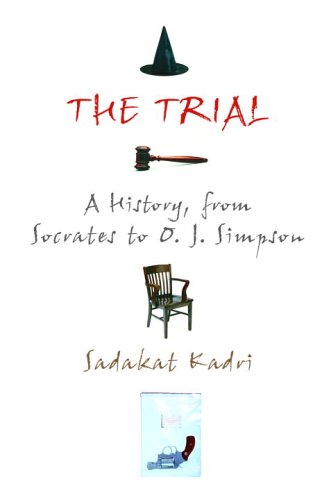
For as long as accuser and accused have faced each other in public, criminal trials have been establishing far more than who did what to whom--and in this fascinating book, Sadakat Kadri surveys four thousand years of courtroom drama. A brilliantly engaging writer, Kadri journeys from the silence of ancient Egypt's Hall of the Dead to the clamor of twenty-first-century Hollywood to show how emotion and fear have inspired Western notions of justice--and the extent to which they still riddle its trials today. He explains, for example, how the jury emerged in medieval England from trials by fire and water, in which validations of vengeance were presumed to be divinely supervised, and how delusions identical to those that once sent witches to the stake were revived as accusations of Satanic child abuse during the 1980s. Lifting the lid on a particularly bizarre niche of legal history, Kadri tells how European lawyers once prosecuted animals, objects, and corpses--and argues that the same instinctive urge to punish is still apparent when a child or mentally ill defendant is accused of sufficiently heinous crimes. But Kadri's history is about aspiration as well as ignorance. He shows how principles such as the right to silence and the right to confront witnesses, hallmarks of due process guaranteed by the U.S. Constitution, were derived from the Bible by twelfth-century monks. He tells of show trials from Tudor England to Stalin's Soviet Union, but contends that "no-trials," in Guantánamo Bay and elsewhere, are just as repugnant to Western traditions of justice and fairness. With governments everywhere eroding legal protections in the name of an indefinite war on terror, Kadri's analysis could hardly be timelier. At once encyclopedic and entertaining, comprehensive and colorful, The Trial rewards curiosity and an appreciation of the absurd but tackles as well questions that are profound. Who has the right to judge, and why? What did past civilizations hope to achieve through scapegoats and sacrifices--and to what extent are defendants still made to bear the sins of society at large? Kadri addresses such themes through scores of meticulously researched stories, all told with the verve and wit that won him one of Britain's most prestigious travel-writing awards--and in doing so, he has created a masterpiece of popular history.
Includes bibliographical references (p. [355]-435) and index.
From Eden to ordeals -- The Inquisition -- The jury trial (1) -- The witch trial -- The trials of animals, corpses, and things -- The Moscow show trials -- The war crimes trials -- The jury trial (2) : a theater of justice.
Reseñas proporcionadas por Syndetics
Library Journal Review
Kadri, who practices criminal law in England, has penned a superb narrative history of trials that explains with equal doses of passion and persuasion the dynamics that have led to courtroom dramas involving all manner of defendants from witches to religious dissidents to modern-day war criminals-not to mention animals and locomotives. Only someone having a broad understanding of law, history, sociology, religion, psychology and politics could have written this riveting and lucid account of justice and vengeance, secrecy and spectacle, while delineating the fundamental conflict between reason and emotion that is inherent in the Western legal tradition. Indeed, Kadri's most lasting contribution may reside in his analysis of the trial process as a cultural construct. The book is bound to garner great praise. Nevertheless, its sound scholarship is marred by the author's regular use of casually foul language, juvenile figures of speech, and provocative illustrations, none of which serves to advance his arguments or clarify his subjects. Notwithstanding the needless vulgarities, this book will be a remarkable addition to the shelves of both general and specialized libraries by reason of its contributions to our understanding of that preeminent cultural phenomenon, the criminal trial.-Gilles Renaud, Ontario Court of Justice, Cornwall (c) Copyright 2010. Library Journals LLC, a wholly owned subsidiary of Media Source, Inc. No redistribution permitted.
Publishers Weekly Review
Kadri's history of the criminal trial in the Western legal tradition presents representative cases, many famous, some little known, to illustrate the approaches, both rational and not, that organized societies have used to deal with law-breaking. One theme is the role of evidence in criminal prosecutions. Medieval trial by ordeal, for example, relied on the direct intervention of God to reveal guilt or innocence. In later epochs, confessions were accorded decisive weight, even if they were extracted by torture, as in the Inquisition and Stalin's show trials. Today, of course, we apply an intricate code of evidence, but, the author says, we still have verdicts based on ignorance and hysteria, and we have celebrity trials where evidence is subordinated to publicity. Much more serious is Kadri's summary of war crimes prosecutions stemming from atrocities in WWII and in Vietnam. Not many of the trials discussed reached objectively just conclusions, but these judicial failures tend to illuminate the dynamics (secrecy vs. transparency, hatred of crime vs. fear of mistaken verdicts) underlying criminal prosecutions. This thoughtful survey by Kadri, a prize-winning travel writer and criminal lawyer in England, helps us understand how far our system has advanced and how far we still have to go. B&w illus. Agent, Derek Johns, A.P. Watt (U.K.). (Aug. 30) (c) Copyright PWxyz, LLC. All rights reserved
CHOICE Review
This encyclopedic history of the trial from ancient times to the present provides an authoritative one-volume history of the various forms and purposes of trials throughout Western civilization. Early trials were often regarded as acts of divine judgment (ordeals, the Inquisition), but in the Middle Ages they came to be understood as instruments of human agency, a substitute for divine judgment. Attorney and barrister Kadri is particularly good on the origins of the Anglo-American jury trial. He detours to explore the misuses of the trial process (the Moscow show trials) and the perhaps unrealistic aspirations of other trials (war crimes trials). He also shows how the legal process can turn reasonable principles into absurd practices, leading to trials of animals, corpses, and inanimate objects. With a gripping subject, fluid writing, witty prose, wonderful anecdotes, and an authoritative style, this tour de force moves swiftly through a vast territory. The result is a magnificent book suitable for all sorts of people, from inquisitive high school students to blue-chip lawyers. For those whose appetite is whetted, Kadri provides a useful list for further reading. This most certainly should be an award winner. ^BSumming Up: Essential. All levels/libraries. M. M. Feeley University of California, Berkeley
Booklist Review
Unexpectedly lively for a legal history, Kadri's study of the trajectory of the modern Western jury trial bounces from the Inquisition to Nuremberg to O. J. Simpson with an eye for the fundamental (the crucial importance of obtaining a confession, for example); the perennial (political power struggles played out in court); and the absurd (trying corpses, animals, and inanimate things). At times, the author's penchant for the ridiculous threatens hilarity; a passage on trial by morsel, a medieval ordeal revealing legal truth through swallowing prowess, rivals any Monty Python skit. Yet beneath all the courtroom oddities, Kadri makes a set of deadly serious points about the trial's social function as a public morality play that, through spectacle and perhaps superstition, preserves order by publicly reiterating precepts key to a society's self-image. Nor are his points solely bound to medieval jurisprudence: as shown by Stalin's show trials, the Scopes trial, the Bernhard Goetz case, and others, spectacle is alive, well, and, these days, on Court TV. Entertaining, sociologically perceptive, and highly recommended. --Brendan Driscoll Copyright 2005 Booklist