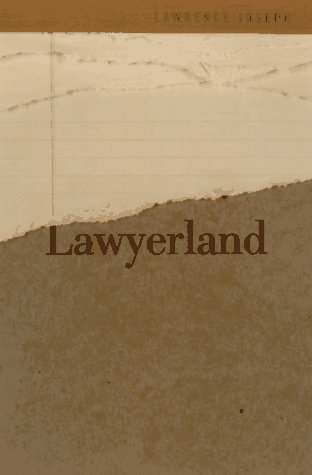
Imagen de portada de Amazon
Imagen de Amazon.com
Imagen de cubierta Syndetics
Portada de Syndetics
Imagen de OpenLibrary

Lawyerland what lawyers talk about when they talk about law Lawrence Joseph.

Por: Detalles de publicación: New York Farrar, Straus & Giroux 1997.Edición: 1st edDescripción: 225 p. 22 cmISBN:
  • 0374184178 (hard : alk. paper)
Otro título:
  • Lawyer land
Tema(s): Clasificación LoC:
  • KF 297 .J64 1997
Valoración
    Valoración media: 0.0 (0 votos)
Existencias
Imagen de cubierta Tipo de ítem Biblioteca actual Biblioteca de origen Colección Ubicación en estantería Signatura topográfica Materiales especificados Info Vol URL Copia número Estado Notas Fecha de vencimiento Código de barras Reserva de ítems Prioridad de la cola de reserva de ejemplar Reservas para cursos
Libro Biblioteca de Derecho Mons. Fremiot Torres Oliver Colección General biblioteca derecho KF 297 .J64 1997 (Navegar estantería(Abre debajo)) Disponible 70000000613328
Total de reservas: 0

Descripciones mejoradas de Syndetics:

What do lawyers talk about when they talk about law? Lawrence Joseph, who is both a lawyer and an acclaimed poet, has always known that lawyers think and act differently among themselves than they do when they are on the record in court or in the company of those people who are, as he puts it, non-lawyers. So he met in downtown Manhattan with lawyers from every sector of the legal world - criminal, corporate, labor, personal injury, insurance defense, you name it - and encouraged them to speak without restraint about their work, their clients, other lawyers, and the law itself. From these exchanges Joseph has created, in Lawyerland, eight composites (or phenotypes, as his Judge Celia Day would call them) who vividly represent the legal culture at the end of the century. Speaking with rare candor, these lawyers are by turns grandiose and filled with self-doubt; piercingly intelligent and breathtakingly crude; wise about their work and innocent of their own egotism and moral compromises. With an unerring ear for dialogue, a cunning artistry, and a prosecutor's radar for loaded testimony, Joseph has captured the argot and mannerisms of the legal trade and the strange truths that emerge when lawyers let their guard down for a while.

Reseñas proporcionadas por Syndetics

Library Journal Review

In this quirky but oddly appealing look at the attitudes and perceptions of a variety of New York lawyers, chapters read like the dialog in a good legal novel. Law professor Joseph (St. John's Univ.) describes his work as "truthful" rather than "factual"; the candor requires that names, places, and incidents be masked. The chapters consist of dialogs with a variety of lawyers‘criminal, personal injury, labor, and corporate‘as well as judges. The style is free-form; the interviewer fades away as the lawyer's voice takes over in a near stream-of-consciousness monolog about law and lawyering. Readers of John Grisham novels may balk at the book's starkness and lack of movement, but those who enjoy Scott Turow may wish to give this work a try.‘Patrick Petit, Catholic Univ. Law Lib., Washington, D.C. (c) Copyright 2010. Library Journals LLC, a wholly owned subsidiary of Media Source, Inc. No redistribution permitted.

Publishers Weekly Review

Joseph, a poet and law professor at St. John's University in New York, sat down (mostly at meals) with several lawyers of his acquaintance and distilled their conversations into stories that read like radio mini-plays. Indeed, the frank, high-pitched language verges on Mamet. "Reasonable doubt? They go fucking bananas!" declares a weary criminal lawyer of the law-fascinated juries he encounters. A corporate lawyer offers some grim truth: "What we do is determined by who pays us." A loquacious judge, after damning lawyers as liars, finally tells her interviewer of a mind-boggling attempted-murder case involving a husband and wife that resonates with painful clarity. A torts lawyer explicates the world of medical malpractice, where transactional costs trump other considerations: "The public believes in fairness. Well, what's fair for me isn't fair for you." A black lawyer tells a hilarious story about a black law partner who, exasperated by a condescending white client, finally "[g]oes and violates Negro Rule Number One," i.e., never act crazy: act smart. The noirish world that Joseph creates should serve as a tart reminder to practicing lawyers and as a cautionary tale for the aspiring; others may wish for stories with a larger dose of narrative and epiphany. (May) (c) Copyright PWxyz, LLC. All rights reserved
Compartir
logopucpr-y-vive

Contáctanos

¡Queremos saber de ti!

Tel. 787.841.2000 Ext. 1801

bibliotecavaldes@pucpr.edu

⁣Búscanos en las redes

© 2026 Desarrollado por Ignite Online • All Rights Reserved • Powered by Koha.