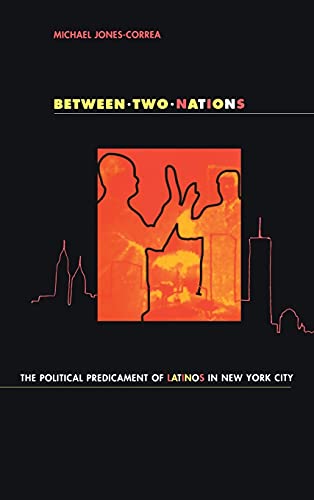

Between two nations the political predicament of Latinos in New York City Michael Jones-Correa.
Detalles de publicación: Ithaca Cornell University Press 1998.Descripción: xiv, 246 p. ill., maps 24 cmISBN:- 0801432928 (alk. paper)
- 0801483646 (pbk. : alk. paper)
- 305.868/07471 21
- F130.S75 J66 1998
| Imagen de cubierta | Tipo de ítem | Biblioteca actual | Biblioteca de origen | Colección | Ubicación en estantería | Signatura topográfica | Materiales especificados | Info Vol | URL | Copia número | Estado | Notas | Fecha de vencimiento | Código de barras | Reserva de ítems | Prioridad de la cola de reserva de ejemplar | Reservas para cursos | |
|---|---|---|---|---|---|---|---|---|---|---|---|---|---|---|---|---|---|---|
| Libro | Biblioteca Mons. Iñaki Mallona (Arecibo) Colección General bev | Disponible | mq329724 |
Descripciones mejoradas de Syndetics:
Immigrants come to the United States from all over Latin America in search of better lives. They obtain residency status, find jobs, pay taxes, and they have children who are American citizens by birth; yet decades may go by before they seek citizenship for themselves or become active participants in the American political process. Between Two Nations examines the lack of political participation among Latin American immigrants in the United States to determine why so many remain outside the electoral process.
Michael Jones-Correa studied the political practices of first-generation immigrants in New York City's multiethnic borough of Queens. Through intensive interviews and participant observation, he found that immigrant participation was stymied both by lack of encouragement to participate and by the requirement to renounce former citizenship, which raised the fear of never being able to return to the country of origin. The hesitation to naturalize as American citizens can extend over decades, leaving immigrants adrift in a political limbo.
Between Two Nations is the first qualitative study of how new immigrants assimilate into American political life. Jones-Correa reexamines assumptions about Latino politics and the diversity of Latino populations in the United States, about the role of informal politics in immigrant communities, and about gender differences in approaches to political activity.
Includes bibliographical references (p. 209-237) and index.
Tabla de contenidos provista por Syndetics
- Acknowledgments(p. xiii)
- Introduction the New Hispanic Immigration(p. 1)
- Part I Setting the Context(p. 11)
- 1 Intimate Strangers: Immigration to Queens(p. 13)
- 2 Participation in the American Polity: Why Citizenship Matters(p. 35)
- 3 Explaining Participation: Why It Takes So Long to Become a Citizen(p. 49)
- Part II The Costs of Choosing(p. 67)
- 4 Resistance from Outside: Machine Politics and the (non) Incorporation of Immigrants(p. 69)
- 5 Resistance from Within: the Myth of Return and the Community of Memory(p. 91)
- Part III Liminal Politics(p. 107)
- 6 In-Between Identities: Race and Ethnicity in the American Context(p. 109)
- 7 The Politics of In-Between: Avoiding Irreconcilable Demands, Keeping Loyalties(p. 124)
- Part IV Breaking the Impasse(p. 149)
- 8 Wanting It Both Ways: the Quest for Dual Citizenship(p. 151)
- 9 Wanting In: Latin American Immigrant Women and the Turn to Electoral Politics(p. 169)
- Part V Conclusion: the New Americans(p. 189)
- 10 Liminality and Democratic Citizenship(p. 191)
- Appendix: Methodology and Interview Sample(p. 203)
- References(p. 209)
- Index(p. 239)
Reseñas proporcionadas por Syndetics
CHOICE Review
This well-researched book provides an excellent and sophisticated analysis of a neglected issue: the political marginality of Latin American immigrants to the US, many of whom acquire residency but not citizenship as soon as they are able. Why is it so, and what are the implications for American democracy, considering that by the year 2010 Latinos will be the largest US minority? Jones-Correa (Harvard Univ.) weaves together portions of interviews with theoretical analysis to unveil the struggle of Latin American immigrants to reconcile conflictual political identities. He explains the lack of immigrant participation in American politics by looking at both resistance from outside ("machine politics") and resistance from within (the "myth of return"). He also examines the political life of Latin American immigrants, including unconventional forms of political protest, such as automobile caravans. The next section considers immigrants' strategies to solve their predicament: while male-dominated immigrant organizations seek dual citizenship, female activists are more inclined to participate in American electoral politics. The concluding chapter shows that instead of blaming the immigrants, the US political establishment should assume responsibility to solve the problem. Highly recommended for research libraries and upper-level undergraduate and graduate students. M. E. Carranza Texas A&M University--KingsvilleNotas de autor provistas por Syndetics
Michael Jones-Correa is Associate Professor of Government and Director of American Studies at Cornell University and the author of Governing American Cities: Inter-Ethnic Coalitions, Competition, and Conflict .