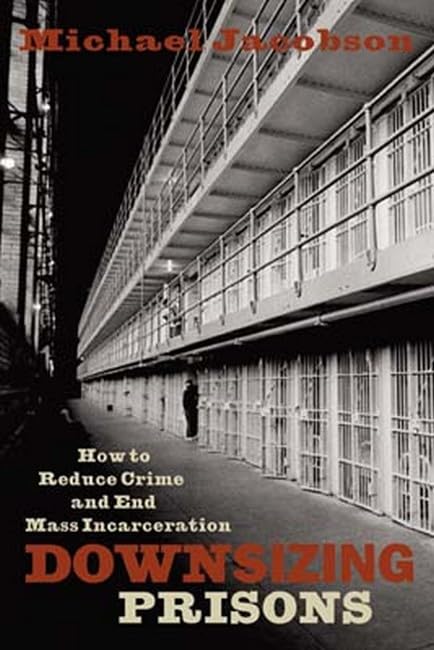
Imagen de portada de Amazon
Imagen de Amazon.com
Imagen de cubierta Syndetics
Portada de Syndetics
Imagen de OpenLibrary

Downsizing prisons how to reduce crime and end mass incarceration Michael Jacobson.

Por: Detalles de publicación: New York and London New York University Press c2005.Descripción: xi, 292 p. ill. 24 cmISBN:
  • 0814742742 (cloth : alk. paper)
Tema(s): Clasificación CDD:
  • 364.60973 J176d 22
Clasificación LoC:
  • HV9471 .J317 2005
Recursos en línea:
Contenidos:
Introduction : bloated prisons -- Mass incarceration -- Unintended consequences -- A new reality for prison systems -- Why prison growth does not reduce crime -- Why parole and probation policies need to change -- Success stories -- Downsizing prisons.
Valoración
    Valoración media: 0.0 (0 votos)
Existencias
Imagen de cubierta Tipo de ítem Biblioteca actual Biblioteca de origen Colección Ubicación en estantería Signatura topográfica Materiales especificados Info Vol URL Copia número Estado Notas Fecha de vencimiento Código de barras Reserva de ítems Prioridad de la cola de reserva de ejemplar Reservas para cursos
Libro Biblioteca Encarnación Valdés Colección General bev 364.60973 J176d (Navegar estantería(Abre debajo)) Disponible 80000002297128
Total de reservas: 0

Descripciones mejoradas de Syndetics:

A convincing argument that mass incarceration neither reduces crime nor ensures safety

Over two million people are incarcerated in America's prisons and jails, eight times as many since 1975. Mandatory minimum sentencing, parole agencies intent on sending people back to prison, three-strike laws, for-profit prisons, and other changes in the legal system have contributed to this spectacular rise of the general prison population.

After overseeing the largest city jail system in the country, Michael Jacobson knows first-hand the inner workings of the corrections system. In Downsizing Prisons , he convincingly argues that mass incarceration will not, as many have claimed, reduce crime nor create more public safety. Simply put, throwing away the key is not the answer.

Includes bibliographical references and index.

Introduction : bloated prisons -- Mass incarceration -- Unintended consequences -- A new reality for prison systems -- Why prison growth does not reduce crime -- Why parole and probation policies need to change -- Success stories -- Downsizing prisons.

Reseñas proporcionadas por Syndetics

Library Journal Review

The United States locks up more of its population than any other country in the world. There are over two million people incarcerated in U.S. prisons and jails-eight times the rate in 1975. This increase can be greatly attributed to sentences for nonviolent drug and property offenses, which skyrocketed during the 1990s. Jacobson (criminology, John Jay Coll.) argues for changes in parole and probation agency operations, reductions in punitive sentencing, and the creation of drug treatment programs in lieu of prison sentences for low-level drug offenders. The premise here is to show how "the tremendous growth of incarceration over the past few decades relates directly to this country's present difficulties in adequately funding its education and healthcare systems." Jacobson does an adequate job defending his belief that incarceration is not the only sentencing alternative. Recommended for specialized collections in criminal justice.-Tim Delaney, SUNY at Oswego (c) Copyright 2010. Library Journals LLC, a wholly owned subsidiary of Media Source, Inc. No redistribution permitted.

CHOICE Review

Building on two critical contributions (Michael Tonry, ed., The Future of Imprisonment, CH, Feb'05, 42-3734, and Joan Petersilia, When Prisoners Come Home: Parole and Prisoner Reentry, CH, Dec'03, 41-2504), Jacobson (John Jay College) presents a compelling data-based case for substantially downsizing prison populations. This is accomplished with the preservation of public safety and a re-distribution of funds to educational and medical needs. Since Jacobson is an insider in the correctional enterprise, he demonstrates the requirements for a solid proposal and recounts the arguments against change in correctional operations. In chapter 1, the introduction of "mass incarceration" frames the arguments. Following is an excellent discussion of the unintended consequences of incarceration. Six structural impediments to prison reform highlight the discussion. Using New York City and San Diego, the author presents evidence that prison growth is not related to increased public safety. A needed clarification of probation and parole initiates a discussion of the reasons for changing parole. Jacobson gives proposals for changing parole policy and three success stories and promising projects. His position, that prisons must change and reductions need to occur, concludes this easily understood book, which should be read by the public and used by policy makers. Excellent bibliography. ^BSumming Up: Essential. All levels/libraries. J. H. Larson University of North Dakota

Notas de autor provistas por Syndetics

Michael Jacobson is currently President of the Vera Institute of Justice, Professor of Criminology in the Department of Law, Police Science, and Criminal Justice Administration at John Jay College of Criminal Justice, and Professor of Sociology at the Graduate Center of the City University of New York.
Compartir
logopucpr-y-vive

Contáctanos

¡Queremos saber de ti!

Tel. 787.841.2000 Ext. 1801

bibliotecavaldes@pucpr.edu

⁣Búscanos en las redes

© 2026 Desarrollado por Ignite Online • All Rights Reserved • Powered by Koha.