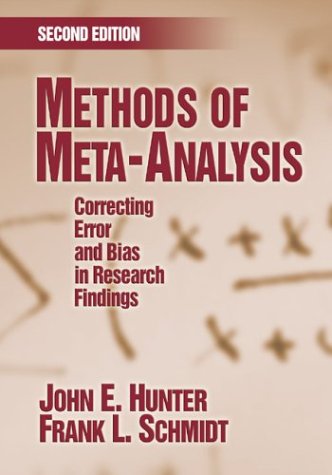

Methods of meta-analysis correcting error and bias in research findings John E. Hunter, Frank L. Schmidt.
Detalles de publicación: Thousand Oaks, Calif. Sage c2004.Edición: 2nd edDescripción: xxxiii, 582 p. ill. 27 cmISBN:- 1412909120 (cloth)
- 300.72 H9451m2 22
- HA29 .H847 2004
- 70.03
| Imagen de cubierta | Tipo de ítem | Biblioteca actual | Biblioteca de origen | Colección | Ubicación en estantería | Signatura topográfica | Materiales especificados | Info Vol | URL | Copia número | Estado | Notas | Fecha de vencimiento | Código de barras | Reserva de ítems | Prioridad de la cola de reserva de ejemplar | Reservas para cursos | |
|---|---|---|---|---|---|---|---|---|---|---|---|---|---|---|---|---|---|---|
| Libro | Biblioteca Encarnación Valdés Colección General bev | 300.72 H9451m2 (Navegar estantería(Abre debajo)) | Disponible | 80000002284829 |
Descripciones mejoradas de Syndetics:
Click ′Additional Materials′ for downloadable sample chapter"Clearly written and compellingly argued, this book explains the procedures and benefits of correcting for measurement error and range restriction and details the methodological developments in meta-analysis over the last decade. No one should consider conducting a meta-analysis without first reading this book. It is essential reading for all scientists."--Michael A. McDaniel, Virginia Commonwealth University
"A book that will certainly appeal not only to the students, but will also be a great reference source for the technically sophisticated professional. The breadth and depth of the coverage, not to mention the novelty and clarity of writing, makes this book a classic in the field. It covers (and at times introduces) many novel issues that will be in the forefront for some years to come--as such a must read for all meta-analysts."--Vish C. Viswesvaran, Ph.D., Director of I/O Program, Florida International University
Meta-analysis is arguably the most important methodological innovation in the social and behavioral sciences in the last 25 years. Developed to offer researchers an informative account of which methods are most useful in integrating research findings across studies, this book will enable the reader to apply, as well as understand, meta-analytic methods. Rather than taking an encyclopedic approach, the authors have focused on carefully developing those techniques that are most applicable to social science research, and have given a general conceptual description of more complex and rarely-used techniques. Fully revised and updated, Methods of Meta-Analysis, Second Edition is the most comprehensive text on meta-analysis available today.
New to the Second Edition:
* An evaluation of fixed versus random effects models for meta-analysis* New methods for correcting for indirect range restriction in meta-analysis* New developments in corrections for measurement error* A discussion of a new Windows-based program package for applying the meta-analysis methods presented in the book* A presentation of the theories of data underlying different approaches to meta-analysis
Includes bibliographical references (p. 527-562) and indexes.
Tabla de contenidos provista por Syndetics
- Preface to 2nd Edition
- Preface to 1st Edition
- Acknowledgements
- Introduction to Meta-Analysis
- Integration Research Findings Across Studies
- General problem and an example
- Problems with statistical significance tests
- Is statistical power the solution?
- Confidence intervals
- Meta-analysis
- Role of meta-analysis in the behavioral and social sciences
- Role of meta-analysis in theory development
- Increasing use of meta-analysis
- Meta-analysis in industrial-organizational psychology
- Wider impact of meta-analysis on psychology
- Impact of meta-analysis outside psychology
- Meta-analysis and social policy
- Meta-analysis and theories of data
- Conclusions
- Study Artifacts and Their Impact on Study Outcomes
- Study Artifacts
- Sampling error, statistical power, and the interpretation of research literatures
- When and how to cumulate
- Undercorrection for artifacts in the corrected standard deviation
- Coding study characteristics and capitalization on sampling error in moderator analysis
- A look ahead in the book
- Meta-Analysis of Correlations
- Meta-Analysis of Correlations Corrected Individually for Artifacts
- Introduction and Overview
- Bare bones meta-analysis: Correcting for sampling error only
- Artifacts other than sampling error
- Multiple simultaneous artifacts
- Meta-analysis of individually corrected correlations
- A worked example: Indirect range restriction
- Summary of meta-analysis correcting each correlation individually
- Exercise 1: Bare bones meta-analysis
- Exercise 2: Meta-analysis correcting each correlation individually
- Meta-Analysis of Correlations Using Artifact Distributions
- Full artifact distribution meta-analysis
- Accuracy of corrections for artifacts
- Mixed meta-analysis: Partial artifact information in individual studies
- Summary of artifact distribution of meta-analysis of correlations
- Exercise: Artifact distribution meta-analysis
- Technical Questions in Meta-Analysis of Correlations
- r versus : Which should be used?
- r vs. regression slopes and intercepts in meta-analysis
- Technical factors that cause overestimation of
- Fixed and random models in meta-analysis
- Credibility vs. confidence intervals in meta-analysis
- Computing confidence intervals in meta-analysis
- Range Restriction in meta-analysis: New technical analysis
- Criticisms of meta-analysis procedures for correlations
- Meta-Analysis of Experimental Effects and Other Dichotomous Comparisons
- Treatment Effects: Experimental Artifacts and Their Impact
- Quantification of the treatment effect: The d statistic and the point-biserial correlation
- Sampling error in d values: Illustrations
- Error of measurement in the dependent variable
- Error of measurement in the treatment variable
- Variation across studies in treatment strength
- Range variation on the dependent variable
- Dichotomization of the dependent variable
- Imperfect construct validity in the dependent variable
- Imperfect construct validity in the treatment variable
- Bias in the effect size (d statistic)
- Recording, computational, and transcriptional errors
- Multiple artifacts and corrections
- Meta-Analysis Methods for d Values
- Effect size indices: d and r
- An Alternative to d: Glass' d
- Sampling error in the d statistic
- Cumulation and correction of the variance for sampling error
- Analysis of moderator variables
- Correcting d values for measurement error in the dependent variable
- Measurement error in the independent variable in experiments
- Other artifacts and their effects
- Correcting for multiple artifacts
- Summary of meta-analysis of d values
- Exercise: Meta-Analysis of d-Values
- Technical Questions in Meta-Analysis of d Values
- Alternative experimental designs
- Within-subjects experimental designs
- Meta-analysis and the within-subjects design
- Statistical power in the two designs
- Threats to internal and external validity
- Bias in observed d values
- Use of multiple regression in moderation analysis of d values
- General Issues in Meta-Analysis
- General Technical Issues in Meta-analysis
- Fixed effects versus random effects models in meta-analysis
- Second order sampling error: General principles
- Detecting moderators not hypothesized a priori
- Second order meta-analysis
- Large N studies and meta-analysis
- Second order sampling error: Technical treatment
- The detection of moderator variables: Summary
- Hierarchical analysis of moderator variables
- Exercise: Second order meta-analysis
- Cumulation of Findings Within Studies
- Fully replicated designs
- Conceptual replications
- Conceptual replications and confirmatory factor analysis
- Conceptual replications: A alternative approach
- Analysis of subgroups
- Summary
- Methods of Integrating Findings Across Studies and Related Software
- The traditional narrative procedure
- The traditional voting method
- Cumulation of p-values across studies
- Statistically correct vote counting procedures
- Meta-analysis of research studies
- Unresolved problems in meta-analysis
- Summary of methods of integrating studies
- Computer programs for meta-analysis
- Locating, Evaluating, and Coding Studies
- Conducting a thorough literature search
- What to do about studies with "methodological weaknesses"
- Coding studies in meta-analysis
- What to include in the meta-analysis report
- Information needed in reports of primary studies
- Appendix: Coding sheet for validity studies
- Availability and Source Bias in Meta-Analysis
- Some evidence on bias
- Effects of methodological quality on mean effect sizes from different sources
- Multiple hypotheses and other considerations in availability bias
- Methods for detecting availability bias
- Methods for correcting for availability bias
- Summary of Psychometric Meta-Analysis
- Meta-analysis methods and theories of data
- What is the ultimate purpose of meta-analysis?
- Appendix: Windows Based Meta-Analysis Software Package
- References
- Author Index
- Subject Index
- About the Authors
Notas de autor provistas por Syndetics
John E. (Jack) Hunter (1939--2002) was a professor in the Department of Psychology at Michigan State University. He received his Ph.D. in quantitative psychology from the University of Illinois. Jack coauthored four books and authored or coauthored over 200 articles and book chapters on a wide variety of methodological topics, including confirmatory and exploratory factor analysis, measurement theory and methods, statistics, and research methods. He also published numerous research articles on such substantive topics as intelligence, attitude change, the relationship between attitudes and behavior, validity generalization, differential validity/selection fairness, and selection utility. Much of his research on attitudes was in the field of communications, and the American Communications Association named a research award in his honor. Professor Hunter received the Distinguished Scientific Award for Contributions to Applied Psychology from the American Psychological Association (APA) (jointly with Frank Schmidt) and the Distinguished Scientific Contributions Award from the Society for Industrial/Organizational Psychology (SIOP) (also jointly with Frank Schmidt). He was a Fellow of APA, APS, and SIOP, and was a past president of the Midwestern Society for Multivariate Experimental Psychology. For the story of Jack's life, see Schmidt (2003).
Frank L. Schmidt is the Gary F. Fethke Leadership Professor Emeritus in the Department of Management and Organization in the Tippie College of Business at the University of Iowa. He received his Ph.D. in industrial/organizational psychology from Purdue University and has been on the faculties of Michigan State and George Washington Universities. He has authored or coauthored seven books and nearly 200 articles and book chapters on measurement, statistics, research methods, individual differences, and personnel selection. He headed a research program in the U.S. Office of Personnel Management in Washington, D.C., for 11 years, during which time he published numerous research studies in personnel psychology, primarily with John Hunter. Their research on the generalizability of employment selection method validities led to the development of the meta-analysis methods presented in this book. Professor Schmidt has received the Distinguished Scientific Award for Contributions to Applied Psychology from the American Psychological Association (APA) (jointly with John Hunter) and the Distinguished Scientific Contributions Award from the Society for Industrial/Organizational Psychology (SIOP) (also jointly with John Hunter). He has also received the Ingram Olkin Award and the Frederick Mosteller Award, both for contributions to meta-analysis methodology; the Scientific Award for Applications of Psychology from the Association for Psychological Science (APS); the Gold Medal Lifetime Achievement award from the APA Foundation; the Distinguished Career Award for Contributions to Human Resources, and the Distinguished Career Achievement Award for Contributions to Research Methods, both from the Academy of Management. He is a Fellow of the APA, the Association for Psychological Science, and SIOP, and is past president of Division 5 (Measurement, Statistics, & Evaluation) of the APA.