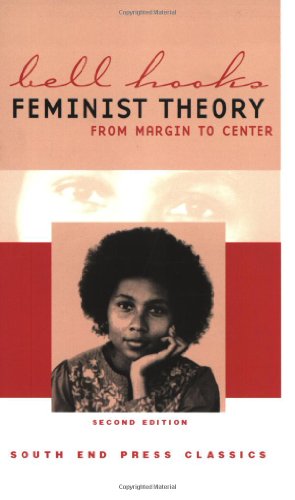

Feminist theory from margin to center Bell Hooks.
Series South End Press classics ; v. 5Detalles de publicación: Cambridge, MA South End Press c2000.Edición: 2nd edDescripción: xvii, 179 p. 23 cmISBN:- 0896086135 (paper)
- 305.42/0973 21
- HQ1426 .H675 2000
| Imagen de cubierta | Tipo de ítem | Biblioteca actual | Biblioteca de origen | Colección | Ubicación en estantería | Signatura topográfica | Materiales especificados | Info Vol | URL | Copia número | Estado | Notas | Fecha de vencimiento | Código de barras | Reserva de ítems | Prioridad de la cola de reserva de ejemplar | Reservas para cursos | |
|---|---|---|---|---|---|---|---|---|---|---|---|---|---|---|---|---|---|---|
| Libro | Biblioteca Encarnación Valdés Colección General bev | 305.42 H784f2 (Navegar estantería(Abre debajo)) | Disponible | 80000002373192 |
Descripciones mejoradas de Syndetics:
An Interview with bell hooks, author of Feminism is for Everybody: Passionate Politics
SOUTH END PRESS: Your work on radical black feminism has been an inspiration for many young feminists of color, and you yourself were in your early 20s when you wrote your first book, Ain't I a Woman . What differences do you see in the political and cultural climate that young progressive activists face today, compared to when you were formulating your own politics?
BELL HOOKS: One of the major differences I see in the political climate today is that there is less collective support for coming to critical consciousness-in communities, in institutions, among friends. For example, when I was coming to feminist consciousness-as one aspect of my political consciousness-at Stanford University, there was a tremendous buzz about feminism throughout the campus. Women were organizing in the dorms, women were resisting biased curriculum, all of those things. So, it really offered a kind of overall support for coming to consciousness, whereas what so frequently happens now in academic settings is that people feel much more that they don't have this kind of collective support.
SEP: What do you think has contributed to that change?
BH: The institutionalization of Black Studies, Feminist Studies, all of these things led to a sense that the struggle was over for a lot of people and that one did not have to continue the personal consciousness-raising and changing of one's viewpoint.
SEP: Could you describe some of the influences on your own politicization? In your writing you have focused very much on your development as a woman, as a writer, and as a critic and political thinker. Could you describe that process?
BH: One of the issues that I continually write about is that the words we use to define political positions-whether we talk about being on the left or being feminist-do not mean that people may not have arrived at positions of resistance that could be clearly described by that language before they come to that language. In my case, I've talked a great deal about how growing up in a very patriarchal household was the setting for my development of resistance. But it was not until the organi
Includes bibliographical references (p. [167]-172) and index.
Notas de autor provistas por Syndetics
Bell Hooks was born Gloria Watkins on September 25, 1952. She grew up in a small Southern community that gave her a sense of belonging as well as a sense of racial separation. She has degrees from Stanford University, the University of Wisconsin, and the University of California at Santa Cruz. She has served as a noted activist and social critic and has taught at numerous colleges. Hooks uses her great-grandmother's name to write under as a tribute to her ancestors.Hooks writes daring and controversial works that explore African-American female identities. In works such as Ain't I a Woman: Black Women and Feminism and Talking Back: Thinking Feminist, Thinking Black, she points out how feminism works for and against black women. Oppressed since slavery, black women must overcome the dual odds of race and gender discrimination to come to terms with equality and self-worth.
(Bowker Author Biography)