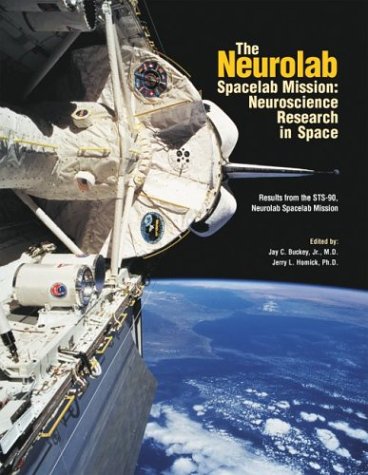

The Neurolab Spacelab mission neuroscience research in space : results from the STS-90, Neurolab Spacelab mission edited by Jay C. Buckey Jr., Jerry L. Homick.
Series NASA SP ; no. 535.Detalles de publicación: Houston, Tex. National Aeronautics and Space Administration, Lyndon B. Johnson Space Center [Washington, D.C.? Supt. of Docs., U.S. G.P.O., distributor 2003?]Descripción: x, 333 p. ill. 29 cmISBN:- 0972533907 (hbk.)
- 0160513227
- 616.9/80214 21
- RC1151.C45 N48 2003
- 2003 M-378
- WL 102
| Imagen de cubierta | Tipo de ítem | Biblioteca actual | Biblioteca de origen | Colección | Ubicación en estantería | Signatura topográfica | Materiales especificados | Info Vol | URL | Copia número | Estado | Notas | Fecha de vencimiento | Código de barras | Reserva de ítems | Prioridad de la cola de reserva de ejemplar | Reservas para cursos | |
|---|---|---|---|---|---|---|---|---|---|---|---|---|---|---|---|---|---|---|
| Libro | Biblioteca Encarnación Valdés Colección General bev | 616.9 N4946 (Navegar estantería(Abre debajo)) | Disponible | 80000002205501 |
Descripciones mejoradas de Syndetics:
Offers solutions and best practices to respond to recurrent problems and contemporary challenges in the field
Since the publication of the first edition of Environmental Impact Assessment in 2003, both the practice and theory of impact assessment have changed substantially. Not only has the field been subject to a great deal of new regulations and guidelines, it has also evolved tremendously, with a greater emphasis on strategic environmental, sustainability, and human health impact assessments. Moreover, there is a greater call for impact assessments from a global perspective. This Second Edition, now titled Impact Assessment to reflect its broader scope and the breadth of these many changes, offers students and practitioners a current guide to today's impact assessment practice.
Impact Assessment begins with an introduction and then a chapter reviewing conventional approaches to the field. Next, the book is organized around recurrent problems and contemporary challenges in impact assessment process design and management, enabling readers to quickly find the material they need to solve tough problems, including:
How to make impact assessments more influential, rigorous, rational, substantive, practical, democratic, collaborative, ethical, and adaptive How each problem and challenge-reducing process would operate at the regulatory and applied levels How each problem can be approached for different impact assessment types-sustainability assessment, strategic environmental assessment, project-level EIA, social impact assessment, ecological impact assessment, and health impact assessment How to link and combine impact assessment processes to operate in situations with multiple overlapping problems, challenges, and impact assessment types How to connect and combine impact assessment processesEach chapter first addresses the topic with current theory and then demonstrates how that theory is applied, presenting requirements, guidelines, and best practices. Summaries at the end of each chapter provide a handy tool for structuring the design and evaluation of impact assessment processes and documents. Readers will find analyses and new case studies that address such issues as multi-jurisdictional impact assessment, climate change, cumulative effects assessment, follow-up, capacity building, interpreting significance, and the siting of major industrial and waste facilities.
Reflecting current theory and standards of practice, Impact Assessment is appropriate for both students and practitioners in the field, enabling them to confidently respond to a myriad of new challenges in the field.
Shipping list no.: 2003-0200-P.
"NASA SP-2003-535."
Includes bibliographical references and index.
The aim of this book is to provide a general overview of the 1998 Neurolab space shuttle mission, to enable both generalists and experts to understand the mission and receive the information they need. The book is divided into three sections. The first contains scientific reports from the individual investigator teams, in which experiments and results are presented. The reports are divided into five major research areas: the balance system; sensory integration and navigation; nervous system development in weightlessness; blood pressure control; and circadian rhythms, sleep, and respiration. The second section provides technical reports of descriptions of procedures or hardware developed specifically for the flight. The last section offers crewmember perspectives on the mission, including discussion of problems that arose during flight and how they may be corrected in the future.