Imagen de portada de Amazon
Imagen de Amazon.com
Imagen de cubierta Syndetics
Portada de Syndetics
Imagen de OpenLibrary

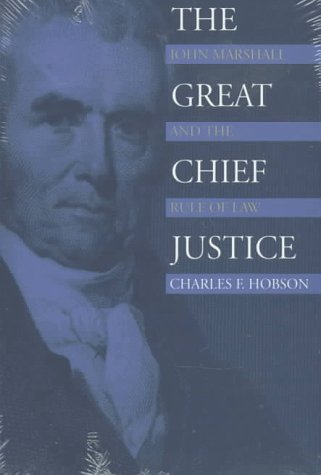
The great chief justice John Marshall and the rule of law Charles F. Hobson.

Por: Series American political thoughtDetalles de publicación: Lawrence, Kansas University Press of Kansas 1996.Descripción: xv, 256 pTipo de contenido:
Tipo de medio:
Tipo de soporte:
ISBN:
  • 0700607889 (alk. paper)
Tema(s): Clasificación CDD:
  • 347.73 H684g.
Clasificación LoC:
  • KF8745 .M3 H63 1996
Valoración
    Valoración media: 0.0 (0 votos)
Existencias
Imagen de cubierta Tipo de ítem Biblioteca actual Biblioteca de origen Colección Ubicación en estantería Signatura topográfica Materiales especificados Info Vol URL Copia número Estado Notas Fecha de vencimiento Código de barras Reserva de ítems Prioridad de la cola de reserva de ejemplar Reservas para cursos
Libro Biblioteca de Mayagüez Colección General mb KF8745 .M3 H63 1996 (Navegar estantería(Abre debajo)) Disponible 50000002104957
Total de reservas: 0

Descripciones mejoradas de Syndetics:

"John Marshall remains one of the towering figures in the landscape of American law. From the Revolution to the age of Jackson, he played a critical role in defining the "province of the judiciary" and the constitutional limits of legislative action. In this masterly study, Charles Hobson clarifies the coherence and thrust of Marshall's jurisprudence while keeping in sight the man as well as the jurist." "Hobson argues that contrary to his critics, Marshall was no ideologue intent upon appropriating the lawmaking powers of Congress. Rather, he was deeply committed to a principled jurisprudence that was based on a steadfast devotion to a "science of law" richly steeped in the common law tradition. As Hobson shows, such jurisprudence governed every aspect of Marshall's legal philosophy and court opinions, including his understanding of judicial review." "The chief justice, Hobson contends, did not invent judicial review (as many have claimed) but consolidated its practice by adapting common law methods to the needs of a new nation. In practice, his use of judicial review was restrained, employed almost exclusively against acts of the state legislatures. Ultimately, he wielded judicial review to prevent the states from undermining the power of a national government still struggling to establish sovereignty at home and respect abroad."--BOOK JACKET.Title Summary field provided by Blackwell North America, Inc. All Rights Reserved

Includes bibliographical references and index.

Reseñas proporcionadas por Syndetics

Library Journal Review

Since 1990, there have been a number of new biographies of Supreme Court justices from Hugo Black to Thurgood Marshall. So it is no surprise that John Marshall, chief justice from 1801 until his death in 1835 and the principal founder of the American system of constitutional law, should receive renewed attention. Certainly, Marshall has not been ignored by historians and biographers. Albert Beveridge's The Life of John Marshall (1916-19) remains the classic, and briefer works, both with the title John Marshall, have been authored by Leonard Baker (1974) and Francis Stite (1981). Hobson, chief editor of "The John Marshall Papers" documentary project at the College of William and Mary since 1979, combines a historian's perspective with experience in document editing. Editing Marshall's papers gave Hobson an appreciation for Marshall's vigorous constitutional vision, which he examines in this judicial biography. Hobson writes of Marshall's jurisprudence in the areas of judicial review, the contract clause, and national supremacy. This excellent work is strongly recommended for academic, law, and larger public libraries.‘Jerry E. Stephens, U.S. Court of Appeals Lib., Oklahoma City (c) Copyright 2010. Library Journals LLC, a wholly owned subsidiary of Media Source, Inc. No redistribution permitted.

Publishers Weekly Review

This biography of John Marshall's life and thought revises the revisionism. Early biographies of Marshall (chief justice of the Untied States, 1801-1835) tended to be blindly respectful. Then came the four-volume biography by Albert J. Beveridge that appeared between 1916 and 1919. Beveridge popularized Marshall as an intelligent bumpkin, whose willful ignorance of legal precedent allowed him to practice creative jurisprudence. Hobson believes otherwise. The premise of this book is that Marshall had a masterful understanding of precedent. Hobson makes a convincing case, aided by his editorship, beginning in 1979, of Marshall's papers. (To date, eight volumes of those papers have been published.) Hobson gained additional insight into Marshall's times and thought by serving as editor of James Madison's papers. The way Madison's thought illuminates Marshall's thought, and vice versa, is fascinating. At one point, Hobson comments that the vision of a new nation inspiring Madison was the same vision inspiring Marshall as chief justice several decades later. That shared vision meant continuity in American jurisprudence until the presidency of Andrew Jackson, when a communal society began turning into an individualistic quasi-democracy. Hobson's research is impressive and his writing clear. This is not the book to read for an understanding of Marshall's life outside the courtroom. It is the book to read if the goal is understanding the life of Marshall's mind. (Sept.) (c) Copyright PWxyz, LLC. All rights reserved

CHOICE Review

Hobson (editor of The Papers of John Marshall, sponsored by the Institute of Early American History and Culture and the College of William and Mary) has written an excellent book about one of America's greatest jurists. During a 34-year career as Chief Justice of the US and, as then required by law, service on the US Circuit Courts of Virginia and North Carolina, Marshall wrote an impressive number of opinions in both major constitutional and more ordinary cases. Those opinions constitute the primary source for this study. The book is neatly organized into seven substantive chapters. The first two provide a brief biographical sketch of Marshall and present Hobson's argument that the common law tradition prominent in 18th-century Virginia was largely responsible for shaping Marshall the lawyer and jurist. Chapters 3-5, which constitute the heart of the book, deal with Marshall's major constitutional pronouncements on judicial review, the contract clause, and national supremacy. The final two chapters focus on his views toward judicial discretion and the limits of judicial power. Extensive endnotes. Highly recommended for all levels of readers. R. Stidham Appalachian State University
Compartir
logopucpr-y-vive

Contáctanos

¡Queremos saber de ti!

Tel. 787.841.2000 Ext. 1801

bibliotecavaldes@pucpr.edu

⁣Búscanos en las redes

© 2026 Desarrollado por Ignite Online • All Rights Reserved • Powered by Koha.