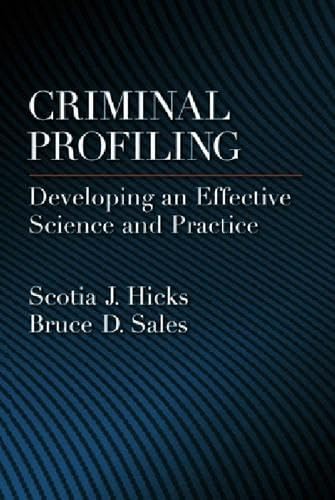

Criminal profiling developing an effective science and practice Scotia J. Hicks, Bruce D. Sales.
Series Law and public policyDetalles de publicación: Washington, DC American Psychological Association c2006.Descripción: x, 293 p. ill. 27 cmISBN:- 1591473926
- 363.258 H6311c 22
- HV8073.5 .H53 2006
| Imagen de cubierta | Tipo de ítem | Biblioteca actual | Biblioteca de origen | Colección | Ubicación en estantería | Signatura topográfica | Materiales especificados | Info Vol | URL | Copia número | Estado | Notas | Fecha de vencimiento | Código de barras | Reserva de ítems | Prioridad de la cola de reserva de ejemplar | Reservas para cursos | |
|---|---|---|---|---|---|---|---|---|---|---|---|---|---|---|---|---|---|---|
| Libro | Biblioteca de Mayagüez Colección General mb | HV8073.5 .H53 2006 (Navegar estantería(Abre debajo)) | Disponible | 50000003179172 | ||||||||||||||
| Libro | Biblioteca Encarnación Valdés Colección General bev | 363.258 H6311c (Navegar estantería(Abre debajo)) | Disponible | 80000002308495 |
Descripciones mejoradas de Syndetics:
The authors aim to transform criminal profiling into a credible science and practice that reliably aids law enforcement investigation. They explore in detail how a science of profiling may be constructed and tested.
Includes bibliographical references (p. 259-272) and indexes.
The roots of modern profiling -- Profiling today -- Current nonscientific models of profiling -- Problems with nonscientific profiling models -- The current model of scientific profiling -- Problems with the scientific model of profiling -- The future of profiling -- From goals to theory -- Crime scene evidence -- Offender characteristics : the constructs of motives, personality, and behavior -- Motive and behavior -- Personality and behavior -- A scientific model of profiling -- Steps toward testing a scientific model of profiling -- Conclusion: recommendations for practice.
gccoct2007
Tabla de contenidos provista por Syndetics
- Chapter 1 Introduction: The Roots of Modern Profiling(p. 3)
- I Profiling Today(p. 15)
- Chapter 2 Current Nonscientific Models of Profiling(p. 17)
- Chapter 3 Problems With Nonscientific Profiling Models(p. 49)
- Chapter 4 The Current Model of Scientific Profiling(p. 71)
- Chapter 5 Problems With the Scientific Model of Profiling(p. 87)
- II The Future of Profiling(p. 125)
- Chapter 6 From Goals to Theory(p. 127)
- Chapter 7 Crime Scene Evidence(p. 135)
- Chapter 8 Offender Characteristics: The Constructs of Motives, Personality, and Behavior(p. 157)
- Chapter 9 Motive and Behavior(p. 171)
- Chapter 10 Personality and Behavior(p. 187)
- Chapter 11 A Scientific Model of Profiling(p. 207)
- Chapter 12 Steps Toward Testing a Scientific Model of Profiling(p. 231)
- Chapter 13 Conclusion: Recommendations for Practice(p. 249)
- References(p. 259)
- Author Index(p. 273)
- Subject Index(p. 279)
- About the Authors(p. 293)