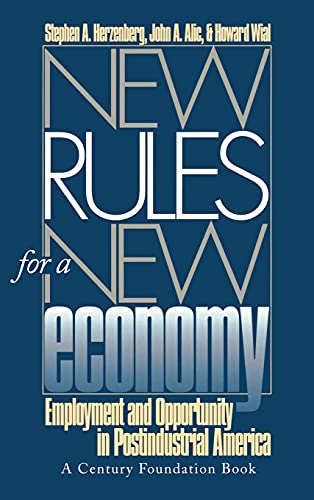

New rules for a new economy employment and opportunity in postindustrial America Sthephen A. Herzenberg, John A. Alic, Howard Wial
Detalles de publicación: Ithaca A Twenty Century Fund Book 1998.Edición: 1st. pubDescripción: xiii,214 pISBN:- 0801435242 (alk. paper)
- HD5724 .H43 1998
| Imagen de cubierta | Tipo de ítem | Biblioteca actual | Biblioteca de origen | Colección | Ubicación en estantería | Signatura topográfica | Materiales especificados | Info Vol | URL | Copia número | Estado | Notas | Fecha de vencimiento | Código de barras | Reserva de ítems | Prioridad de la cola de reserva de ejemplar | Reservas para cursos | |
|---|---|---|---|---|---|---|---|---|---|---|---|---|---|---|---|---|---|---|
| Libro | Biblioteca de Mayagüez Colección General mb | HD 5724 .H43 1998 (Navegar estantería(Abre debajo)) | Disponible | 50000002087251 |
Descripciones mejoradas de Syndetics:
Three quarters of the American workforce is now employed in services, a substantial portion in low-paying, dead-end jobs. Can the service economy do as well by the American worker as the old manufacturing economy? Can the widely shared prosperity that accompanied steady increases in productivity and performance in manufacturing be replicated in the services? They can and they will, the authors of this timely book contend, but only if outmoded policies and practices are brought into line with the new economy. New Rules for a New Economy explains why this must be accomplished and how we can start.
The authors call for new, decentralized institutions suited to a dynamic economy in which change is constant and rapid. In particular, they see a need for job ladders and worker associations that cut across firm boundaries. These institutions would foster individual and collective learning, mark out career paths, and facilitate coordination among both individuals and organizations in a networked economy. The authors propose new rules to reshape labor market institutions and policy, improving economic performance and opportunities for workers.
Unusual in providing a comprehensive theoretical perspective that is grounded in detailed case research, this book points the way to a better future, not just for elite knowledge workers but for everyone.
Includes bibliographical references and index.
Tabla de contenidos provista por Syndetics
- Foreword(p. vii)
- Preface(p. xi)
- 1 Recreating the Prosperity of the Past in the Economy of the Future(p. 1)
- 2 The Service Economy and the Service Worker(p. 21)
- 3 Work Systems(p. 37)
- 4 The Dynamics of Change in Work Systems(p. 57)
- 5 Reorganizing Work: Using Knowledge and Skill to Improve Economic Performance(p. 83)
- 6 Business Organization(p. 107)
- 7 Creating Multiemployer Institutions: Career Paths and Performance Improvement(p. 123)
- 8 A New Deal for a New Economy(p. 149)
- Appendix A Services Compared with Manufacturing: Jobs and Productivity(p. 175)
- Appendix B Employment Estimates by Work System(p. 185)
- Notes(p. 191)
- Index(p. 209)
Extracto provisto por Syndetics
Reseñas proporcionadas por Syndetics
Publishers Weekly Review
Written by economic consultants, this book is a treatise on the changing demographics of the American workforce and how corporations should work to alter job patterns in order to adapt to evolving employment trends. The authors first cite statistics to show the lack of growth in pay, benefits and positions for the lowest-skilled workers. Despite the technological and economic growth since WWII, the majority of manufacturing jobs remain low paying and provide few prospects for future growth. According to the authors, there is little chance that the level of service provided by these workers will improve without changes in these jobs. Among the strategies the authors advise: raising the minimum wage and expanding training programs across different companies. Although the sections on the evolution of the workplace since WWII are quite interesting, this book will appeal primarily to employment specialists and human resource professionals. (Sept.) (c) Copyright PWxyz, LLC. All rights reservedCHOICE Review
Despite the US's current prosperity, many American workers experience economic anxiety. The authors of this study attribute that anxiety to three causes. The first is low pay and lack of opportunity in certain types of occupations. Second, even workers with good jobs fear the possibility of downsizing. Last, productivity in the service sector remains stagnant, with little human capital investment. To describe changes in labor markets, the authors categorize work systems according to levels of workers' skills and autonomy. In the "tightly constrained" system, for example, workers are intensely monitored, have relatively low skills, and suffer from declining real wages and lack of advancement opportunities. High-skill autonomous workers, in contrast, have increased their share of employment and enjoy job security and mobility. To raise the quality and economic rewards of work throughout the economy, the authors propose strategic options available to government and business. Their prescriptions include increasing the minimum wage, better methods of measuring and improving performance in the service sector, multiemployer institutions to promote training, and government programs to reduce unemployment. Overall, the authors offer a concise survey of labor market problems and innovative approaches to deal with them. Recommended for public, academic, and professional library collections. R. L. Hogler; Colorado State UniversityNotas de autor provistas por Syndetics
Stephen A. Herzenberg and Howard Wial are with the Keystone Research Center in Harrisburg and Philadelphia, Pennsylvania. John A. Alic is a consultant in Washington, D.C., and an adjunct faculty member at the Johns Hopkins School of Advanced International Studies.