Imagen de portada de Amazon
Imagen de Amazon.com
Imagen de cubierta Syndetics
Portada de Syndetics
Imagen de OpenLibrary

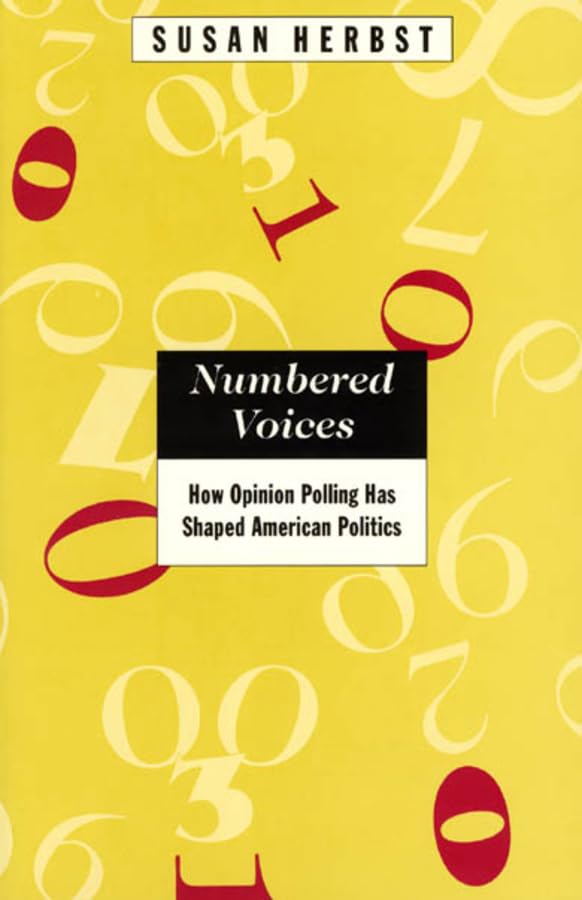
Numbered voices how opinion polling has shaped American politics Susan Herbst.

Por: Series American politics and political economyDetalles de publicación: Chicago University of Chicago Press 1993.Descripción: xi, 227 p. illISBN:
  • 0226327426 (alk. paper)
Tema(s): Clasificación CDD:
  • 303.3/8/0973 20
Clasificación LoC:
  • HN90.P8 H47 1993
Valoración
    Valoración media: 0.0 (0 votos)
Existencias
Imagen de cubierta Tipo de ítem Biblioteca actual Biblioteca de origen Colección Ubicación en estantería Signatura topográfica Materiales especificados Info Vol URL Copia número Estado Notas Fecha de vencimiento Código de barras Reserva de ítems Prioridad de la cola de reserva de ejemplar Reservas para cursos
Libro Biblioteca de Mayagüez Colección General mb HN 90 .P8 H47 1993 (Navegar estantería(Abre debajo)) Disponible 50000001830271
Total de reservas: 0

Descripciones mejoradas de Syndetics:

Quantifying the American mood through opinion polls appears to be an unbiased means for finding out what people want. But in Numbered Voices, Susan Herbst demonstrates that the way public opinion is measured affects the use that voters, legislators, and journalists make of it.

Exploring the history of public opinion in the United States from the mid-nineteenth century to the present day, Herbst shows how numbers served both instrumental and symbolic functions, not only conveying neutral information but creating a basis authority. Addressing how the quantification of public opinion has affected contemporary politics and the democratic process, Herbst asks difficult but fundamental questions about the workings of American politics.

"An original and thought-provoking analysis of why we have polls, what they accomplish, and how they affect the current political scene. Herbst's scholarship is impeccable, her writing is clear and crisp, and her findings are original. . . . Every reader will benefit by carefully weighing the issues she raises and the conclusions she draws."--Doris A. Graber, Political Science Quarterly

"An intelligent, theoretically rich, and historically broad account of public opinion over several millennia. . . . The historical accounts are interesting and her interpretations are thought-provoking."--Paul Brace, Journal of American History

Includes bibliographical references (p. 205-217) and index.

Tabla de contenidos provista por Syndetics

  • Preface
  • Introduction
  • 1 Quantification and Rationality
  • 2 Numbers and Symbolic Politics
  • 3 Techniques of Opinion Expression and Measurement
  • 4 Partisan Politics and the Symbolic Use of Straw Polls, 1856-1936
  • 5 Congressmen, Journalists, and Opinion Assessment, 1930-1950
  • 6 Contemporary Public Opinion Research
  • 7 Crowd Estimation and Public Opinion
  • 8 Opinion Quantification and Democracy
  • Notes
  • Bibliography
  • Index

Reseñas proporcionadas por Syndetics

CHOICE Review

A half century ago polls were touted as providing factual information about the popular mood. Recent studies such as David W. Moore's The Superpollsters: How They Measure and Manipulate Public Opinion in America (CH, Sep'92) and its predecessor, Roland Perry's Hidden Power: The Programming of the President (1984), and most recently, Media Polls in American Politics, ed. by Thomas Mann and Gary Orren (CH, Apr'93), assess how the proliferation of polls have shaped American politics. These studies find as much or more to criticize about the impact of polls as to applaud, and Herbst's book is in this tradition. Public opinion data, she concludes, have become a commodity purchased by individuals and groups seeking to gain or sustain power. This primary conclusion follows from the author's two central concerns: explaining why opinion polls are so pervasive in American politics and identifying the uses that are made of opinion data. Herbst's short but powerful interdisciplinary assessment of public opinion polling is both historically and theoretically grounded. Highly recommended for specialists in the field. Graduate; faculty; professional. E. C. Dreyer; University of Tulsa

Booklist Review

For a university colloquium on the measurement of public opinion, Herbst's tract would incite reasoned debate if the attendees were scholars of philosophy, history, and epistemology. They would drop names like de Tocqueville, Max Weber, and Walter Lippmann to theorize about numbers and power. But the public library needn't be excluded from such erudition, because the author's work also contains many morsels of American history for the dedicated amateur scholar. It recounts the origin of the "straw" poll in the nineteenth century. It refers repeatedly to the greatest cautionary tale in statistical sampling, the magazine Literary Digest's 1936 prediction of an Alf Landon victory. It notes the passing of other archaic methods of gauging the public mood--counting crowd sizes, for example. As such cheek-by-jowl techniques have been superseded by pollsters, Herbst worries about the deleterious effect on participatory democracy, and to point up the flavor of the past, she has surveyed a sample of politicians and journalists of the 1940s to see how they took the public pulse. To them, a standard deviation was the bar patron that didn't wear a particular campaign button, not a number crunched by a computer. A blend of anecdote and theory, this work is suitable for the larger collection.--Gilbert Taylor
Compartir
logopucpr-y-vive

Contáctanos

¡Queremos saber de ti!

Tel. 787.841.2000 Ext. 1801

bibliotecavaldes@pucpr.edu

⁣Búscanos en las redes

© 2026 Desarrollado por Ignite Online • All Rights Reserved • Powered by Koha.