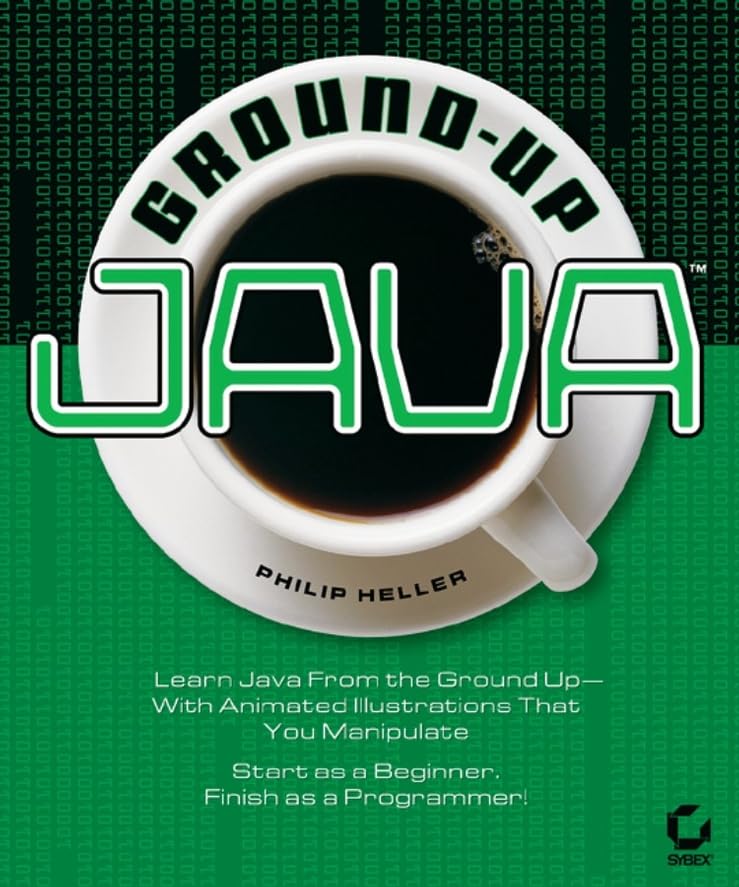

Ground-Up Java Philip Heller.
Idioma: Español Detalles de publicación: San Francisco, CA Sybex c2004.Descripción: xxii, 488 p. ill. 23 cm. + 1 CD-ROM (4 3/4 in.)ISBN:- 0782141900
- QH 76.73 .J38 H455 2004
| Imagen de cubierta | Tipo de ítem | Biblioteca actual | Biblioteca de origen | Colección | Ubicación en estantería | Signatura topográfica | Materiales especificados | Info Vol | URL | Copia número | Estado | Notas | Fecha de vencimiento | Código de barras | Reserva de ítems | Prioridad de la cola de reserva de ejemplar | Reservas para cursos | |
|---|---|---|---|---|---|---|---|---|---|---|---|---|---|---|---|---|---|---|
| Libro | Biblioteca de Mayagüez Colección General mb | QA76.73 .J38 H455 2004 (Navegar estantería(Abre debajo)) | Incluyé CD-ROM | Disponible | 50000002143914 |
Descripciones mejoradas de Syndetics:
Learn Java From the Ground-Up-With Animated Illustrations that You Manipulate
This is the first effective Java book for true beginners. Sure, books before now focused on basic concepts and key techniques, and some even provided working examples on CD. Still, they lacked the power to transform someone with no programming experience into someone who sees, who really "gets it."
Working with Ground-Up Java, you will definitely get it. This is due to the clarity of Phil Heller's explanations, and the smoothly flowing organization of his instruction. He's one of the best Java trainers around.
But what's really revolutionary are his more than 30 animated illustrations, which you'll find on the enclosed CD. Each of these small programs, visual and interactive in nature, vividly demonstrates how its source code works. You can modify it in different ways, distinctly altering the behavior of the program. As you experiment with these tools-and you can play with them for hours-you'll gain both the skills and the fundamental understanding needed to complete each chapter's exercises, which steadily increase in sophistication. No other beginning Java book can take you so far, so quickly, and none will be half as much fun.
Note: CD-ROM/DVD and other supplementary materials are not included as part of eBook file.
Learn Java from the Ground Up-with animated illustrations that you manipulate. Start as a beginer, finish as a programmer.
CD-ROM disponible en el libro.
Includes index.
Tabla de contenidos provista por Syndetics
- Introduction(p. xix)
- Chapter 1 An Introduction to Computers That Will Actually Help You in Life(p. 1)
- Memory: Not Exactly 0s and 1s(p. 2)
- Memory Organization(p. 4)
- A Very Simple Computer(p. 5)
- Playing with SimCom(p. 8)
- The Lessons of SimCom(p. 11)
- Exercises(p. 13)
- Chapter 2 Data(p. 15)
- Understanding Compiled Languages(p. 16)
- Compiled vs. Assembly Languages(p. 17)
- The Java Virtual Machine(p. 19)
- Data Types(p. 19)
- Integer Data Types(p. 21)
- Floating-Point Data Types(p. 24)
- Representing Characters(p. 25)
- Representing Logical Values(p. 25)
- Recap of Java's Data Types(p. 25)
- Declaring and Assigning(p. 26)
- A Very Simple Java Program(p. 28)
- Output(p. 29)
- Exercises(p. 30)
- Chapter 3 Operations(p. 33)
- White Space and Comments(p. 34)
- Arithmetic Operations(p. 37)
- Basic Arithmetic(p. 37)
- Precedence and Parentheses(p. 38)
- Bitwise Operations(p. 40)
- Modulo(p. 42)
- Shifting(p. 42)
- Unary Arithmetic(p. 44)
- ++ and--(p. 45)
- Boolean Operations(p. 46)
- And, Or, Exclusive Or, Inversion(p. 46)
- Short-Circuit Operators(p. 49)
- Comparison Operations(p. 50)
- Compound Assignment(p. 51)
- Numeric Result Type(p. 52)
- Precedence Summary(p. 54)
- Exercises(p. 55)
- Chapter 4 Methods(p. 57)
- Method Structure(p. 58)
- Argument Lists(p. 61)
- More on Return Types(p. 64)
- Polymorphism(p. 65)
- Methods That Call Methods(p. 66)
- Passing by Value(p. 67)
- Order(p. 68)
- Scope(p. 68)
- Exercises(p. 70)
- Chapter 5 Conditionals and Loops(p. 73)
- Conditionals(p. 74)
- if(p. 74)
- The Ternary Operator(p. 76)
- switch(p. 77)
- Loops(p. 82)
- While Loops(p. 82)
- For Loops(p. 86)
- Breaking and Continuing(p. 88)
- Nesting(p. 90)
- Labeled break and Labeled continue(p. 94)
- Loops and Scope(p. 97)
- Exercises(p. 98)
- Chapter 6 Arrays(p. 101)
- Clusters of Data(p. 102)
- Declaring Arrays(p. 102)
- Creating Arrays(p. 103)
- Using Array Components(p. 104)
- Array Length(p. 104)
- Array Initialization(p. 105)
- Arrays and Loops(p. 105)
- Multi-Dimensional Arrays(p. 106)
- Arrays as Objects(p. 109)
- Passing References to Methods(p. 112)
- Garbage Collection(p. 114)
- Exercises(p. 115)
- Chapter 7 Introduction to Objects(p. 117)
- Arrays Versus Objects(p. 118)
- Classes(p. 119)
- Objects and Their Data(p. 120)
- Multiple Objects(p. 122)
- Objects and Their Methods(p. 126)
- The Truth About static(p. 128)
- Static Data(p. 128)
- Static Methods(p. 130)
- The main Method(p. 132)
- Reference Data(p. 134)
- Exercises(p. 136)
- Chapter 8 Inheritance(p. 139)
- Superclasses and Subclasses(p. 140)
- Inheritance from Superclasses(p. 142)
- An Inheritance Example(p. 145)
- Construction and Constructors(p. 146)
- Overloading Constructors(p. 147)
- Default Constructors(p. 148)
- The Chain of Constructions(p. 149)
- Overriding(p. 152)
- Polymorphism Revisited(p. 154)
- Inheritance Polymorphism(p. 156)
- Exercises(p. 160)
- Chapter 9 Packages and Access(p. 163)
- Packages(p. 164)
- Creating Your Own Package(p. 166)
- Finding Packages: classpath(p. 168)
- Importing(p. 170)
- Access(p. 172)
- Public Access(p. 174)
- Private Access(p. 174)
- Default Access(p. 175)
- Protected Access(p. 177)
- Access and Overriding(p. 178)
- Final and Abstract(p. 180)
- Final(p. 180)
- Abstract(p. 182)
- Exercises(p. 186)
- Chapter 10 Interfaces(p. 187)
- A List of Method Declarations(p. 188)
- Using Interfaces(p. 189)
- Objects and References(p. 190)
- Data in Interfaces(p. 192)
- Extending Interfaces(p. 194)
- Exercises(p. 195)
- Chapter 11 Exceptions(p. 197)
- Exceptions Oversimplified(p. 198)
- The Trouble with Error Codes(p. 198)
- Throwing Exceptions(p. 200)
- Catching Exceptions(p. 202)
- Exceptions in the Real World(p. 203)
- Two Families of Exceptions(p. 205)
- Runtime Exceptions and Stack Traces(p. 206)
- Checked Exceptions(p. 208)
- Multiple Catch Blocks(p. 210)
- Catch Blocks and instanceof(p. 212)
- Checked Exceptions and Stack Traces(p. 216)
- Throwing Checked Exceptions(p. 217)
- Exercises(p. 220)
- Chapter 12 The Core Java Packages and Classes(p. 221)
- The API Pages(p. 222)
- Digression: A Personal Anecdote(p. 223)
- Starting at the Top(p. 224)
- Deprecated Methods(p. 228)
- The java.lang Package(p. 228)
- The java.lang.String Class(p. 229)
- The java.lang.Object Class(p. 236)
- The java.lang.Integer Class, and other Wrappers(p. 240)
- The java.lang.System Class(p. 241)
- The java.lang.Math Class(p. 243)
- Exercises(p. 244)
- Chapter 13 File Input and Output(p. 247)
- Files As Sequences of Bytes(p. 248)
- Writing and Reading Bytes(p. 249)
- Backslashes in Filenames(p. 249)
- Writing Bytes(p. 251)
- Reading Bytes(p. 254)
- Writing and Reading Data(p. 256)
- Exercises(p. 267)
- Chapter 14 Painting(p. 269)
- Frames(p. 270)
- Colors(p. 273)
- Painting(p. 276)
- Drawing and Filling with a Graphics Object(p. 277)
- Text and Fonts(p. 283)
- Frame Lab(p. 287)
- Exercises(p. 290)
- Chapter 15 Components(p. 291)
- A Survey of Components(p. 292)
- Buttons(p. 293)
- Checkboxes(p. 296)
- Choices(p. 301)
- Labels(p. 304)
- Menus(p. 305)
- Text Fields(p. 309)
- Text Areas(p. 310)
- Scrollbars(p. 312)
- Layout Managers(p. 313)
- The Flow Layout Manager(p. 314)
- The Border Layout Manager(p. 317)
- Panels(p. 320)
- Other Layout Managers(p. 325)
- Exercises(p. 327)
- Chapter 16 Events(p. 329)
- Event-Driven Programs(p. 330)
- Threads(p. 332)
- Action Listeners and Action Events(p. 333)
- Getting Information from an Action Event(p. 339)
- Improving the GUI(p. 343)
- Events from other Components(p. 351)
- Check Boxes, Choices, and Item Events(p. 351)
- Text Fields and Text Areas(p. 353)
- Events from Menus(p. 355)
- Scrollbars and Adjustment Events(p. 355)
- Exercises(p. 357)
- Chapter 17 Final Project(p. 359)
- Description of the Project(p. 360)
- Building the Pieces(p. 361)
- The File Menu(p. 362)
- Specifying a File(p. 365)
- Specifying Colors(p. 368)
- The Main Display Area(p. 376)
- Painting Colored Code(p. 378)
- Putting It All Together(p. 389)
- Goodbye! Don't Forget to Write!(p. 391)
- Exercises(p. 392)
- Appendix A Downloading and Installing Java(p. 395)
- Overview of the Process(p. 396)
- Windows(p. 396)
- Creating Program Files(p. 400)
- Macintosh(p. 401)
- Creating Program Files(p. 404)
- Appendix B Solutions to the Exercises(p. 405)
- Chapter 1(p. 406)
- Chapter 2(p. 407)
- Chapter 3(p. 409)
- Chapter 4(p. 413)
- Chapter 5(p. 416)
- Chapter 6(p. 421)
- Chapter 7(p. 423)
- Chapter 8(p. 426)
- Chapter 9(p. 431)
- Chapter 10(p. 435)
- Chapter 11(p. 438)
- Chapter 12(p. 440)
- Chapter 13(p. 443)
- Chapter 14(p. 445)
- Chapter 15(p. 448)
- Chapter 16(p. 454)
- Chapter 17(p. 461)
- Glossary(p. 467)
- Index(p. 475)