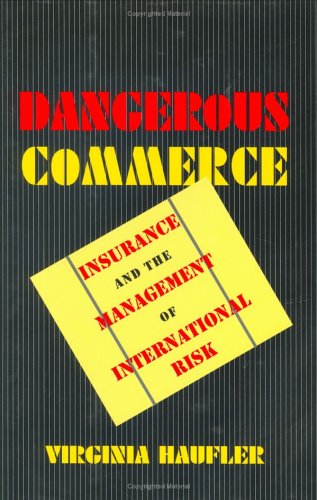

Dangerous commerce insurance and the management of international risk Virginia Haufler.
Detalles de publicación: Ithaca Cornell University Press 1997.Descripción: xiii, 205 p. 24 cmISBN:- 0801432316
- HG 8054 .5 .H38 1997
| Imagen de cubierta | Tipo de ítem | Biblioteca actual | Biblioteca de origen | Colección | Ubicación en estantería | Signatura topográfica | Materiales especificados | Info Vol | URL | Copia número | Estado | Notas | Fecha de vencimiento | Código de barras | Reserva de ítems | Prioridad de la cola de reserva de ejemplar | Reservas para cursos | |
|---|---|---|---|---|---|---|---|---|---|---|---|---|---|---|---|---|---|---|
| Libro | Biblioteca de Derecho Mons. Fremiot Torres Oliver Colección General biblioteca derecho | HG 8054 .5 .H38 1997 (Navegar estantería(Abre debajo)) | Disponible | 70000000638184 |
Descripciones mejoradas de Syndetics:
As businesses search increasingly for opportunities beyond their national borders, they face the risk that political change in other countries will jeopardize their efforts. Anything from minor shifts in regulations to sudden revolutions can threaten business investment, trade, and credit. Virginia Haufler shows that a crucial factor in the expansion of global markets has been the private sector's creation of a sophisticated insurance industry to redistribute the risks entailed in foreign commerce, a privately constructed safety net for international transactions. Haufler believes that the network of relationships and institutions established by the insurers constituted a privately led regime for the management of international risk. She analyzes political risks insurance during three periods of substantial uncertainty: the era from the turn of the century to the beginning of World War I, when British global power began to wane; the interwar years, leading up to the collapse of world trade and a second world war; and the "debt crisis" decade of the 1980s. Public and private involvement in supplying insurance against international risks has varied depending on demand, the availability of resources, and the norms of what can be insured. As the scale and complexity of risks have expanded, Haufler suggests, responsibility has shifted from commercial insurers first to the state and now to multilateral institutions.
Includes bibliographical references (p. 185-198) and index.