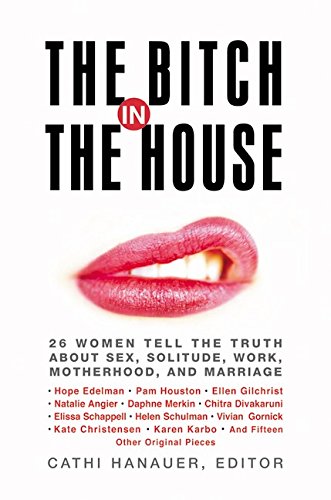
Imagen de portada de Amazon
Imagen de Amazon.com
Imagen de cubierta Syndetics
Portada de Syndetics
Imagen de OpenLibrary

The bitch in the house 26 women tell the truth about sex, solitude, work, motherhood, and marriage edited by Cathi Hanauer ; featuring all original essays by Ellen Gilchrist ... [et al.].

Colaborador(es): Detalles de publicación: New York William Morrow c2002.Edición: 1st edDescripción: xix, 284 p. 24 cmISBN:
  • 0066211662 (hardcover)
  • 0060936460 (trade pbk.)
Tema(s): Clasificación CDD:
  • 305.42 B6241 21
Clasificación LoC:
  • HQ1421 .B523 2002
Contenidos:
Excuse me while I explode: my mother, myself, my anger / E.S. Maduro -- Getting the milk for free / Veronica Chambers -- Crossing to safety / Jen Marshall -- Moving in, moving out, moving on / Sarah Miller -- Papa don't preach / Kerry Herlihy -- Memoirs of an ex-bride: looking back, looking ahead / Daphne Merkin -- I do, not: why I won't marry / Catherine Newman -- Killing the Puritan within / Kate Christensen -- Houseguest hell: my home is not your home / Chitra Divakaruni -- A man in the heart / Hazel McClay -- Why I hate that my mother was right (well, about most things): turning into Elizabeth Taylor / Karen Karbo -- How we became strangers / Jill Bialosky -- Erotics 102: staying bad, staying married / Cynthia Kling -- My marriage, my affairs / Hannah Pine -- My mother's ring: caught between two families / Helen Schulman -- Attila the honey I'm home / Kristin van Ogtrop -- The myth of co-parenting: how it was supposed to be, how it was / Hope Edelman -- Daddy dearest: what happens when he does more than his half? / Laurie Abraham -- Crossing the line in the sand: how mad can mother get? / Elissa Schappell -- Maternal bitch / Susan Squire -- The origin, procreation, and hopes of an angry feminist / Natalie Angier -- Married at 46: the agony and the ecstasy / Nancy Wartik -- The fat lady sings / Natalie Kusz -- The middle way: learning to balance family and work / Ellen Gilchrist -- What independence has come to mean to me: the pain of solitude, the pleasure of self-knowledge / Vivian Gornick -- The perfect equality of our separate chosen paths: becoming a mother, or not / Pam Houston.
Valoración
    Valoración media: 0.0 (0 votos)
Existencias
Imagen de cubierta Tipo de ítem Biblioteca actual Biblioteca de origen Colección Ubicación en estantería Signatura topográfica Materiales especificados Info Vol URL Copia número Estado Notas Fecha de vencimiento Código de barras Reserva de ítems Prioridad de la cola de reserva de ejemplar Reservas para cursos
Libro Biblioteca Encarnación Valdés Colección General bev 305.42 B6241 (Navegar estantería(Abre debajo)) Disponible 80000002158528
Total de reservas: 0

Descripciones mejoradas de Syndetics:

My friends and I moaned about how tired we were. During dips in our conversation, I found myself looking at the teenage couple seated at a table, their chairs side by side. They kissed. My friend asked me about my marriage. "Are you guys having sex?" she asked bluntly... I wanted to laugh.

-- Jill Bialosky

Women today have more choices than at any time in history, yet many smart, ambitious, contemporary women are finding themselves angry, dissatisfied, stressed out. Why are they dissatisfied? And what do they really want? These questions form the premise of this passionate, provocative, funny, searingly honest collection of original essays in which twenty-six women writers invite readers into their lives, minds, and bedrooms to talk about the choices they've made, what's working, and what's not.

Here are a few things people have said about me at the office: "You're unflappable." "Are you ever in a bad mood?" Here are things people -- okay, the members of my family -- have said about me at home: "Mommy is always grumpy." "Why are you so tense?" "You're too mean to live in this house and I want you to go back to work for the rest of your life!"

-- Kristin van Ogtrop

With wit and humor, in prose as poetic and powerful as it is blunt and dead-on, these intriguing women -- ranging in age from twenty-four to sixty-five, single and childless or married with children or four times divorced -- offer details of their lives that they've never publicly revealed.

I didn't want to be a bad mother I wanted to be my mother-safe, protective, rational, calm -- without giving up all my anger, because my anger fueled me. -- Elissa Schappell

The result is an intimate sharing of experience that will move, amuse, and enlighten. This is the sound of the collective voice of successful women today, in all their anger, grace, and glory.

Excuse me while I explode: my mother, myself, my anger / E.S. Maduro -- Getting the milk for free / Veronica Chambers -- Crossing to safety / Jen Marshall -- Moving in, moving out, moving on / Sarah Miller -- Papa don't preach / Kerry Herlihy -- Memoirs of an ex-bride: looking back, looking ahead / Daphne Merkin -- I do, not: why I won't marry / Catherine Newman -- Killing the Puritan within / Kate Christensen -- Houseguest hell: my home is not your home / Chitra Divakaruni -- A man in the heart / Hazel McClay -- Why I hate that my mother was right (well, about most things): turning into Elizabeth Taylor / Karen Karbo -- How we became strangers / Jill Bialosky -- Erotics 102: staying bad, staying married / Cynthia Kling -- My marriage, my affairs / Hannah Pine -- My mother's ring: caught between two families / Helen Schulman -- Attila the honey I'm home / Kristin van Ogtrop -- The myth of co-parenting: how it was supposed to be, how it was / Hope Edelman -- Daddy dearest: what happens when he does more than his half? / Laurie Abraham -- Crossing the line in the sand: how mad can mother get? / Elissa Schappell -- Maternal bitch / Susan Squire -- The origin, procreation, and hopes of an angry feminist / Natalie Angier -- Married at 46: the agony and the ecstasy / Nancy Wartik -- The fat lady sings / Natalie Kusz -- The middle way: learning to balance family and work / Ellen Gilchrist -- What independence has come to mean to me: the pain of solitude, the pleasure of self-knowledge / Vivian Gornick -- The perfect equality of our separate chosen paths: becoming a mother, or not / Pam Houston.

Tabla de contenidos provista por Syndetics

  • Introduction(p. xi)
  • I. Me, Myself, and I
  • Excuse Me While I Explode: My Mother, Myself, My Anger(p. 3)
  • Getting the Milk for Free(p. 15)
  • Crossing to Safety(p. 23)
  • Moving In. Moving Out. Moving On(p. 35)
  • Papa Don't Preach(p. 45)
  • Memoirs of an Ex-Bride: Looking Back. Looking Ahead(p. 53)
  • II. For Better and Worse
  • I Do. Not.: Why I Won't Marry(p. 65)
  • Killing the Puritan Within(p. 73)
  • Houseguest Hell: My Home Is Not Your Home(p. 85)
  • A Man in the Heart(p. 91)
  • Why I Hate That My Mother Was Right (Well ... About Most Things): Turning into Elizabeth Taylor(p. 101)
  • How We Became Strangers(p. 111)
  • Erotics 102: Staying Bad. Staying Married(p. 123)
  • My Marriage. My Affairs(p. 133)
  • III. Mommy Maddest
  • My Mother's Ring: Caught Between Two Families(p. 147)
  • Attila the Honey I'm Home(p. 159)
  • The Myth of Co-Parenting: How It Was Supposed to Be. How It Was(p. 171)
  • Daddy Dearest: What Happens When He Does More Than His Half?(p. 181)
  • Crossing the Line in the Sand: How Mad Can Mother Get?(p. 193)
  • Maternal Bitch(p. 205)
  • The Origin, Procreation, and Hopes of an Angry Feminist(p. 217)
  • IV. Look at Me Now
  • Married at 46: The Agony and the Ecstasy(p. 227)
  • The Fat Lady Sings(p. 239)
  • The Middle Way: Learning to Balance Family and Work(p. 249)
  • What Independence Has Come to Mean to Me: The Pain of Solitude. The Pleasure of Self-Knowledge(p. 257)
  • The Perfect Equality of Our Separate Chosen Paths: Becoming a Mother. Or Not(p. 265)
  • Afterword(p. 277)
  • Contributors(p. 285)
  • Acknowledgments(p. 289)

Extracto provisto por Syndetics

This book was born out of anger - specifically, my own domestic anger, which stemmed from a combination of guilt, resentment, exhaustion, naivete, and the chaos of my life at the time. But ultimately, it is not an angry book. It's a book that shows us that the trials and tribulations of our work and relationships, children and homes and sex lives - complete with their passions, dysfunctions, and frustrations - are not ours alone but the same or similar struggles of so many others. It's a book that reveals that if the grass sometimes seems greener, sometimes it is. And sometimes, it's decidedly not. The book began two years ago, after my family-my husband, Dan, and our two children, then aged four and one - had just left New York City to move to a small town in Massachusetts where the kids could each have a room and Dan could work part-time from home instead of fulltime from an office, enabling him to write his second novel and do his part of the co-parenting arrangement we'd both always (if vaguely) envisioned. The move came, for me, after an autonomous decade in my twenties indulging in all the things I had come to value - a rewarding, lucrative career combined with exercise, romance, solitude, good friends - followed by six whirlwind years that included marrying, moving three times, and birthing and nursing two children, all while contributing my necessary share of the family income by writing a monthly magazine column, publishing a novel, and completing a second novel under contract. By the end, I'd worked my way up to roughly two-thirds time hired child care, much of it taking place in our apartment (in which I also worked). Our final year in New York had been a veritable marathon: nursing a baby at the computer while typing to make a deadline; sprinting home from my daughter's nursery school, both kids in tow, to return phone calls; handing the children off to Dan the instant he walked in at night so I could rush out to a coffee shop to get my work done. When we moved, I expected things to finally be different. I'd be able to work purely and efficiently to focus as I had years ago - knowing Dan was on during those times. We'd be calm, we'd take family bike rides . . .our New Lives would begin. Instead, my life, my marriage, my schedule, felt more overwhelming than ever. The phones rang nonstop. (We had three different "distinctive rings" - Dan's work line, my work line, and the family line, Total nightmare.) FedEx packages and cartons of books I was supposed to be reading - I was writing Mademoiselle's monthly books page at the time arrived by the week, to be added to the still - unpacked boxes that rimmed every room, dust bunnies breeding around them. I rarely managed to cook a good dinner, as my own mother had virtually every night, and I rushed my children through the hours so I could get to all the things I had to do, furious when they wouldn't go to bed, when they were up calling me in the night. Dan was doing more parenting than he ever had (and feeling, I imagined, like a better father than those of previous generations simply by virtue of being around), yet I still felt I was the one who managed and was responsible for the kids - from their meals to their clothing, activities, schoolwork, baby-sitters, birthday parties as well as handling all the "domestic" things I'd always done (grocery shopping, cooking, laundry, school and social responsibilities, and so on). I still had the same work - my income was now even more important - and, it seemed, less time than ever to do it. My days were nonstop at high speed, my brain flooded with lists and obligations. All day long, I stomped around barking orders, irritable and stressed out. I was angry at the cat for waking me, at the car for having no gas when I got in it (late for something - always late), at the toy I'd just tripped on . . . and at Dan. Because he'd used up the coffee filters or Cascade without putting them on the list; because he'd finished his work and had time to check out the New York Times and Salon while I struggled to find time for mine; because I was always more anxious and frantic than he was. Of course, I'd fallen in love with him partly because of this very calm, but now his ability to relax when I never seemed to felt unfair, oblivious, even rude. I resented him and this chaos I found myself in - even as I never stopped being grateful for the elements that created it, Two healthy children, a nice home, an interesting job . . . what could I possibly be mad about? And yet, mad I was. So, night after night, once the kids were asleep (sort of), I left laundry unfolded, phone calls unreturned, school forms unfilled out, and my own work undone to go online and fire furious e-mails to my friends to try to figure it out. And I began to realize something. A lot of these women - particularly those who, like me, were ambitious women (often writers) juggling jobs and marriages and, sometimes, small children - also were resentful, guilty, stressed out. "I want a partner in my husband, not another child," one fired back at me. "I told him if something doesn't change, I'm leaving, even though we just got married," said another, adding, "Yesterday I actually had a fantasy that we got a divorce, moved back into our separate apartments, and just dated each other again." "I'm fine all day at work, but as soon as I get home, I'm a horror," said a third. "I'm the bitch in the house." The bitch in the house. That's exactly how I felt. The opposite of what Virginia Woolf called The Angel in the House - but with anger to boot. Sometimes my friends and I would get on the topic of our sex lives, or - in the case of the married ones, it seemed-lack thereof. "Put me anywhere near a bed and I just want to sleep," said one mother. The recently wed woman mourned the loss of the "hot sex" she'd had with her husband before they'd tied the proverbial knot. One young single friend who'd just moved in with her boyfriend already felt the waning of her desire. (In the same breath, she spoke of how it scared and amazed her how angry she got at him sometimes - how she'd walk in from work and see a sinkful of dishes and explode with rage, while her poor boyfriend watched, baffled, from the couch, beer in hand, newspaper spread before him, stereo blaring the Dave Matthews Band.) Newspaper and magazine stories appeared regularly to echo our feelings. "Why Women Hate Their Husbands," screamed a cover line on Talk magazine. (The article's subtitle: "Love, sex, family, career - it was all supposed to be so easy for the modem woman. Then why are this therapist's patients so furious?") In a piece in the New York Times Magazine, a modem working couple visited the Love Lab (a Family Research Lab in Seattle that, after watching a couple interact, predicts whether they will divorce), and, the male half of the couple reported, "In ten minutes, my wife chalked up one hundred and thirty moments of criticism. I displayed one hundred and thirty-two moments of defensiveness." (His wife, he went on to say, "was a keen critic of an institution into which she had twice been recruited. Marriage, she said, was advertised falsely - the myth of enduring romantic love - and its responsibilities sharply limited a woman's growth.") Women's number one issue in sex therapy had shifted from not being orgasmic to lacking desire; a doctor friend in California confided to me that the top two complaints of her female patients were lack of libido and "inexplicable rage." One friend (full-time working mother, two small kids) told me: "Every woman I know is mad at her husband, just mad mad mad at everything. Every time I bring it up to a woman like me, she just goes bananas. . . . R and I had a fight the other night that involved him saying he feels like I resent him all the time and I feel like he's always failing me. . . . We have that fight about once a month." Naturally, this outpouring of anger interested me. I began to ask these women about their thoughts and experiences - to dig deeper - and to consider and compare potential reasons for this seeming epidemic of female rage. At the same time, I started reading a new book called Flux, in which journalist Peggy Orenstein, after interviewing 200 women in their twenties, thirties, and forties, concludes that "Women's lives have become a complex web of economic, psychological, and social contradictions, with opportunities so intimately linked to constraints that a choice in one realm can have unexpected consequences (or benefits) ten years later in another." Orenstein calls the modern world a "half-changed" one, in which "old patterns and expectations have broken down, but new ideas seem fragmentary, unrealistic, and often contradictory." And I began to wonder if, far from being irrational (or me just being a spoiled brat), my anger - and that of my friends - had clear-cut wellsprings, sources that didn't go away because we had more choices than other generations of women or because we had loving, sensitive partners or even because we led full, privileged lives. At the end of Flux, Orenstein offers suggestions for women, one of which is to share their experience with one another, to "talk across lines of age and circumstance." As I read those words, I realized that this was what I was already doing: gleaning comfort and advice, sympathy and wisdom, from friends of all ages in all situations. The more women I spoke to - whether they were angry or not - the better I felt, and the more insight I gained into my own life and the lives of other women also struggling, whatever their issues happened to be. And I saw that I could expand this correspondence I'd been having and ask many more women to join in the sharing and revelations: women who'd grown up in homes like mine and in less traditional or middle-class ones; women who'd chosen to marry but not to have children, or to have children but not to marry; women who'd divorced, sometimes twice or more. Women who'd remained single and without children. Women with "unusual" arrangements-open marriage, for example, or becoming someone's mistress. To name a few. Ask I did: the most interesting, eloquent women I knew and knew of. I approached mostly novelists and professional writers, but also a handful of other smart, thinking women who I knew had a story to tell. I requested of these potential contributors that they explore a choice they'd made, or their life situation - or their anger, if they felt it-in an essay; that they offer an interesting glimpse into their private lives, as if they were talking to a friend at a café. One after another, they signed on. And this book was launched. By the time I sat down to put it together, I had much more than I had ever hoped for. The authors range in age from twenty-four to sixty-six; their topics and experience incorporate a great breadth and range. Anger, domestic and otherwise, is covered in many incarnations, particularly in the book's third section, "Mommy Maddest": one writer, Hope Edelman, furious because her husband wasn't present enough when their baby was young; another, Laurie Abraham, because hers was so present it made her feel threatened and competitive as a mother. Novelist Helen Schulman describes being overwhelmed by simultaneously caring for her ailing, aging parents and her two young kids, not to mention her marriage and her career. And two women, Pulitzer Prize-winning science writer Natalie Angier and novelist Elissa a both write candidly about their own longtime anger and what it means-and what they hope for - when it comes to their children. But as the book evolved, anger turned out to be only one small part of a much greater picture. Many of these women weren't enraged, in some cases because earlier discontent had led them to pursue a less traditional road, challenges notwithstanding. In the first section, "Me, Myself, and I," Kerry Herlihy tells of finding herself pregnant by a married man-after once being betrayed by another married man-and deciding to have the baby on her own, asking for and expecting nothing from the father (though also welcoming whatever he wanted to give); later in the book, Pam Houston details her chosen path - one of autonomy and adventure-and her own debate, at age thirty-nine, about whether or not to have a baby. Jen Marshall shares her story of moving into a Massachusetts apartment with her longtime boyfriend, quickly finding herself stifled and depressed, and ultimately moving back out - and then to New York - opting instead for long-distance romance with the man she continues to love faithfully. In the book's second section, "For Better and Worse," Catherine Newman - bisexual in her twenties - ruminates about how and why, finding the institution of marriage politically and socially offensive, if not downright absurd, she now lives with her lover (and the father of her son) without becoming his lawfully wedded wife. Novelist Hannah Pine unveils her choice of open marriage: how it came to be, how it works, what she gets out of it, and how she deals with the inevitable jealousy of being alone and awake at five o'clock in the morning knowing her husband is out with another woman. Continue... Excerpted from The Bitch in the House by Cathi Hanauer Copyright © 2002 by Cathi Hanauer Excerpted by permission. All rights reserved. No part of this excerpt may be reproduced or reprinted without permission in writing from the publisher.

Reseñas proporcionadas por Syndetics

Library Journal Review

Despite the flippant title, the 26 very good writers gathered here offer thoughtful personal accounts that address important questions: Which life objectives should one pursue? Which are attainable, negotiable, or wise? When do we know we are the person we are meant to become? These are honest voices, recognizing that, whatever we might wish, a great deal of what happens to us is beyond our control. Among the contributors are such familiar names as Ellen Gilchrist, Chitra Divakaruni, Natalie Angier, and Hope Edelman, all of whom have written original pieces for this collection. Most of the writers take on some basic feminist precepts, particularly those concerning relationships between men and women, and if the picture they paint is accurate and sometimes a little bitter, it is also often wickedly funny. The writing spans three generations of women, and the younger the women the more surprised they are with how little the script has changed in the melodrama of romance. Edited by Hanauer (My Sister's Bones), a former book columnist at Glamour and Mademoiselle, this essay anthology will offer comfort to real women living real lives. Morrow plans much publicity, so public libraries should stock up. Cynthia Harrison, George Washington Univ., Washington, DC (c) Copyright 2010. Library Journals LLC, a wholly owned subsidiary of Media Source, Inc. No redistribution permitted.

Publishers Weekly Review

In the spirit of Virginia Woolf, who wrote of killing the "Angel in the House," these 26 women mostly professional writers focus on the inner "bitch": the frustration, anger and rage that's never far from the surface of many women's lives. They sound off on the difficult decisions of living with lovers, marrying, staying single and having children. Those who haven't chosen the single life are almost always frustrated by their mates' incompetence or their toddlers' neediness. (They reserve special scorn for overly laid-back live-in lovers content to live off a hardworking woman's checkbook.) While a handful of entries touch other sources of anger being criticized for one's weight, simultaneously caring for ailing parents and a young family, coping with a husband who's out to win his baby daughter's loyalty most focus on the love vs. work problem. For many of these women, this means a struggle over the right to be a bitch and inflict unpleasantness on others for the sake of a higher goal (one's work) versus the feminine imperative to "make nice." While unbridled rage is terribly cathartic even in print it's the quieter moments that provide more food for thought. Daphne Merkin's observation that she's "more equipped to handle the risks of loneliness than those of intimacy" and thus better off divorced, or Nancy Wartik's thought that "some compromises might actually be healthy," will ring true for many readers. Others may find it comforting to know that even smart, articulate, successful women can have deeply unsettled inner lives. Agent, Elizabeth Kaplan. (On sale Sept. 17) Forecast: With a classy list of contributors (ranging from Natalie Angier to Vivian Gornick), and first serial rights sold to O magazine, Elle, Glamour and Self, this one will find an enthusiastic readership. (c) Copyright PWxyz, LLC. All rights reserved

Booklist Review

I am woman--hear me roar! And whine, and praise, and ponder the state of contemporary womanhood, from anxiety attacks to the mommy track, from corporate boardrooms to the suburban bedroom. Asked to explore a significant element of her life, each of the 26 remarkable women in this impassioned anthology does so in thoughtfully introspective, honorably truthful, and candidly self-revelatory essays that feel less like contemporary feminist rhetoric and more like late-night, soul-searching conversations between best friends. As one would expect from a powerhouse lineup that includes New York Times best-selling authors and Pulitzer Prize^-winning journalists, the writing is superb: smart, sassy, and honest--oh, are they honest! Call it "therapy in a pen"; there's no such thing as "TMI" (too much information) from women definitely not ashamed to let it all hang out: the anger and rage (hence the title). But self-recriminations and doubts, delights and triumphs are here, too, in this must-read for every woman, be she mother or daughter, wife or lover, sister or girlfriend. --Carol Haggas
Compartir
logopucpr-y-vive

Contáctanos

¡Queremos saber de ti!

Tel. 787.841.2000 Ext. 1801

bibliotecavaldes@pucpr.edu

⁣Búscanos en las redes

© 2026 Desarrollado por Ignite Online • All Rights Reserved • Powered by Koha.