Imagen de Amazon.com

Portada de Syndetics
Imagen de OpenLibrary
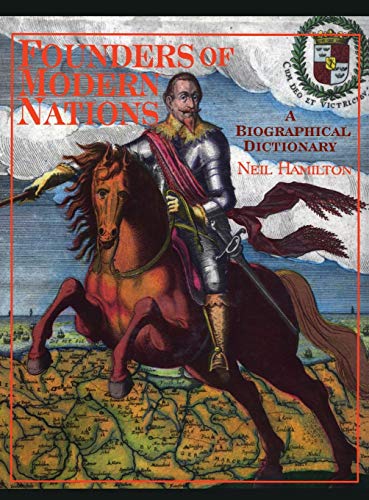
Founders of Modern Nations: A Biographical Dictionary / Neil A. Hamilton.
Idioma: Español Detalles de publicación: Santa Barbara California: ABC-Clio, c1995.Descripción: xviii, 505 p. : ill.; 29 cmTipo de contenido:- 0874367506
| Imagen de cubierta | Tipo de ítem | Biblioteca actual | Biblioteca de origen | Colección | Ubicación en estantería | Signatura topográfica | Materiales especificados | Info Vol | URL | Copia número | Estado | Notas | Fecha de vencimiento | Código de barras | Reserva de ítems | Prioridad de la cola de reserva de ejemplar | Reservas para cursos | |
|---|---|---|---|---|---|---|---|---|---|---|---|---|---|---|---|---|---|---|
| Libro | Biblioteca de Mayagüez Sala de Referencia mb | D226.7 .H36 1995 (Navegar estantería(Abre debajo)) | Disponible | 50000001956415 |
Total de reservas: 0
Descripciones mejoradas de Syndetics:
Presents the biographies of men and women who possessed the vision and the will to establish independent nations, including Washington, Castro, Mao, and Ghandi.
Includes bibliographical references and index.
Reseñas proporcionadas por Syndetics
Library Journal Review
This dictionary presents those men and women who possessed both the vision to establish independent nations of united people and the will to use whatever means, whether peaceful or violent, to obtain that goal. The 322 entries cover the rulers, revolutionaries, politicians, and military leaders responsible for the formation of existing nations since 1300. Hamilton's accurate, well-written entries cover such people as Washington, Castro, Mao, and Gandhi as well as lesser-known people responsible for founding independent nations in Africa, Asia, and now Eastern Europe and the former Soviet Union. No glowing pictures appear here: Hamilton's biographies cover both the positive and negative aspects of his subjects. Also included are 86 country profiles and a chronology of the founding of nations and revolutions. This excellent book complements familiar titles like the Chambers Dictionary of Political Biography (1991), Frank Thackery's Statesmen Who Changed the World (Greenwood, 1993), Harris M. Lentz III's Heads of States and Governments (McFarland, 1994), and Historic World Leaders (LJ 5/1/94), offering greater detail in the select area on which it focuses. Its approach, presentation, and coverage of the many changes that have occurred since the fall of both the Berlin Wall and the Soviet Union recommend it for all school, public, and academic libraries.Stephen L. Hupp, Univ. of Pittsburgh Lib., Johnston, Pa. (c) Copyright 2010. Library Journals LLC, a wholly owned subsidiary of Media Source, Inc. No redistribution permitted.CHOICE Review
Hamilton has written biographical sketches of more than 300 persons considered founders of some 180 modern nations. The sketches are arranged alphabetically, range from one to several double-column pages, list references to secondary sources, and occasionally include a photograph. An "Entry Locator" near the front lists nations alphabetically and gives for each the names of founders. An appendix, "Country Profiles," supplies one or two paragraphs on the history of each nation, which is sometimes helpful in tying together the roles of multiple founders. Many countries are credited with a single founder (e.g., Comoros, Bulgaria, Cyprus, Latvia, Sweden); others have several (the US, 8; China, 7; Mexico, 6; Ireland, 5). Only founders of modern regimes are selected, hence Lenin, Julius Caesar, and Napoleon are excluded. Some inclusions are questionable. Mikhail Gorbachev, who presided over the demise of a regime, shares space with Catherine the Great and Boris Yeltsin, and Thomas Paine, although his contribution to the American Revolution was important, was out of the country and played no direct role in the adoption of the US Constitution. Nations with unsettled recent histories earn multiple founders; for Nicaragua, Daniel Ortega and Violeta Chamorro, and for Iran, Shah Reza Pahlavi and the Ayatollah Ruhollah Khomeini. Although brief biographies of George Washington can be found in numerous other sources, only here will one find more than a passing reference to Horloyn Choibalsang (Mongolia) or Philibert Tsiranana (Madagascar). A good optional choice for most academic collections. J. W. Barnes Shepherd CollegeBooklist Review
This source provides biographical information for more than 300 men and women identified as "founding parents" of existing countries. Hamilton defines a modern nation as "a political entity that exists today and that conforms to the characteristics of nation-states emergent in Europe as the Middle Ages came to an end." This definition excludes the prime movers in the former Soviet Union and Yugoslavia. The criteria for inclusion are figures who "created the nation with the territorial boundaries as they still exist . . . [and] who changed their governments in revolutionary ways, provided such changes, even after some alteration, continue as a prominent feature." Thus, Cuba is represented by JoseMartiand Fidel Castro. The dictionary is divided in two parts. The biographical section, arranged alphabetically, consists of a one-or two-page sketch of the person, describing his or her contributions as a national founder. Cross-references in small caps direct the reader to others from that country. A brief bibliography concludes each article. The second section of brief country profiles outlines the history leading to the development of each nation. Other useful features are an index listing the founders by country (and giving the names as entered in the dictionary--a useful feature for Arab and Asian names where the surname may not be evident), a brief chronology, clear outline maps of the continents showing the countries whose leaders are included in the work, and a bibliography. Unfortunately, both the bibliographies at the ends of biographies and the one at the end of the book do not note publishers. Some biographical sketches are illustrated with black-and white portraits. The index includes more than personal and country names; other subjects are also indexed. Founders of Modern Nations provides an excellent starting point for students doing research. While some of the people can be found in any encyclopedia (e.g., Kenyatta, Chiang Kai-shek, Nasser), many of them, especially those from small countries, will be difficult to find in standard reference books. This is an outstanding source for public, academic, and high-school libraries. (Reviewed March 15, 1996)Notas de autor provistas por Syndetics
Neil A. Hamilton is a professor of history at Spring Hill College in Mobile, AL, & also serves as adjunct professor of American history at University of South Alabama. The author of "The ABC-Clio Companion to the 1960s Counterculture in America" & "Militias in America: A Reference Handbook", he holds a Ph.D. in American history from the University of Tennessee & lives in Fairhope, AL.(Bowker Author Biography)