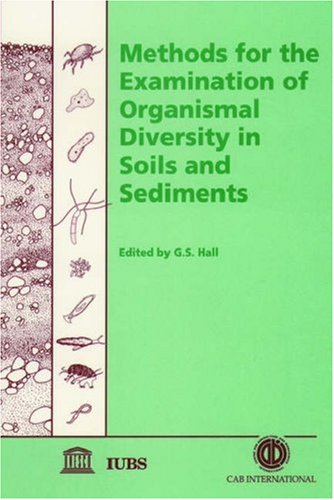

Methods for the examination of organismal diversity in soils and sediments edited by Geoffrey S. Hall ; project coordinators, Pierre Lasserre and David L. Hawksworth.
Detalles de publicación: Wallingford, Oxon, UK New York, NY, USA CAB International in association with United Nations Educational, Scientific, and Cultural Organization and the International Union of Biological Sciences c1996.Descripción: xii, 307 p. ill. 24 cmISBN:- 0851991491
- 631.4/6 21
- S593 .M44525 1996
| Imagen de cubierta | Tipo de ítem | Biblioteca actual | Biblioteca de origen | Colección | Ubicación en estantería | Signatura topográfica | Materiales especificados | Info Vol | URL | Copia número | Estado | Notas | Fecha de vencimiento | Código de barras | Reserva de ítems | Prioridad de la cola de reserva de ejemplar | Reservas para cursos | |
|---|---|---|---|---|---|---|---|---|---|---|---|---|---|---|---|---|---|---|
| Referencia | Biblioteca Encarnación Valdés Sala de Referencia bev | 631.46 M592 (Navegar estantería(Abre debajo)) | Disponible | 80000001784845 |
Descripciones mejoradas de Syndetics:
Our lack of knowledge of the organisms dwelling in soils and sediments and of their roles in ecological processes constitutes a major barrier to understanding how ecosystems operate. This topic has both academic and applied relevance. Thus, in order to forecast the implications of perturbations in a site on both the species present and the ecosystem functioning, whether direct (e.g. pollution or physical disturbance) or indirect (e.g. climate change), methods need to be available that can be used to ascertain what organisms are present in a sample.
This book provides an authoritative manual of the techniques now used for different organisms. It has been developed as part of a project initiated by the International Union of Biological Sciences (IUBS), supported by UNESCO. It covers both soil organisms and those inhabiting freshwater and marine sediments, from microbes (bacteria, algae, fungi, etc.) to macrofauna (earthworms, nematodes, molluscs, etc.). The chapters are arranged by organismal groups and have been written by recognized specialists from the USA and Europe. The book makes a major contribution to the literature and is indispensable for soil and aquatic biologists and ecologists, as well as those with a broader interest in biodiversity and environmental sciences.
Includes bibliographies and index.
Tabla de contenidos provista por Syndetics
- Foreword
- Preface
- Acknowledgements
- 1 Heterotrophic Bacteria: The Cultivation Approach
- 2 Chemolithotrophic Bacteria
- 3 Actinomycetes
- 4 Cyanobacteria (Blue-Green Algae)
- 5 Analysis of Non-Culturable Bacteria
- 6 Algae
- 7 Protozoa
- 8 Dictyostelids and Myxomycetes
- 9 Yeasts
- 10 Zoosporic Fungi
- 11 Filamentous Fungi
- 12 Arbuscular Mycorrhizas
- 13 Micro- and Macro-Arthropods
- 14 Mites
- 15 Meiofauna in Marine and Freshwater Sediments
- 16 Rotifers
- 17 Turbellarians
- 18 Nematodes in Soils
- 19 Land and Freshwater Molluscs and Crustaceans
- 20 Earthworms
- 21 Marine Macrofauna: Polychaetes
- 22 Burrowing Mega- and Macrofauna from Marine Sediments: the Minor Groups
- Index