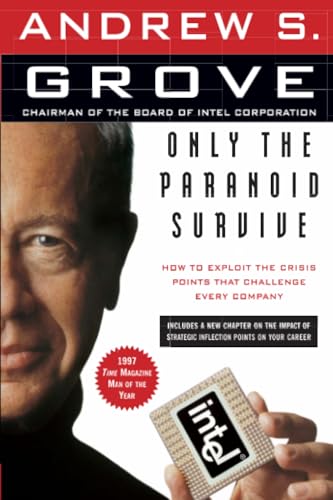

Only the paranoid survive! the threat and promise of strategic inflection points Andrew S. Grove.
Detalles de publicación: New York Currency Doubleday 1996.Edición: 1st edDescripción: xii, 210 pISBN:- 0385483821
- 658.4/06 20
- HD58.8 .G765 1996
| Imagen de cubierta | Tipo de ítem | Biblioteca actual | Biblioteca de origen | Colección | Ubicación en estantería | Signatura topográfica | Materiales especificados | Info Vol | URL | Copia número | Estado | Notas | Fecha de vencimiento | Código de barras | Reserva de ítems | Prioridad de la cola de reserva de ejemplar | Reservas para cursos | |
|---|---|---|---|---|---|---|---|---|---|---|---|---|---|---|---|---|---|---|
| Libro | Biblioteca Encarnación Valdés Colección General bev | 658.406 G883o (Navegar estantería(Abre debajo)) | Disponible | 80000001939670 |
Descripciones mejoradas de Syndetics:
Andy Grove, founder and former CEO of Intel shares his strategy for success as he takes the reader deep inside the workings of a major company in Only the Paranoid Survive .
Under Andy Grove's leadership, Intel became the world's largest chip maker and one of the most admired companies in the world. In Only the Paranoid Survive , Grove reveals his strategy for measuring the nightmare moment every leader dreads--when massive change occurs and a company must, virtually overnight, adapt or fall by the wayside--in a new way.
Grove calls such a moment a Strategic Inflection Point, which can be set off by almost anything: mega-competition, a change in regulations, or a seemingly modest change in technology. When a Strategic Inflection Point hits, the ordinary rules of business go out the window. Yet, managed right, a Strategic Inflection Point can be an opportunity to win in the marketplace and emerge stronger than ever.
Grove underscores his message by examining his own record of success and failure, including how he navigated the events of the Pentium flaw, which threatened Intel's reputation in 1994, and how he has dealt with the explosions in growth of the Internet. The work of a lifetime, Only the Paranoid Survive is a classic of managerial and leadership skills.
Tabla de contenidos provista por Syndetics
- Preface Only the Paranoid Survive(p. 1)
- Chapter 1 Something Changed(p. 9)
- What Happened to Us(p. 18)
- "That Guy Is Always the Last to Know"(p. 21)
- Chapter 2 A "10X" Change(p. 25)
- The Six Forces Affecting a Business(p. 27)
- A "10X" Force(p. 30)
- The Strategic Inflection Point(p. 32)
- Chapter 3 The Morphing of the Computer Industry(p. 37)
- Before the Strategic Inflection Point(p. 39)
- After the Strategic Inflection Point(p. 45)
- Winners and Losers(p. 48)
- The New Rules of the Horizontal Industry(p. 51)
- Chapter 4 They're Everywhere(p. 53)
- "10X" Change: Competition(p. 56)
- Wal-Mart: An overwhelming force in town(p. 56)
- Next: The software company(p. 57)
- "10X" Change: Technology(p. 60)
- Sound takes over silent movies(p. 61)
- Upheaval in the shipping industry(p. 62)
- The PC revolution: A tale of denial(p. 63)
- "10X" Change: Customers(p. 65)
- Changing tastes in cars(p. 66)
- Attitude shifts(p. 66)
- The double whammy in supercomputers(p. 67)
- "10X" Change: Suppliers(p. 68)
- Airlines flex their muscles(p. 68)
- The end of second sourcing(p. 69)
- "10X" Change: Complementors(p. 71)
- "10X" Change: Regulation(p. 71)
- The demise of patent medicines(p. 72)
- The reordering of telecommunications(p. 72)
- Privatization(p. 75)
- Chapter 5 "Why Not Do It Ourselves?"(p. 79)
- Entering Our Strategic Inflection Point(p. 85)
- The Route to Survival(p. 89)
- Looking Back(p. 94)
- Chapter 6 "Signal" or "Noise"?(p. 99)
- Is X-ray Technology a "10X" Force?(p. 101)
- RISC versus CISC(p. 103)
- Is It or Isn't It?(p. 106)
- Helpful Cassandras(p. 108)
- Avoiding the Trap of the First Version(p. 112)
- Debate(p. 114)
- Arguing with the Data(p. 116)
- Fear(p. 117)
- Chapter 7 Let Chaos Reign(p. 121)
- The Touchy-Feely Issues(p. 123)
- The Inertia of Success(p. 127)
- Strategic Dissonance(p. 128)
- Experimentation(p. 129)
- The Business Bubble(p. 131)
- A New Industry Map(p. 134)
- Chapter 8 Rein in Chaos(p. 137)
- Traversing the Valley of Death(p. 140)
- Redeploying Resources(p. 144)
- Leading Via Strategic Actions(p. 146)
- The Clarity Imperative(p. 152)
- Adjusting to the New(p. 157)
- Dynamic Dialectic(p. 160)
- The Other Side of the Valley(p. 163)
- Chapter 9 The Internet: Signal or Noise? Threat or Promise?(p. 165)
- What Is the Internet Anyway?(p. 167)
- Bits and Stolen Eyeballs(p. 172)
- What About Us?(p. 177)
- Threat or Promise?(p. 179)
- What Do We Do?(p. 181)
- Chapter 10 Career Inflection Points(p. 185)
- Your Career Is Your Business(p. 188)
- The Mental Fire Drill(p. 191)
- Timing Is Everything(p. 193)
- Get in Shape for Change(p. 194)
- A New World(p. 197)
- Notes(p. 199)
- Index(p. 217)
Extracto provisto por Syndetics
Notas de autor provistas por Syndetics
Andrew S. Grove is chairman and former CEO of Intel Corporation in Santa Clara, California. He is the author of several books on technology and management, including High Output Management (1983), One-on-One With Andy Grove: How to Manage Your Boss, Yourself, and Your Co-Workers (1987) and Only the Paranoid Survive (1996). He has also written a weekly column on management for the San Jose Mercury News.Born September 2, 1936, in Budapest, Hungary, Grove emigrated to the U.S. in 1957 and became a naturalized citizen in 1962. He studied Chemical Engineering at City College in New York, and earned a Ph.D. in 1963 from University of California, Berkeley. He began working at Fairchild Semiconductor Research Laboratory in San Jose, California in 1963, gradually moving up the ranks to become Assistant Director of Research and Development in 1967. He joined Intel Corporation in 1968 as Vice President and Director of Operations. In 1997, Grove received the Technology Leader of the Year award from Industry Week, and was named Man of the Year by Time Magazine.
(Bowker Author Biography)