Imagen de portada de Amazon
Imagen de Amazon.com
Imagen de cubierta Syndetics
Portada de Syndetics
Imagen de OpenLibrary

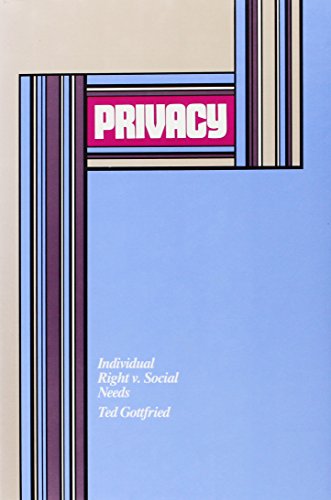
Privacy individual right v. social needs Ted Gottfried.

Por: Series Issue and debateDetalles de publicación: Brookfield, Conn. Millbrook Press c1994.Descripción: 112 p. ill. 24 cmISBN:
  • 1562944037
Tema(s): Clasificación CDD:
  • 342.73/0858 347.302858 20
Clasificación LoC:
  • KF1262.Z9 G68 1994
Resumen: Analyzes the controversial area of individual privacy with a focus on such issues as the confidentiality of medical and other personal information, the ethics of drug testing, the rights of the news media to intrude into private lives, and the need to balance law enforcement and privacy concerns.
Valoración
    Valoración media: 0.0 (0 votos)
Existencias
Imagen de cubierta Tipo de ítem Biblioteca actual Biblioteca de origen Colección Ubicación en estantería Signatura topográfica Materiales especificados Info Vol URL Copia número Estado Notas Fecha de vencimiento Código de barras Reserva de ítems Prioridad de la cola de reserva de ejemplar Reservas para cursos
Libro Biblioteca Encarnación Valdés Colección General bev 342.730858 G686p (Navegar estantería(Abre debajo)) Disponible 80000002015306
Total de reservas: 0

Descripciones mejoradas de Syndetics:

Analyzes the controversial area of individual privacy with a focus on such issues as the confidentiality of medical and other personal information, the ethics of drug testing, the rights of the news media to intrude into private lives, and the need to balance law enforcement and privacy concerns.

Includes bibliographical references and index.

Analyzes the controversial area of individual privacy with a focus on such issues as the confidentiality of medical and other personal information, the ethics of drug testing, the rights of the news media to intrude into private lives, and the need to balance law enforcement and privacy concerns.

Reseñas proporcionadas por Syndetics

School Library Journal Review

Gr 8 Up-Gottfried discusses the competing interests that exist when the press prints sensitive information; the police search or seize personal property; the government regulates private conduct (sex, abortion, pornography); employers require employees to submit to drug tests; doctors release patients' medical records; and strangers snoop in data banks. One chapter also looks at how young people's privacy rights have been limited by the courts-useful information for teens, but Janet R. Price and Alan H. Levine's The Rights of Students (Univ. of Southern Illinois, 1988) is superior on that topic. Unfortunately, sloppy writing and the tendency to oversimplify sometimes interfere with clarity. Legal phrases (probable cause, good faith) are used without explanation. Discussion of the rule that excludes evidence obtained without a warrant is unnecessarily vague and confusing. Curiously, the author talks more about threats to privacy posed by the ``outing'' of gays and lesbians by other gays than about the constitutionally significant, high-profile issue of whether gays and lesbians have a right to engage in private consensual conduct (barely mentioned). Though Stephen Goode's The Right to Privacy (Watts, 1983; o.p.) is more clearly written, Gottfried's book benefits from currency.-Claudia Morrow, Berkeley Public Library, CA (c) Copyright 2010. Library Journals LLC, a wholly owned subsidiary of Media Source, Inc. No redistribution permitted.

Booklist Review

Gr. 8-12. In this well-written, easy-to-follow discussion of the key privacy debates, Gottfried addresses issues such as law enforcement and surveillance as well as morality issues (such as abortion and birth control), medical privacy (including issues concerning AIDS), and complications in information dissemination brought on by bigger and better data banks. He also looks at media coverage of celebrities, public figures, people accused of crimes and their victims, and, finally, youth and privacy. In each case, he presents both sides of the question and makes it clear that there are no easy solutions to resolving the trade-offs between privacy and society's "need to know." These are issues that interest teens, and the careful selection of case law and examples highlights the problems in a way that will enable a wide range of readers to understand key points. Extensive notes from sources that would be available to high-school students, a solid, approachable recommended reading list, and a helpful summary of the major court decisions contribute to making this a must for public and school libraries and a valuable tool for librarians and educators who are guiding students to ideas for speeches, papers, and/or debates on important current issues. ~--Jeanne Triner
Compartir
logopucpr-y-vive

Contáctanos

¡Queremos saber de ti!

Tel. 787.841.2000 Ext. 1801

bibliotecavaldes@pucpr.edu

⁣Búscanos en las redes

© 2026 Desarrollado por Ignite Online • All Rights Reserved • Powered by Koha.