Imagen de Amazon.com

Portada de Syndetics
Imagen de OpenLibrary
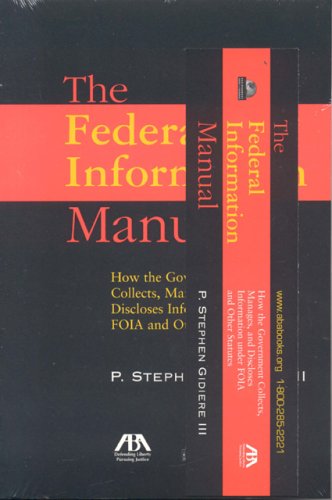
The federal information manual how the goverment collects, manages and discloses information under FOIA and other statutes P. Stephen Gidiere III.
Detalles de publicación: Chicago, Ill. ABA Section of Environment Energy and Resources c2006.Edición: 1st. edDescripción: xv, 446 p. 23 cmISBN:- 1590315790
- 9781590315798
- How the government collects, manages, and discloses information under FOIA and other statutes
- KF 5753 .G53 2005
| Imagen de cubierta | Tipo de ítem | Biblioteca actual | Biblioteca de origen | Colección | Ubicación en estantería | Signatura topográfica | Materiales especificados | Info Vol | URL | Copia número | Estado | Notas | Fecha de vencimiento | Código de barras | Reserva de ítems | Prioridad de la cola de reserva de ejemplar | Reservas para cursos | |
|---|---|---|---|---|---|---|---|---|---|---|---|---|---|---|---|---|---|---|
| Libro | Biblioteca de Derecho Mons. Fremiot Torres Oliver Colección General biblioteca derecho | KF 5753 .G53 2005 (Navegar estantería(Abre debajo)) | Disponible | 70000000776737 |
Total de reservas: 0
Descripciones mejoradas de Syndetics:
Focuses on the vast amount of federal information and the legal framework that controls the government's collection, management, and disclosure of its records.
Includes bibliographical references and index.
Tabla de contenidos provista por Syndetics
- List of Figures and Tables(p. xi)
- Acknowledgments(p. xiii)
- About the Author(p. xv)
- Chapter 1 An overview of federal information disputes(p. 1)
- 1.1 The Players in Federal Information Disputes(p. 3)
- 1.1.1 Congress(p. 3)
- 1.1.2 The courts(p. 5)
- 1.1.3 Federal agencies(p. 6)
- 1.1.4 Department of Justice(p. 8)
- 1.1.5 Executive Office of the President(p. 10)
- 1.1.6 National Archives and Records Administration(p. 11)
- 1.2 Trends in Federal Information Law(p. 12)
- Chapter 2 Agency Collection of Information(p. 15)
- 2.1 Agency Information Requests and Their Enforcement(p. 16)
- 2.1.1 Responding to an information request(p. 17)
- 2.1.2 The Environmental Protection Agency's information request authorities(p. 23)
- 2.1.2.1 CERCLA Section 104(e)(p. 25)
- 2.1.2.2 RCRA Section 3007(p. 28)
- 2.1.2.3 Clean Air Act Section 114(p. 29)
- 2.1.2.4 Clean Water Act Section 308(p. 30)
- 2.1.2.5 Toxic Substances Control Act Section 8(p. 31)
- 2.2 Administrative Subpoenas(p. 32)
- 2.3 The Paperwork Reduction Act(p. 33)
- 2.3.1 Coverage of the PRA: A "collection of information"(p. 35)
- 2.3.2 The information collection review process(p. 36)
- 2.3.3 Consequences of an agency's failure to display a valid control number(p. 39)
- 2.4 Agency Use of Web Cookies and Other Persistent Tracking Technology(p. 41)
- Chapter 3 Management of Agency Records(p. 45)
- 3.1 The Federal Records Act(p. 46)
- 3.1.1 Coverage of the Federal Records Act(p. 47)
- 3.1.1.1 Covered agencies(p. 47)
- 3.1.1.2 Covered records(p. 48)
- 3.1.2 Records management obligations under the Federal Records Act(p. 50)
- 3.1.3 Electronic records under the Federal Records Act(p. 55)
- 3.1.4 Remedies for violations of the Federal Records Act(p. 56)
- 3.2 Indices of Major Information Systems(p. 57)
- 3.3 Ensuring the Quality of Federal Information(p. 61)
- 3.3.1 The Information Quality Act(p. 61)
- 3.3.1.1 Coverage of the Information Quality Act(p. 62)
- 3.3.1.2 Standards for information quality(p. 64)
- 3.3.1.3 The correction process(p. 66)
- 3.3.1.4 Judicial review of an agency's denial of an information correction request(p. 67)
- 3.3.2 Correction of personal information under the Privacy Act(p. 69)
- Chapter 4 Classified Information(p. 71)
- 4.1 Classification of Information by the Executive Branch(p. 76)
- 4.1.1 The original classification process(p. 79)
- 4.1.2 Duration of classification and automatic declassification(p. 82)
- 4.1.3 Challenges to classification status(p. 87)
- 4.1.3.1 Challenges by authorized holders(p. 87)
- 4.1.3.2 Challenges by the general public(p. 88)
- 4.1.4 The Interagency Security Classification Appeals Panel(p. 90)
- 4.2 Access to Classified Information(p. 92)
- 4.2.1 Federal employees, officials, and contractors(p. 94)
- 4.2.1.1 The security clearance process(p. 96)
- 4.2.1.2 Administrative and judicial review of agency security clearance decisions(p. 98)
- 4.2.2 Historical researchers and former Presidential appointees(p. 99)
- 4.2.3 Federal judges and their staff(p. 100)
- 4.2.4 Members of Congress and their staff(p. 102)
- 4.3 Classified Information under the Atomic Energy Act(p. 104)
- 4.4 Penalties for Unauthorized Disclosure of Classified Information(p. 107)
- 4.5 Use of Classified Information by Criminal Defendants: The Classified Information Procedures Act(p. 108)
- 4.6 Use of Classified Information in Civil Cases: The Military and State Secrets Privilege(p. 114)
- Chapter 5 Access to Federal Records(p. 119)
- 5.1 Access to Records of Executive Branch Agencies(p. 120)
- 5.1.1 Meaning of the term "agency" for FOIA purposes(p. 123)
- 5.1.2 Meaning of the term "agency record"(p. 128)
- 5.1.3 Meaning of the term "any person"(p. 129)
- 5.1.4 Public reading rooms(p. 133)
- 5.2 Access to Personal Information under the Privacy Act(p. 135)
- 5.3 Presidential Records(p. 137)
- 5.3.1 Ownership and control of presidential records(p. 137)
- 5.3.2 Meaning of the term "presidential record"(p. 138)
- 5.3.3 Disposition of presidential records(p. 139)
- 5.3.4 Access to presidential records(p. 141)
- 5.3.4.1 The difference between a request for presidential records and a request for agency records(p. 141)
- 5.3.4.2 The assertion of executive privilege over presidential records(p. 143)
- 5.3.4.3 Administrative appeal from the denial of a request for presidential records(p. 144)
- 5.3.5 Access to the Nixon tapes and Kennedy assassination records(p. 144)
- 5.4 Access to Congressional and Court Records via the Common Law Right of Access(p. 145)
- 5.5 Access by Members of the Media(p. 147)
- Chapter 6 Electronic Records and Federal Public Web Sites(p. 149)
- 6.1 Overview of the Electronic Freedom of Information Act Amendments of 1996(p. 150)
- 6.2 Electronic Records(p. 151)
- 6.3 Searching Electronic Databases in Response to a FOIA Request(p. 154)
- 6.4 An Overview of the E-Government Act of 2002(p. 157)
- 6.5 Content and Organization of Federal Agency Public Web Sites(p. 160)
- 6.5.1 Web site requirements in the E-Government Act(p. 164)
- 6.5.2 Web site requirements in the FOIA(p. 166)
- 6.5.3 Web site requirements in the Information Quality Act(p. 167)
- 6.5.4 Web site requirements in the Paperwork Reduction Act(p. 168)
- 6.5.5 Privacy requirements for federal public Web sites(p. 168)
- 6.5.6 Web site access for people with limited English proficiency(p. 170)
- 6.6 Security of Federal Information and Information Systems(p. 171)
- 6.6.1 The Federal Information Security Management Act(p. 171)
- 6.6.2 The Internet disconnect orders in Cobell v. Norton(p. 172)
- 6.7 Access to Federal Electronic and Information Technology by People with Disabilities(p. 173)
- 6.8 The Preservation of Electronic Federal Records(p. 175)
- 6.9 The Computer Matching and Privacy Protection Act(p. 176)
- Appendix 6-1 Recommended Guidelines for Federal Public Web Sites(p. 178)
- Chapter 7 The Elements of a Successful FOIA Request(p. 181)
- 7.1 Where to Send the Request(p. 182)
- 7.2 How to Describe the Sought-After Records(p. 183)
- 7.3 Method of Delivery(p. 185)
- 7.4 An Agency's Duty to Search(p. 186)
- 7.5 Deadline for the Agency's Response: Why 20 Days Doesn't Mean 20 Days(p. 191)
- 7.6 Multitrack and Expedited Processing(p. 197)
- 7.7 Search, Review, and Duplication Fees(p. 201)
- 7.7.1 FOIA's fee categories(p. 202)
- 7.7.2 Fee waivers and reductions(p. 208)
- 7.7.3 Fee waivers for requests that further litigation(p. 210)
- 7.7.4 Judicial review of fee determinations(p. 211)
- 7.8 Elements of an Agency's Response to a FOIA Request(p. 213)
- 7.9 Administrative Appeal of an Adverse Response(p. 215)
- Chapter 8 Reasons for the Withholding of Agency Records(p. 219)
- 8.1 Classified Information(p. 223)
- 8.2 Internal Personnel Rules and Practices of an Agency(p. 227)
- 8.2.1 The "Low 2" prong of Exemption 2(p. 227)
- 8.2.2 The "High 2" prong of Exemption 2(p. 228)
- 8.3 Information Protected by Other Statutes(p. 233)
- 8.4 Trade Secrets and Confidential or Privileged Business Information(p. 236)
- 8.4.1 Trade secrets(p. 236)
- 8.4.2 Confidential business information(p. 237)
- 8.4.2.1 The competitive harm and impairment prongs(p. 238)
- 8.4.2.2 The "third prong" of national parks(p. 239)
- 8.4.2.3 Voluntarily submitted information: The Critical Mass decision(p. 241)
- 8.4.3 Privileged information(p. 244)
- 8.5 Privileged Inter-agency or Intra-agency Memorandums or Letters(p. 245)
- 8.5.1 Inter-agency or intra-agency memorandums or letters(p. 245)
- 8.5.2 Examples of privileges recognized under Exemption 5(p. 248)
- 8.5.2.1 Attorney-client privilege(p. 248)
- 8.5.2.2 Attorney work-product doctrine(p. 249)
- 8.5.2.3 Deliberative process privilege(p. 252)
- 8.5.2.4 The presidential communications privilege(p. 256)
- 8.5.3 The government's confidential business information(p. 257)
- 8.6 Personnel, Medical, and Similar Files(p. 260)
- 8.7 Law Enforcement Information(p. 263)
- 8.7.1 Exemption 7(A): Interference with enforcement proceedings(p. 265)
- 8.7.2 Exemption 7(B): Deprivation of right to fair trial or impartial adjudication(p. 265)
- 8.7.3 Exemption 7(C): Unwarranted invasion of personal privacy(p. 266)
- 8.7.4 Exemption 7(D): Confidential informants(p. 269)
- 8.7.5 Exemption 7(E): Law enforcement techniques, procedures, or guidelines(p. 270)
- 8.7.6 Exemption 7(F): Danger to life or physical safety(p. 271)
- 8.8 Financial Institution Information(p. 272)
- 8.9 Geological and Geophysical Information Concerning Wells(p. 273)
- 8.10 Exclusions from the FOIA(p. 274)
- 8.11 Information about Sensitive Resources(p. 276)
- 8.11.1 Cultural, historical, and tribal resources(p. 277)
- 8.11.2 Threatened, endangered, and sensitive species(p. 279)
- 8.12 Information Already Publicly Available(p. 284)
- 8.13 The Mosaic Effect(p. 289)
- 8.14 The Impact of Attorney General Memoranda on FOIA Implementation(p. 291)
- Appendix 8-1 Selected Exemption 3 Statutes Invoked by Federal Agencies(p. 295)
- Chapter 9 Litigation Involving Federal Records(p. 307)
- 9.1 Litigating to Compel Disclosure under the FOIA(p. 308)
- 9.2 Litigating to Prevent Disclosure of Confidential Business Information(p. 314)
- 9.2.1 Defending a claim of confidential business information at the administrative level(p. 314)
- 9.2.1.1 The importance of marking information as confidential(p. 315)
- 9.2.1.2 The substantiation process(p. 316)
- 9.2.2 The "reverse FOIA" action(p. 321)
- 9.2.3 Environmental and natural resources statutes specifically addressing confidential business information(p. 324)
- 9.2.4 Disclosure of confidential business information as a compensable taking(p. 327)
- 9.3 Discovery in Non-FOIA Civil Litigation with the Government(p. 331)
- 9.3.1 FOIA as a discovery tool(p. 332)
- 9.3.2 Claims of privilege by federal agencies(p. 334)
- 9.3.2.1 The government's exclusive privileges(p. 334)
- 9.3.2.2 Privilege logs(p. 336)
- 9.3.2.3 How the government invokes its privileges in litigation(p. 337)
- 9.3.2.4 Appointment of special master to review privilege claims(p. 341)
- 9.3.3 Confidential information and protective orders(p. 341)
- 9.4 Standing in Information Cases(p. 343)
- 9.4.1 The basics of Article III and prudential standing(p. 344)
- 9.4.2 Informational standing(p. 345)
- Chapter 10 Homeland Security Information(p. 349)
- 10.1 The Impact of September 11 on Federal Information Policy(p. 350)
- 10.2 Use of Existing FOIA Exemptions to Protect Homeland Security Information(p. 353)
- 10.2.1 Exemption 1-Information regarding weapons of mass destruction(p. 355)
- 10.2.2 Exemption 2-Risk of circumvention(p. 356)
- 10.2.3 Exemption 3-Other statues(p. 360)
- 10.2.4 Exemption 4-Privately-owned infrastructure(p. 361)
- 10.2.5 Exemption 7-Law enforcement information(p. 361)
- 10.3 Critical Energy Infrastructure Information(p. 368)
- 10.3.1 FERC's CEII rulemaking(p. 369)
- 10.3.2 What is CEII?(p. 370)
- 10.3.3 Submission of CEII to FERC(p. 371)
- 10.3.4 How to request CEII(p. 374)
- 10.3.5 The role of the submitter of CEII(p. 377)
- 10.3.6 Judicial review of decisions by the CEII coordinator(p. 378)
- 10.4 USA PATRIOT Act(p. 379)
- 10.5 Homeland Security Act of 2002(p. 381)
- 10.5.1 Creation of the Department of Homeland Security(p. 381)
- 10.5.2 Critical Infrastructure Information Act of 2002(p. 383)
- 10.5.3 Homeland Security Information Sharing Act(p. 386)
- Text of Freedom of Information Act, 5 U.S.C. [section] 552(p. 389)
- Glossary of Abbreviations(p. 401)
- Glossary of Federal Information Statutes(p. 403)
- Table of Cases(p. 405)
- Index(p. 433)