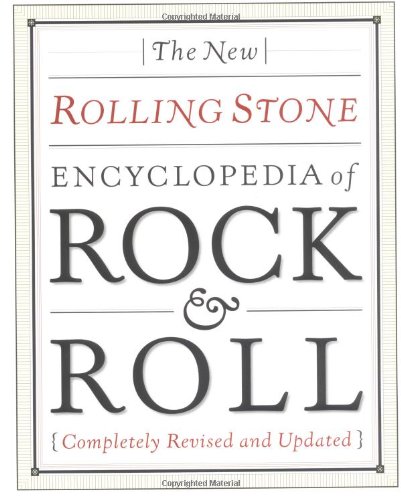
Selected by the Rock and Roll Hall of Fame as its official source of information, this authoritative volume, first published in 1983, once again tops the charts with its full coverage of every aspect of the rock scene. Accompanying the more than 2,200 performer profiles are essays that reveal the artists' musical influences, first breaks, hits and misses, and more.
Rev. ed. of: The Rolling stone encyclopedia of rock & roll. c1983.
"A Rolling Stone Press book."
Includes discographies.
Reseñas proporcionadas por Syndetics
Library Journal Review
Contributing editor Jon Pareles notes in the preface that rock is about tension "between formula and innovation...between independence and the chance to reach the mass public." This work, while definitive, leans toward formula and mass appeal, taking few chances. Ultimately, it is a reference work on rock'n'roll, not of rock'n'roll. That being said, it's hard to argue with 2200 meticulously researched entries describing rock figures from the famous to the all but forgotten. A typical entry for a band gives the year and date the group formed, the members and their birth dates and places, their instruments, and a discography followed by an essay. The essays range from 100 words (Mungo Jerry) to four-plus pages (Elvis) and deal noncritically with the artists' work, history, and influence. The discographies are often incomplete, which the editors chalk up to the overlaps created by compilation and greatest-hits albums. There are also essays that attempt to define genres (rap, industrial, techno, etc.), which unfortunately give scant detail and fail to distinguish between those artists who have entries in the book and those who do not. Also, there are no bibliographies for either the genre or artist essays. Despite these flaws, however, if you are looking for a basic reference on rock'n'roll, this is the one to buy. Recommended for all libraries.-Adam Mazmanian, "Library Journal" (c) Copyright 2010. Library Journals LLC, a wholly owned subsidiary of Media Source, Inc. No redistribution permitted.
Booklist Review
In 1983 the first edition of this book broke ground in covering rock and roll and its history. This new edition has expanded in size by more than a third to include new performers. In order to keep the size reasonable, some solo entries from the previous edition have been combined into group entries. Dates and discographies (not always inclusive) preface each of the 2,000 entries, which vary in length from two paragraphs for Laura Branigan to three pages for the Beatles. One could quibble about relative coverage. Does Kinky Friedman need such a long entry, since his musical impact is limited? There is a good range in coverage in terms of both time (Leadbelly to Del-Vikings to the Cranberries) and genres (Basia to Cypress Hill to Def Leppard). In addition to entries for performers, there are such topical entries as AOR, Grunge, MTV, and Gangsta Rap. Each letter of the alphabet contains a list of Grammy winners whose names begin with that letter. This information might be more useful arranged by date in one list. Black-and-white portraits are provided rather sparingly. With its reasonable price and its currency through early 1995, The New Rolling Stone Encyclopedia is recommended for high-school and public libraries. (Reviewed December 15, 1995)
The new Rolling stone encyclopedia of rock & roll
APA
Romanowski P., Pareles J. & George-Warren H. (1995). The new Rolling stone encyclopedia of rock & roll. New York: Fireside.
Chicago
Romanowski Patricia, Pareles Jon and George-Warren Holly. 1995. The new Rolling stone encyclopedia of rock & roll. New York: Fireside.
Harvard
Romanowski P., Pareles J. and George-Warren H. (1995). The new Rolling stone encyclopedia of rock & roll. New York: Fireside.
MLA
Romanowski Patricia, Pareles Jon and George-Warren Holly. The new Rolling stone encyclopedia of rock & roll. New York: Fireside. 1995.