Reseñas proporcionadas por Syndetics
Publishers Weekly Review
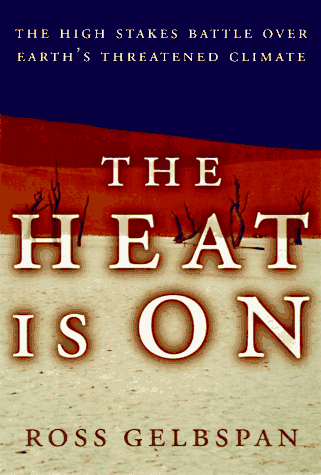
Pulitzer Prize-winning journalist Gelbspan argues forcefully that there is no scientific controversy over whether global warming is occurring. In a style accessible to the general reader, he demonstrates just how much agreement there is among scientists that global warming caused by humans has already begun, that it has been responsible for the deadly extremes in weather increasingly common in recent years and that radical measures must be taken immediately if wholesale ecological disaster is to be averted. He also contends that "the reason most Americans don't know what is happening to the climate is that the oil and coal industries have spent millions of dollars to persuade them that global warming isn't happening." Gelbspan documents these interests' self-serving disinformation campaigns, reveals the appalling ignorance of many congressional leaders voting to defund climate research and discloses the monetary ties between the oil and coal industries and the handful of scientists arguing that we have nothing to fear. That the insurance industry, with so much to lose if weather-related claims continue to pour in, is banding together with environmentalists in calling for swift global action, demonstrates that many from across the political spectrum are beginning to recognize the concern of most of the world's scientists. An included technical appendix refuting criticism raised by greenhouse skeptics will likely prove too long and too technical for all but the most dedicated readers. (May) (c) Copyright PWxyz, LLC. All rights reserved
School Library Journal Review
YALike Our Stolen Future (Dutton, 1996), this is a readable and cogent discussion of important environmental issues. Gelbspan writes a response to what he terms the oil and coal industries' attempts to downplay the coming emergency of global warming. Covering the confusing issues of the current debate, he explains why fluctuating temperatures, not just warmer temperatures, are part of the evidence for climate change caused by mass industrialization. He convincingly describes the possible outcomes for the planet and society if science is ignored: plagues, flooding, starvation, and anarchy. Arguments against the dire climatic possibilities, and those who espouse them, are thoroughly discussed, referenced, and disputed. The detailed index and bibliographic notes to each chapter make this book a comprehensive reference source as well an educational work of nonfiction. Rebuttals from the United Nations Intergovernmental Panel on Climate Change (IPCC) to well-known climate-change skeptics are included in an appendix. An important addition to YAs' store of knowledge concerning the planet they are to inherit.Carol DeAngelo, Garcia Consulting Inc., EPA Headquarters, Washington, DC (c) Copyright 2010. Library Journals LLC, a wholly owned subsidiary of Media Source, Inc. No redistribution permitted.
CHOICE Review
Gelbspan offers a passionate account of climate change induced by increased concentrations of greenhouse gases and their predicted environmental impacts. In this well-written and quite readable work, the author does not claim to present a balanced portrayal of the scientific uncertainty in climate projections and, as the title suggests, his premise is that climate change is occurring and will continue to do so. He makes some compelling arguments for action to ameliorate this change or at least slow the rate at which it occurs. Certainly the scientific community would urge the same; some countries and some industries have already adopted risk adverse behavior. Perhaps had this been highlighted, the message would have seemed less "apocalyptic," and also the chapter "One Pathway to a Future" would have seemed more focused. Gelbspan's intent is clearly a "call to arms" and the appendix "A Scientific Critique of the Greenhouse Skeptics" is particularly interesting. However, this section and the book as a whole presents science in a rather adversarial light. In truth, science and the discussion of uncertainty and precision is rarely conducted in this manner. Nevertheless, a provocative work that provides a good example of the way science is presented in the political arena. Upper-division undergraduates and up. S. C. Pryor; Indiana University
Booklist Review
Irritated by a minority viewpoint among climatologists (that human activity is not the cause of global warming), Gelbspan launches an energetic criticism of their ideas and their sponsors. Formerly a newspaper reporter on environmental topics, Gelbspan earnestly believes that without immediate drastic action, humanity faces an imminent apocalypse of rising sea levels, desertification, and superdestructive storms. With the consequences of inertia as so stated, no wonder Gelbspan excoriates a half-dozen scientists, the conservative newspapers and Republican politicians who cite them, and the coal and oil interests that subsidize their organizations. After confounding his enemies, Gelbspan dilates on extant programs to decrease carbon dioxide emissions, such as international conventions or market-based inducements, all of which he argues are inadequate to the crisis: carbon taxes and a massive clean-energy technology donation by the West to China and India (to stop them from a coal-burning binge) are his desired policies. With interest in the entire subject bound to increase with the next UN environment conference, slated for fall 1997 in Kyoto, Gelbspan's alarm bell will doubtlessly be heard. --Gilbert Taylor