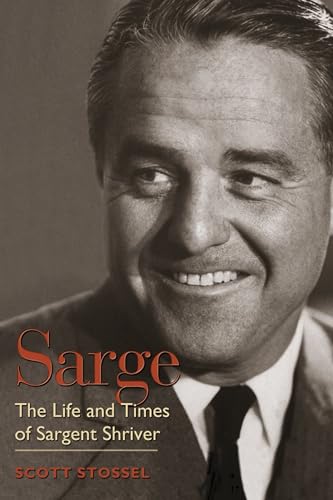

Sarge the life and times of Sargent Shriver Scott Stossel ; foreword by Bill Moyers.
Detalles de publicación: Washington, D.C. Smithsonian Books c2004.Descripción: xxx, 761 p. ill. 24 cmISBN:- 1588341275 (alk. paper)
- Shriver, Sargent 1915-
- Kennedy family
- Democratic Party U.S. -- Biography
- Politicians -- United States -- Biography
- Ambassadors -- United States -- Biography
- Lawyers -- United States -- Biography
- Businessmen -- Illinois -- Chicago -- Biography
- United States -- Politics and government -- 1945-1989
- United States -- Politics and government -- 1989-
- 973.924092 S5616s 22
- E840.8.S525 S37 2004
| Imagen de cubierta | Tipo de ítem | Biblioteca actual | Biblioteca de origen | Colección | Ubicación en estantería | Signatura topográfica | Materiales especificados | Info Vol | URL | Copia número | Estado | Notas | Fecha de vencimiento | Código de barras | Reserva de ítems | Prioridad de la cola de reserva de ejemplar | Reservas para cursos | |
|---|---|---|---|---|---|---|---|---|---|---|---|---|---|---|---|---|---|---|
| Libro | Biblioteca Encarnación Valdés Colección General bev | 973.924092 S5616s (Navegar estantería(Abre debajo)) | Disponible | 80000002361122 |
Descripciones mejoradas de Syndetics:
Working for four presidents over six decades, R. Sargent "Sarge" Shriver founded the Peace Corps, launched the War on Poverty, created Head Start and Legal Services for the Poor, started the Special Olympics, and served as ambassador to France. Yet from the moment he married Joseph P. Kennedy's daughter Eunice in 1953, Shriver had to navigate a difficult course between independence and family loyalty that tended to obscure his incredible achievements.
Scott Stossel, through complete access to Shriver and his family, renders the story of his life in cinematic detail. Shriver's myriad historical legacies are testaments to the power of his vision and his ability to inspire others. But it is the colorful personality and indomitable spirit of the man himself--traits that allowed him to survive the Depression, WWII, and the Kennedy family--that will inspire readers today to expand the "horizons of the possible."
Includes bibliographical references (p. 729-738) and index.
Tabla de contenidos provista por Syndetics
- Foreword(p. xi)
- Acknowledgments(p. xvii)
- Introduction(p. xxi)
- Part 1 Youth (1915-1945)
- 1. States' Rights, Religious Freedom, and Local Self-Government(p. 3)
- 2. The Education of a Leader(p. 18)
- 3. A Yale Man(p. 31)
- 4. War(p. 59)
- Part 2 The Chicago Years (1945-1960)
- 5. Joseph P. Kennedy(p. 83)
- 6. Eunice(p. 95)
- 7. The Long Courtship(p. 103)
- 8. Marriage(p. 111)
- 9. Religion and Civil Rights(p. 117)
- 10. Chicago Politics(p. 130)
- 11. Dawn of the New Frontier(p. 140)
- 12. The Talent Hunt(p. 173)
- Part 3 The Peace Corps (1961-1963)
- 13. The Towering Task(p. 189)
- 14. Shriver's Socratic Seminar(p. 209)
- 15. The Battle for Independence(p. 218)
- 16. "The Trip"(p. 226)
- 17. Storming Capitol Hill(p. 233)
- 18. Shriverizing(p. 246)
- 19. Timberlawn(p. 259)
- 20. Bigger, Better, Faster(p. 268)
- 21. Psychiatrists and Astrologers(p. 277)
- 22. Growing Pains(p. 288)
- 23. Tragedy(p. 297)
- Part 4 The War on Poverty (1964-1968)
- 24. Shriver for Vice President(p. 325)
- 25. Origins of the War on Poverty(p. 333)
- 26. "Mr. Poverty"(p. 345)
- 27. A Beautiful Hysteria(p. 355)
- 28. Mobilizing for War(p. 372)
- 29. Wooing Congress(p. 379)
- 30. The Law of the Jungle(p. 395)
- 31. "Political Pornography"(p. 402)
- 32. Head Start(p. 416)
- 33. A Revolution in Poverty Law(p. 431)
- 34. "Double Commander-in-Chief"(p. 447)
- 35. The OEO in Trouble(p. 452)
- 36. King of the Hill(p. 468)
- 37. What Next?(p. 481)
- Part 5 France (1968-1970)
- 38. Springtime in Paris(p. 497)
- 39. "Sarjean Shreevair"(p. 507)
- 40. The 1968 Election(p. 513)
- 41. Nixon in Paris(p. 537)
- 42. Au Revoir(p. 551)
- Part 6 Democratic Politics (1970-1976)
- 43. The Politics of Life(p. 561)
- 44. International Men of Mystery(p. 568)
- 45. Shriver for Vice President(p. 577)
- 46. Shriver for President(p. 608)
- Part 7 Private Life, Public Service (1976-2003)
- 47. Nuclear Politics(p. 645)
- 48. Special Olympics, a Family Affair(p. 658)
- 49. Faith and Hope(p. 673)
- Notes(p. 685)
- Bibliography(p. 729)
- Index(p. 739)
Extracto provisto por Syndetics
Reseñas proporcionadas por Syndetics
Library Journal Review
Sargant Shriver is best remembered for running in 1972 for vice president with Democratic presidential candidate George McGovern in an inept campaign that ended the dominance of their party. Stossel, a senior editor at Atlantic Monthly, offers a sweeping portrayal of Shriver, which demonstrates that despite this ill-fated election, he was one of the most highly regarded political leaders of his time. Shriver married Eunice Kennedy, the President's sister, and, as Stossel convincingly shows, his career was both bolstered and constrained by his membership in the Kennedy family. Without the support of Joe Kennedy, the family patriarch, he would not have had the chance to be a player in high-level politics. However, Shriver's career was also hindered by the Kennedy political pecking order. He did achieve great success as the founder and director of the Peace Corps, director of the War on Poverty, ambassador to France, and founder of both Head Start and the Special Olympics. Stossel also includes compelling stories about Shriver's World War II heroism and his nerve-fraying role planning President Kennedy's funeral. Shriver is well served by this first-rate biography, which portrays him as a distinguished leader. Highly recommended for most public and academic libraries.-Karl Helicher, Upper Merion Twp. Lib., King of Prussia, PA (c) Copyright 2010. Library Journals LLC, a wholly owned subsidiary of Media Source, Inc. No redistribution permitted.Publishers Weekly Review
This is a superbly researched, immensely readable political biography by Stossel, a senior editor at the Atlantic Monthly. Although Sargent Shriver (b. 1915) was never victorious in electoral politics, he emerges here as one of the more adept and dedicated public servants of the 20th century. His early professional direction was determined less by his own ambition than by his relationship to the Kennedys through his marriage to John and Robert Kennedy's sister Eunice. Suspending his own political aspirations to devote his efforts to John's 1960 presidential campaign, he went on to serve as the first director of the Peace Corps. Worried about charges of nepotism, Shriver agreed to serve only if Kennedy put his nomination before the Senate for review. In the minds of many, he would never emerge from his connection to the Kennedys, but his legacy, as Stossel argues convincingly, is impressive in its own right. Shriver headed the War on Poverty for President Johnson, which led to the eventual creations of VISTA and Head Start, and other services for the poor. He later served as ambassador to France, created the Special Olympics, ran for vice-president with George McGovern in 1972, and was a candidate for the presidential nomination in 1976. While some may find Stossel's view of Shriver hagiographic, that may have less to do with Stossel than with his subject, an inspiring figure whose life reaffirms the power of politics and government to effect positive, creative change. Set against a century of totalitarianism, war and gross inhumanity, Shriver's devotion to the "empowerment of impoverished groups" is a model of integrity and idealism. 40 b&w photos. Agent, Ron Goldfarb. (May) (c) Copyright PWxyz, LLC. All rights reservedNotas de autor provistas por Syndetics
Scott Stossel is the editor of The Atlantic. He is the author of Sarge: The Life and Times of Sargent Shriver and My Age of Anxiety: Fear, Hope, Dread, and the Search for Peace of Mind.(Bowker Author Biography)