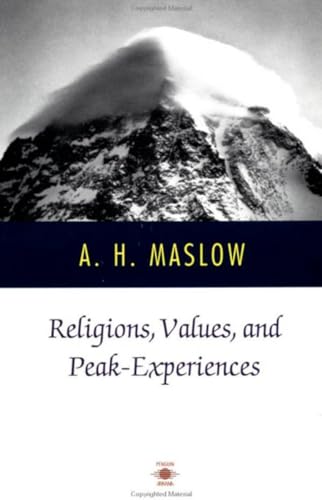

Religions, values, and peak-experiences by Abraham H. Maslow.
Detalles de publicación: New York Penguin Arkana 1994.Descripción: xx, 123 p. 20 cmISBN:- 0140194878 (pbk.)
| Imagen de cubierta | Tipo de ítem | Biblioteca actual | Biblioteca de origen | Colección | Ubicación en estantería | Signatura topográfica | Materiales especificados | Info Vol | URL | Copia número | Estado | Notas | Fecha de vencimiento | Código de barras | Reserva de ítems | Prioridad de la cola de reserva de ejemplar | Reservas para cursos | |
|---|---|---|---|---|---|---|---|---|---|---|---|---|---|---|---|---|---|---|
| Libro | Biblioteca Encarnación Valdés Colección General bev | 201.6 M3979r 1994 (Navegar estantería(Abre debajo)) | Disponible | 80000002279530 |
Descripciones mejoradas de Syndetics:
Proposing religious experience as a legitimate subject for scientific investigation, Maslow studies the human need for spiritual expression.
Originally published: Columbus : Ohio State University Press, 1964.
Preface has c1970.
Includes bibliographical references (p. 117-123).
ch. 1. Introduction -- ch. 2. Dichotomized science and dichotomized religion -- ch. 3. "Core-religious," or "transcendent," experience -- ch. 4. Organizational dangers to trascendent experiences -- ch. 5. Hope, skepticism, and man's higher nature -- ch. 6. Science and the religious liberals and non-theists -- ch. 7. Value-free education -- ch. 8. Conclusions.
Written in the mid-1960s, this is Maslow's classic treatise on transcendent states of being and their essential value in human life. Proposing religious experience as a legitimate subject for scientific investigation, Maslow studies the human need for spiritual expression.
Notas de autor provistas por Syndetics
In its first edition, Abraham Maslow's "Toward a Psychology of Being" (1962) sold more than 100,000 copies. Like R. D. Laing, Maslow questioned the old psychoanalytic notions of being well or ill "adjusted" to the world and spoke from a broadly human base. Human nature---the inner nature of every individual which is uniquely his or her own---"seems not to be . . . necessarily evil; . . . the basic human capacities are on their face either neutral, premoral or positively good." What we call evil behavior appears most often to be a secondary reaction to frustration of this intrinsic nature." On this foundation, Maslow built an affirmation of people and people's potentialities for self-fulfillment and psychological health. He considered his "humanistic" or "Eupsychian" approach to be part of the revolution then taking place in psychology, as in other fields, toward a new view of people. He saw people as sociable, creative, and loving beings whose welfare is not in the cure of "neurosis" or other ills, but on the development of their most socially and personally constructive potentials.Maslow was born in New York City and received his B.A., M.A., and Ph.D. from the University of Wisconsin. He was chairman of the psychology department at Brandeis University in Waltham, Massachusetts. He taught for 14 years at Brooklyn College, and was the president of the American Psychological Association from 1967 to 1968. His wife Bertha helped edit his journals and last papers after his death and assisted with a memorial volume about him.
(Bowker Author Biography)