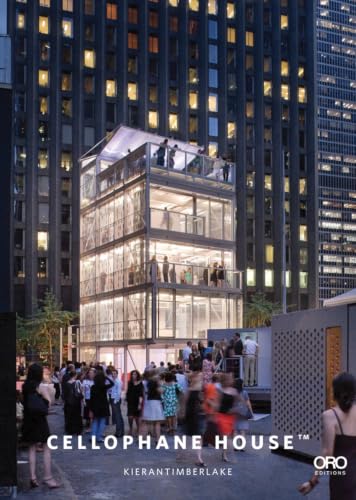

Cellophane House. Kieran Timberlake; Foreword Sandy Isenstadt; Afterword Billie Faircloth txt
Philadelphia : KieranTimberlake , 2011Edición: 1st EditionDescripción: x, 145 p. ill. ;col. ;plans. ; 21 cmTipo de contenido:- text
- unmediaded
- volume
- 9780983130130
- 0983130132
- 23 728.372
- NA737.K49 C45 2011
| Imagen de cubierta | Tipo de ítem | Biblioteca actual | Biblioteca de origen | Colección | Ubicación en estantería | Signatura topográfica | Materiales especificados | Info Vol | URL | Copia número | Estado | Notas | Fecha de vencimiento | Código de barras | Reserva de ítems | Prioridad de la cola de reserva de ejemplar | Reservas para cursos | |
|---|---|---|---|---|---|---|---|---|---|---|---|---|---|---|---|---|---|---|
| Libro | CARIBET Biblioteca Arquitectura Colección General CARIBET | General NA737.K49 C45 2011 (Navegar estantería(Abre debajo)) | 1 | Disponible | 91000000023481 |
Descripciones mejoradas de Syndetics:
CELLOPHANE HOUSE(tm) chronicles the design and execution of a five-story, off-site fabricated home assembled on-site in just sixteen days as part of The Museum of Modern Art exhibition, Home Delivery: Fabricating the Modern Dwelling. Through a series of questions, the book explores several of KieranTimberlake's ongoing research agendas including speed of on-site assembly, design for disassembly, a holistic approach to the life cycle of materials, and the development of a lightweight, high-performance, energy gathering building envelope.
Cellophane House(tm) takes a holistic approach to factory fabrication, reinventing the way a building is assembled, its materials, and spatial experience. An innovative aluminum frame enables mass-customization of the home in multiple configurations, rapid assembly, and adaptability to different sites and climates. Disassembly, rather than demolition, is inherent as an end-of-life option to successfully preserve the embodied energy in the recyclable house materials. More than a building experiment, it suggests a new way forward in an approach to mass housing.
Cellophane House(tm) has received awards from several groups: the AIA Housing Committee, the AIA Technology Committee, Boston Society of Architects, the Chicago Athenaeum Museum of Architecture and Design, AIA Philadelphia and AIA Pennsylvania Chapters.
Include index
Alpha : Back to the beginning / Stephen Kieran and James Timberlake --
Conception : Why a five-story transparent house? ; What is a parametric model? What materials are used in Cellophane House? ; How is Cellophane House held together? ; What are the benefits of the aluminum frame? ; Can other materials be used? ; How is SmartWrap made? ; How does the Cellophane House envelope perform? ; How is performance measured? --
Assembly : What is the assembly process? How was Cellophane House delivered? ; Did Cellophane House assemble as expected? ; What is a bathroom pod? ; How are the acrylic stairs made? ; How is the house illuminated? --
Exhibition --
Disassembly : How was Cellophane House removed from the site? ; What type of documentation was used for disassembly? ; How was Cellophane House packed and stored? ; Was any material wasted? ; What makes Cellophane House different from other off-site fabrications? --
Omega : Future redux / Stephen Kieran and James Timberlake ; Notes on cellophane / Billie Faircloth --
CELLOPHANE HOUSE(tm) chronicles the design and execution of a five-story, off-site fabricated home assembled on-site in just sixteen days as part of The Museum of Modern Art exhibition, Home Delivery: Fabricating the Modern Dwelling. Through a series of questions, the book explores several of KieranTimberlake's ongoing research agendas including speed of on-site assembly, design for disassembly, a holistic approach to the life cycle of materials, and the development of a lightweight, high-performance, energy gathering building envelope.
Cellophane House(tm) takes a holistic approach to factory fabrication, reinventing the way a building is assembled, its materials, and spatial experience. An innovative aluminum frame enables mass-customization of the home in multiple configurations, rapid assembly, and adaptability to different sites and climates. Disassembly, rather than demolition, is inherent as an end-of-life option to successfully preserve the embodied energy in the recyclable house materials. More than a building experiment, it suggests a new way forward in an approach to mass housing.
Cellophane House(tm) has received awards from several groups: the AIA Housing Committee, the AIA Technology Committee, Boston Society of Architects, the Chicago Athenaeum Museum of Architecture and Design, AIA Philadelphia and AIA Pennsylvania Chapters.
Notas de autor provistas por Syndetics
Stephen Kieran began his practice in Philadelphia in 1984. He teaches at the University of Pennsylvania.