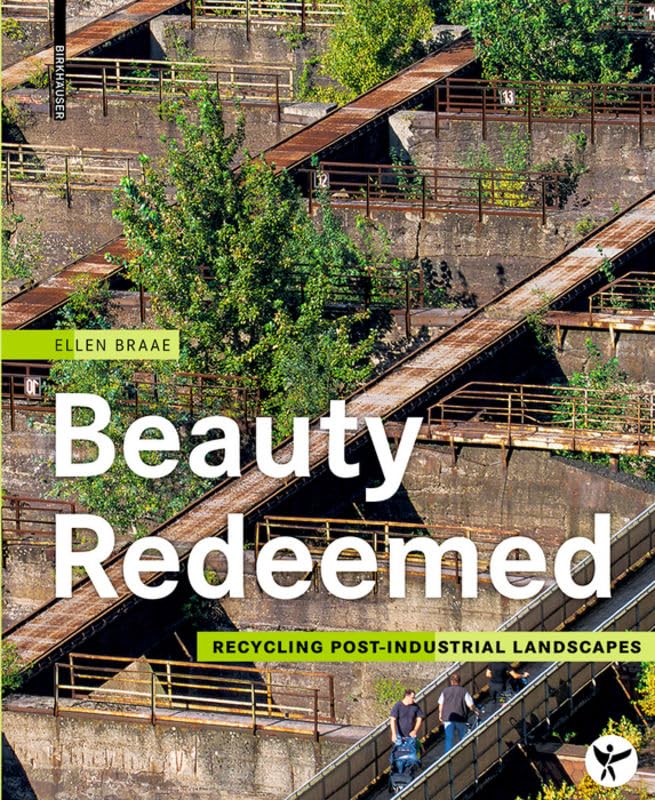

Beauty redeemed : recycling post-industrial landscapes / Ellen Braae ; editor: Lise Bek. txt
Idioma: Inglés Berlin : Ikaro Press , 2015Descripción: 335 p. illus (chiefly color) 28 cmTipo de contenido:- text
- unmediaded
- volume
- 9783035603460
- NA9053.U7 B73 2015
| Imagen de cubierta | Tipo de ítem | Biblioteca actual | Biblioteca de origen | Colección | Ubicación en estantería | Signatura topográfica | Materiales especificados | Info Vol | URL | Copia número | Estado | Notas | Fecha de vencimiento | Código de barras | Reserva de ítems | Prioridad de la cola de reserva de ejemplar | Reservas para cursos | |
|---|---|---|---|---|---|---|---|---|---|---|---|---|---|---|---|---|---|---|
| Libro | CARIBET Biblioteca Arquitectura Colección General CARIBET | General NA9053.U7 B73 2015 (Navegar estantería(Abre debajo)) | 1 | Disponible | 91000000046433 |
Descripciones mejoradas de Syndetics:
Der Umgang mit Industriebrachen ist in allen Ländern Europas und Nordamerikas ein großes Thema. Eine Art Initialzündung für deren Wiederentdeckung im großen Stil war in Deutschland die Umgestaltung eines stillgelegten Hüttenwerks ab 1990 zum Landschaftspark Duisburg Nord durch Peter Latz. Industrielle Relikte wurden dabei nicht etwa abgerissen oder überformt, sondern als integraler Teil des Gesamtkonzepts begriffen und mit neuen Nutzungen versehen. Viele weitere Projekte mit ähnlichem Ansatz sind in den letzten Jahrzehnten entstanden. Dazu zählen Parc del Clòt in Barcelona, Parque do Tejo e Trancão in Lissabon oder Michel Desvignes im Werden begriffener Parc aux Angéliques in Bordeaux.
Dieses Buch liefert jedoch nicht nur einen systematischen Handlungsrahmen für die Nachnutzung industrieller Ruinen. Es verfolgt gleichzeitig deren Geschichte: Die Autorin, Professorin für Landschaftsarchitektur an der Universität Kopenhagen, spannt einen weiten Bogen von der Ruinenromantik des 19. Jahrhunderts über den industriellen Niedergang (exemplifiziert durch Detroit) bis hin zur Wiederentdeckung der transformierten Landschaft und der Wiederentdeckung von deren Schönheit.
Includes Index.
Includes bibliographical references (p.324).
01 From industrial to post-industrial urban landscape /
Industrial landscapes as an element of post - industrial urbanisation Waves of industrialisation Factories and infrastructure Motorisation and mass production Globalisation and de - industrialisation Detroit , the 20th - century capital Phases of Fordism Standardised work routines on the assembly line The factory as a city machine Decentralised production The impact of Fordism on architecture and urban planning Post - Fordism - Toyotism De - industrialisation The collapse of Detroit Stalking Detroit The Ruhr District , a 21st - century capital New urban development patterns Growth and decline Drosscape or terrain vague
IBA Emscher Park , Germany Potteries Thinkbelt , England Fürst - Pückler - Land , Germany
02 The post-industrial landscape a new kind of cultural heritage /
The leavings of the past and site - specific aspects Industrial culture as a new field for preservation ? 70 " New Heritage ' Urbs fluxus 78 Urban mutability and the role of the landscape as a mediator The city as a single vast ecosystem The city of intermediate spaces Open spaces as inverted objects ' Dynamic enclaves and heterotopias The role of post - industrial landscapes The challenges and potentials of the new cultural heritage landscape
GR® 2013 , France Landschaftspark Duisburg - Nord , Germany Terra Nova , Germany 114
03 Landscape aesthetics and atmospheres /
From the breakdown of norms to an action - oriented interdisciplinary approach Profession and concept New departures and new formulations in the design professions Between art and science An eye for landscape Background of the concept of landscape Ritter ' s landscape Seel ' s critique of Ritter A modern - day ' landscape The return of natural beauty The Beautiful , the Sublime and the Picturesque The aesthetic experience Seel ' s aesthetic forms of experience Atmosphere Convergence between goodness and beauty ? Beauty in the perspective of sustainability
Parc del Clot , Spain Brikettfabrik Witznitz , Germany Bremerhaven Old Harbour , Germany
04 The fascination with ruins and ruinous industrial landscapes as sites of memory /
The ruin as a monument From waste to monument and the cult of ruins The inherent values of ruins looking for essence Distinguishing values A balance of forces Building a future out of ruins Fragments and processing them Reverse ruin Ruinosity and present day ruins The nature of memory Input from the theory of memory The social structure of memory The spatial anchorage of memory Places of memory and topoi Experience and perception Ruinous industrial landscapes places of memory 200 Monuments and memorial structures A matrix for preservation 202 The city as collective memory The mutability of the ' monument Dynamic anchors of memory
Parque do Tejo e Trancão , Portugal Frederiksværk , Denmark Île de Nantes , France
05 Industrial landscapes between preservation , restoration and re - use /
Industrial areas between preservation and re - use Interpretation as an artistic practice Post - production Use of spolia Spolia in 20th - century urban theory Use of spolia in post - Antiquity The potential uses of spolia transformation strategy Ideologies and practices of restoration John Ruskin - the ethicist of decay Eugène Viollet - le - Duc - optimising structural logic Carlo Scarpa one present - one past The Exners - processes ' as found ' Chipperfield and Harrap - remodelling architectural intentions Approaches to transformation Halden Zollverein , Germany Westpark Bochum , Germany Parc aux Angéliques , France
06 Design as intervention outline for a transformation theory /
Transformation as design practice and theory From theories of restoration re - use to transformation Design versus transformation Design - starting from a sheet of paper Transformation - of , on , with from the site ' Projection and production ' Intervention Constituting a ' transformation area and the object for transformation The transformation area as a monument The object of transformation as context Constituting codices Edification Détourage The open formulation of the objectives of transformation Production in time - four paradigms of transformation Data - materials , processes and immaterial aspects Data : materials Data : processes Data : immaterial Data summation Protocol - four transformation paradigms Difference transformation Continuity transformation Cultivation transformation Optimisation transformation Transformation of ruinous industrial landscapes in time
07 Beauty redeemed taking aesthetics seriously /
The experience of beauty Mind and body The spatial and cultural implications of industry Design as transformation - changing and through what already exists Design versus transformation Building up knowledge and a new form of creativity Transformation as narrative Conceptualising time in design
Coping with post-industrial sites is a pressing issue throughout Europe and North America. One point of departure for their general rediscovery was the revitalisation by Latz + Partner in the early 1990s of an abandoned steelworks as Landschaftspark Duisburg-Nord; industrial relics were not demolished but seen as integral parts of the overall concept and imbued with new meanings and uses. Many more projects with a similar approach have since been executed and this book presents a selection of the most seminal, such as Chemetoff's Île de Nantes, Parc del Clot in Barcelona, Hargreaves/PROAP's Parque do Tejo e Tranca̋o in Lisbon and Michel Desvigne's Parc aux Angéliques in Bordeaux. Beauty Redeemed offers a systematic framework for the consideration and use of post-industrial sites. The author, Professor of Landscape Design at Copenhagen University, places these 'leftovers' in their broad historical and aesthetic context, proceeding from the 19th-century Romantic fascination with ruins through present-day industrial decline as exemplified by Detroit to a renaissance of the transformed landscape. Transformation, understood as designing with the 'as found', forms the basis of this design theory; it explores design work informed by a sensibility for redeemed beauty and various concepts of relating past, present and future.--Back cover.
Notas de autor provistas por Syndetics
Ellen Marie Braae, Professorin am Department of Geosciences and Natural Resource Management, Universität Kopenhagen