Imagen de Amazon.com

Portada de Syndetics
Imagen de OpenLibrary
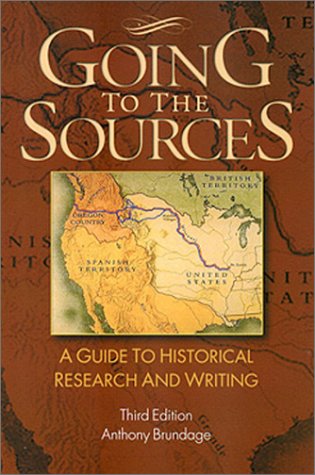
Going to the sources a guide to historical research and writing Anthony Brundage.
Detalles de publicación: Wheeling, Ill. Harlan Davidison c2002.Edición: 3rd edDescripción: xii, 107 p. ill., col. map 22 cmISBN:- 0882959697 (pbk. : alk. paper)
- 907.2 B8944g3 21
- D16 .B893 2002
| Imagen de cubierta | Tipo de ítem | Biblioteca actual | Biblioteca de origen | Colección | Ubicación en estantería | Signatura topográfica | Materiales especificados | Info Vol | URL | Copia número | Estado | Notas | Fecha de vencimiento | Código de barras | Reserva de ítems | Prioridad de la cola de reserva de ejemplar | Reservas para cursos | |
|---|---|---|---|---|---|---|---|---|---|---|---|---|---|---|---|---|---|---|
| Referencia | Biblioteca Encarnación Valdés Sala de Referencia bev | 907.2 B8944g3 (Navegar estantería(Abre debajo)) | Disponible | 80000002132408 |
Total de reservas: 0
Descripciones mejoradas de Syndetics:
Anthony Brundage has revised his popular book to render an even more detailed, practical and 'user friendly' tool for students faced with what can be a daunting task: the researching and writing of a research paper or historiographical essay. After an introductory chapter that describes the different schools of historical thought, Going to the Sources becomes a handy manual, helping the reader to identify and access the many sources -- both old and new -- available to historical researchers. Accordingly, this new edition includes a detailed discussion of electronic databases and a list of World Wide Web sites devoted to history.
Includes bibliographical references (p. 91) and index.
Tabla de contenidos provista por Syndetics
- Preface(p. XI)
- Chapter 1 The Ever-Changing Shape and Texture of the Past(p. 1)
- Static and Dynamic Concepts of History(p. 1)
- Revising Our View of the Past(p. 3)
- New Forms of Historical Consciousness(p. 4)
- Toward a "People's History"(p. 5)
- Minorities and Women Enter History(p. 6)
- The Annales School and Cliometrics(p. 8)
- Psychology and History(p. 11)
- Microhistory and Macrohistory(p. 12)
- Postmodernism(p. 12)
- A Multitude of Avenues to the Past(p. 14)
- Chapter 2 The Nature and Variety of Historical Sources(p. 16)
- Primary Sources(p. 16)
- Manuscript Sources(p. 17)
- Published Sources(p. 17)
- Secondary Works(p. 20)
- Books(p. 20)
- Essays(p. 22)
- Articles(p. 23)
- Dissertations and Conference Papers(p. 25)
- Chapter 3 Finding Your Sources: The Library Catalog and Beyond(p. 28)
- The Online Library Catalog(p. 29)
- Subject Headings, Keywords, and Title Words(p. 30)
- Creating and Using a Research Bibliograph(p. 34)
- Published Bibliographies(p. 36)
- Printed and Electronic Indexes and Abstracts(p. 37)
- Finding Scholarly Essays(p. 42)
- Other Important Databases(p. 43)
- Historical Research on the Internet(p. 44)
- Finding Useful Reference Materials(p. 46)
- Chapter 4 Exploring Changing Interpretations: The Historiographic Essay(p. 48)
- Selecting and Refining a Topic(p. 48)
- Research for a Historiographic Essay: A Case Study(p. 50)
- Writing the Historiographic Essay(p. 53)
- Alternative Approaches(p. 66)
- Chapter 5 Engaging with Primary Sources: The Research Paper(p. 68)
- Searching for a Viable Topic(p. 68)
- Finding Primary Sources(p. 69)
- Approaching Your Reading(p. 71)
- Notetaking(p. 72)
- The Outline and Structure of Your Paper(p. 75)
- Some Elements of Effective Writing(p. 76)
- An Open Mind and Intellectual Honesty(p. 79)
- Quoting(p. 80)
- Footnoting(p. 82)
- Editing and Revising(p. 84)
- One Final Look(p. 86)
- Chapter 6 Conclusion: The Open-ended Nature of History(p. 87)
- Appendix A Published Bibliographies(p. 91)
- Appendix B Major Databases for Bibliographic Searching(p. 92)
- Appendix C Footnote/Endnote Formatting(p. 93)
- Appendix D Bibliography Formatting(p. 98)
- Appendix E Commonly Used Abbreviations(p. 101)
- Suggestions for Further Reading(p. 103)
- Index(p. 105)