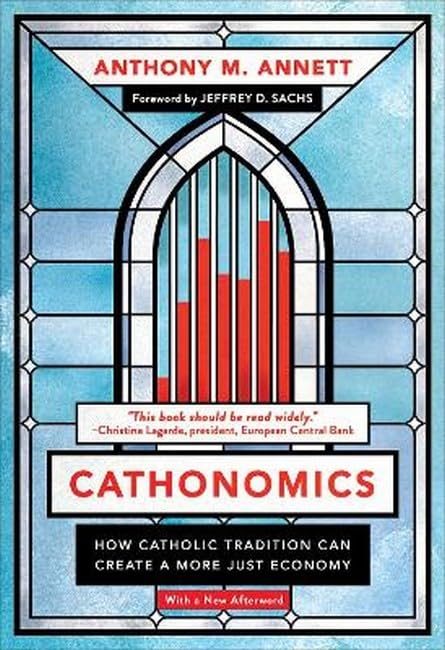

Cathonomics : how Catholic tradition can create a more just economy / Anthony M. Annett.
Editor: Washington, DC : Georgeown University Press, [2022]Descripción: xix, 319 pages : illustrations ; 24 cmTipo de contenido:- text
- unmediated
- volume
- 9781647124724
- BX1795.E27 A55 2022b
| Imagen de cubierta | Tipo de ítem | Biblioteca actual | Biblioteca de origen | Colección | Ubicación en estantería | Signatura topográfica | Materiales especificados | Info Vol | URL | Copia número | Estado | Notas | Fecha de vencimiento | Código de barras | Reserva de ítems | Prioridad de la cola de reserva de ejemplar | Reservas para cursos | |
|---|---|---|---|---|---|---|---|---|---|---|---|---|---|---|---|---|---|---|
| Libro mb | Biblioteca de Mayagüez Colección General mb | BX1795 .E27 A55 2022 (Navegar estantería(Abre debajo)) | c. 1 | Disponible | 52000003299305 |
Descripciones mejoradas de Syndetics:
Inequality is skyrocketing. In this world of vast riches, millions of people live in extreme poverty, barely surviving from day to day. All over the world, the wealthy's increasing political power is biasing policy away from the public interest and toward the financial interests of the rich. At the same time, many countries are facing financial fragility and diminished well-being. On top of it all, the global economy, driven by fossil fuels, has proven to be a collective act of self-sabotage with the poor on the front lines. In a new foreword to his book, Anthony M. Annett examines the Biden administration's economic policies and discusses reactions to Cathonomics .
A growing chorus of economists and politicians is demanding a new paradigm to create a global economy that seeks the common good. In Cathonomics , Annett unites insights in economics with those from theology, philosophy, climate science, and psychology, exposing the failures of neoliberalism while offering us a new model rooted in the wisdom of Catholic social teaching and classical ethical traditions. Drawing from the work of Pope Leo XIII, Pope Francis, Thomas Aquinas, and Aristotle, Annett applies these teachings to discuss current economic challenges, such as inequality, unemployment and underemployment, climate change, and the roles of business and finance.
Cathonomics is an ethical and practical guide for readers of all faiths and backgrounds seeking to create a world economy that is more prosperous, inclusive, and sustainable for all.
"With a new afterword"--Cover.
Includes bibliographical references (pages 291-309).
1. The Old Stuff: Where It All Comes From -- 2. The New Stuff: Modern Catholic Social Teaching -- 3. Who’s Right and Who’s Wrong: Catholic Social Teaching versus the Dominant Economic Paradigm -- 4. The Good, the Bad, and the Ugly: Practically Assessing the Global Economy -- 5. Who Does What? The Roles of Government, Business, and Labor -- 6. Inequality: The Root of Social Ills -- 7. Care for Our Common Home -- 8. Expanding Our Circles: The Global Dimension -- Conclusion -- Bibliography.
"A growing chorus is demanding a new economic paradigm. This callis coming in response to a toxic cocktail of economic and social dissatisfaction-the long arm of the global financial crisis, skyrocketing inequality, the disappearance of good jobs, corporate profit-seeking disconnected from the common good, and the rapidly-advancing destruction of the environment. The cry for change is coming both in the field of economics and on the political stage. And this chorus will only grow stronger in the wake of the COVID19 pandemic. The goalof this book is to offer a rigorous and reasoned moral response to these contemporary challenges. It is an interdisciplin uniting insights in economics with those from theology, philosophy, climate science, and psychology. Its primary thesis is that the field of neoclassical economics is built on a set of assumptions that are both anthropologically erroneous and dangerous. They have led to the rise of neoliberalism and its many dysfunctions. The book argues that an alternative, and far healthier, paradigm exists-that of Catholic social teaching, especially as drawn out in the social encyclicals from PopeLeo XIII to Pope Francis. The book then applies the teachings of Pope Francis to discuss leading economic challenges, such as inequality, employment, climate change, the roles of business and finance. This book is unique is that it makes a popular case for Catholic social teaching largely from the point of view of economics"-- Provided by publisher.
Tabla de contenidos provista por Syndetics
- Foreword(ix)
- Preface(xiii)
- 1 The Old Stuff: Where It All Comes From(1)
- 2 The New Stuff: Modern Catholic Social Teaching(30)
- 3 Who's Right and Who's Wrong? Catholic Social Teaching versus the Dominant Economic Paradigm(67)
- 4 The Good, the Bad, and the Ugly: Practically Assessing the Global Economy(102)
- 5 Who Does What? The Roles of Government, Business, and Labor(138)
- 6 Inequality: The Root of Social Ills(179)
- 7 Care for Our Common Home(217)
- 8 Expanding Our Circles: The Global Dimension(249)
- Conclusion(276)
- Afterword(286)
- Bibliography(291)
- Index(311)
- About the Author(319)