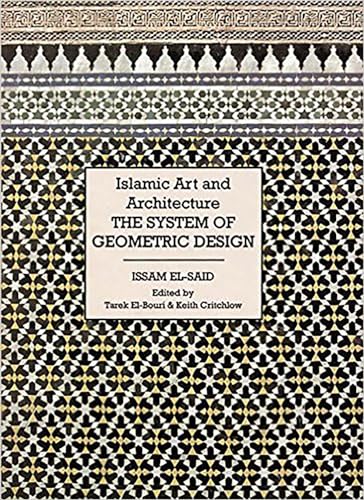
Imagen de portada de Amazon
Imagen de Amazon.com
Imagen de cubierta Syndetics
Portada de Syndetics
Imagen de OpenLibrary

Islamic art and architecture : the system of geometric design. / Issam El-Said ; edited by Tarek El-Bouri & Keith Critchlow ; general editor, Salma Samar Damluji. txt

Por: Colaborador(es): Idioma: Español United Kingdom : Garnet , 1993Edición: First EditionDescripción: 135 p. ill. (some col.) ; 34 cmTipo de contenido:
  • text
Tipo de medio:
  • unmediaded
Tipo de soporte:
  • volume
ISBN:
  • 9781873938454
Otro título:
  • System of geometric design
Tema(s): Clasificación LoC:
  • N6260 E4 1993
Contenidos:
Contents: Preface 6 -- Foreword 8 -- Editors’ Introduction 10 -- I. Geometric Patterns in Islamic Art -- Introduction 14 -- Geometric Patterns based on the Square Repeat Unit and the Root Two Systems of Proportion -- The construction of the square repeat unit and the division of the circle into four, or multiples of four, equal parts 16 -- Determining the size of the square repeat unit 17 -- The grid patterns that underlie the root two system of proportion 19 -- Expressing the grid patterns in terms of a selected square module 20 -- Generating the grid patterns using numbers 22 -- Mathematical or numerical rationalization of the root two system of proportion 24 -- Graphical analyses of geometric patterns based on the root two system of proportion 30 -- Geometric Patterns based on the Hexagonal Repeat Unit and the Root Three System of Proportion -- The construction of the hexagonal repeat unit and the division of the circle into three, or multiples of three, equal parts 56 -- Determining the size of the hexagonal repeat unit 58 -- The gird-patterns that underlie the root three system of proportion and their measure 60 -- Mathematical or numerical rationalization of the root three system of proportion 66 -- Graphical analyses of geometric patterns based on the root three system of proportion 69 -- Geometric Patterns based on the Double Hexagon System of Proportion -- The grid patterns that underlie the double hexagon system of proportion 88 -- Graphical analyses of geometric patterns based on the double hexagon system of proportion 89 -- Notes 113 -- II Man and Measure -- Historical Background 116 -- Numerals and Arithmetic 117 -- Measuring and Dividing Dimensions -- a. Using the Circle 121 -- b. Using Square 124 -- Geometry and Irrational Numbers 128 -- The Remen and the Royal Cubit 130 -- The Grid Pattern 132 -- Notes 133 -- Bibliography 134 -- Index 135 --
Valoración
    Valoración media: 0.0 (0 votos)
Existencias
Imagen de cubierta Tipo de ítem Biblioteca actual Biblioteca de origen Colección Ubicación en estantería Signatura topográfica Materiales especificados Info Vol URL Copia número Estado Notas Fecha de vencimiento Código de barras Reserva de ítems Prioridad de la cola de reserva de ejemplar Reservas para cursos
Libro CARIBET Biblioteca Arquitectura Colección General CARIBET General N6260 E4 1993 (Navegar estantería(Abre debajo)) 1 Disponible 91000000018051
Total de reservas: 0

Descripciones mejoradas de Syndetics:

Issam El-Said pinpoints the rules of composition that form the basis of the geometric concepts of Islamic art. He then shows how intricate patterns are based on these basic principles. Fully illustrated in three colors to show the development of the patterns, this book offers an insight into how craftsmen and designers in the Muslim world achieved monumental feats of artistic expression using the simplest of tools. Chapter I presents graphical analyses of numerous complex patterns, to reveal the numerical rationale behind them. In Chapter II, the author analyses the system of measure used in ancient Egypt, before the use of numbers for calculating measurements. He shows how measuring cords and a geometric method based on a grid-pattern originating from the circle were employed by master craftsmen in the design of Islamic art and architecture. The book offers an insight into how craftsmen and designers in the Muslim world have achieved monumental feats of artistic expression with harmony and precision, using the simplest of tools such as a ruler, a string and templates, together with a system of measure that is both simple and sophisticated.

Index

Includes bibliographical references (p. 134) and index.

Contents:
Preface 6 --
Foreword 8 --
Editors’ Introduction 10 --
I. Geometric Patterns in Islamic Art --
Introduction 14 --
Geometric Patterns based on the Square Repeat Unit and the Root Two Systems of Proportion --
The construction of the square repeat unit and the division of the circle into four, or multiples of four, equal parts 16 --
Determining the size of the square repeat unit 17 --
The grid patterns that underlie the root two system of proportion 19 --
Expressing the grid patterns in terms of a selected square module 20 --
Generating the grid patterns using numbers 22 --
Mathematical or numerical rationalization of the root two system of proportion 24 --
Graphical analyses of geometric patterns based on the root two system of proportion 30 --
Geometric Patterns based on the Hexagonal Repeat Unit and the Root Three System of Proportion --
The construction of the hexagonal repeat unit and the division of the circle into three, or multiples of three, equal parts 56 --
Determining the size of the hexagonal repeat unit 58 --
The gird-patterns that underlie the root three system of proportion and their measure 60 --
Mathematical or numerical rationalization of the root three system of proportion 66 --
Graphical analyses of geometric patterns based on the root three system of proportion 69 --
Geometric Patterns based on the Double Hexagon System of Proportion --
The grid patterns that underlie the double hexagon system of proportion 88 --
Graphical analyses of geometric patterns based on the double hexagon system of proportion 89 --
Notes 113 --
II Man and Measure --
Historical Background 116 --
Numerals and Arithmetic 117 --
Measuring and Dividing Dimensions --
a. Using the Circle 121 --
b. Using Square 124 --
Geometry and Irrational Numbers 128 --
The Remen and the Royal Cubit 130 --
The Grid Pattern 132 --
Notes 133 --
Bibliography 134 --
Index 135 --

Paul & Co., Jun/06/1995.

Reseñas proporcionadas por Syndetics

CHOICE Review

This is a study of the basic methods and procedures of the geometrical system of design in Islamic art. Drawings and calculations demonstrate the ways to generate geometric patterns that are based on the square and hexagonal repeat units and their root systems of proportion. The study proposes to illustrate the thesis that the use of geometric patterns gives Islamic art one of its chief characteristics. However, it falls short of its objective: no analytical interpretation of the patterns in their historical or artistic context is offered. There is a brief chapter on the history of geometric patterns in ancient Mesopotamia and Egypt, but it is not satisfactory. This is a book for artists and designers who are interested in the subject. The book consists of two chapters of a dissertation by El-Said, who died before completing it; the chapters were reworked by El-Bouri and Critchlow. Critchlow is a well-known exponent of the esoteric philosophical values of the self-evident mathematical patterns in Islamic art. His Islamic Patterns: An Analytical and Cosmological Approach (1976) is a more satisfactory work on this subject. Graduate; professional. U. U. Bates; Hunter College, CUNY

Notas de autor provistas por Syndetics

Issam El-Said (1938-1988) was an Iraqi artist and scholar. He earned an Architecture degree from Corpus Christi College, Cambridge in 1961; studied art at Hammersmith College of Art and Design, London and prepared for a PhD on the Methodology of Geometric Proportioning in Islamic Architecture at the University of Newcastle-upon-Tyne in 1988, which was sadly not completed due to his untimely death that year. As an artist, he achieved great renown and his works are in private and public collections worldwide including the British Museum, the Victoria and Albert Museum and the National Museums in Baghdad and Amman.
Compartir
logopucpr-y-vive

Contáctanos

¡Queremos saber de ti!

Tel. 787.841.2000 Ext. 1801

bibliotecavaldes@pucpr.edu

⁣Búscanos en las redes

© 2026 Desarrollado por Ignite Online • All Rights Reserved • Powered by Koha.