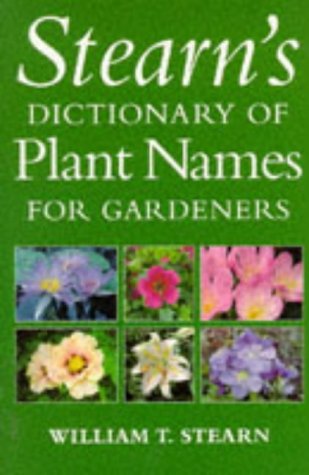
Imagen de portada de Amazon
Imagen de Amazon.com
Imagen de cubierta Syndetics
Portada de Syndetics
Imagen de OpenLibrary

Stearn's dictionary of plant names for gardeners a handbppk on the origin and meaning of the botanical names some cultiuvated plants William T. Stearn.

Por: Colaborador(es): Detalles de publicación: London Cassell New York, NY Distributed in the U.S. by Sterling Pub. Co. 1996.Edición: [Paperback ed., reprinted with emendations.]Descripción: 363 p. illISBN:
  • 0304347825
Tema(s):
Valoración
    Valoración media: 0.0 (0 votos)
Existencias
Imagen de cubierta Tipo de ítem Biblioteca actual Biblioteca de origen Colección Ubicación en estantería Signatura topográfica Materiales especificados Info Vol URL Copia número Estado Notas Fecha de vencimiento Código de barras Reserva de ítems Prioridad de la cola de reserva de ejemplar Reservas para cursos
Referencia Biblioteca Mons. Iñaki Mallona (Arecibo) Sala de Referencia ab 581.03 S839s (Navegar estantería(Abre debajo)) Disponible 80000001950628
Total de reservas: 0

Descripciones mejoradas de Syndetics:

An erudite and entertaining compendium of the meaning and origin of botanical names. An example: nasturtium comes from the Latin for "twisted nose," due to its pungent taste. Also lists some 3,000 of the most widely accepted vernacular names, cross-indexed to the botanical appeliation. This revision and enlargement of Stearn's A Gardener's Dictionary of Plant Names (1972) offers discussions of plant classification, binomial nomenclature, and the structure and pronunciation of botanical Latin. Not illustrated. Annotation copyright by Book News, Inc., Portland, OR

"This is a revised edition of a Gardener's dictionary of plant names, revised and enlarged in the 1972 by william T. Stearn from A. W. Smith's A Gardener'sbook of plant names, 1963."--T.p. verso.

Includes bibliographical references (p. 330-332)

Reseñas proporcionadas por Syndetics

Library Journal Review

This volume updates and expands the 1972 Gardener's Dictionary of Plant Names by the same author, which in turn updated A.W. Smith's Gardener's Book of Plant Names (1963). You may want to keep the earlier volumes for their pronunciation guides, but definitely buy the new volume for its inclusion of 6000 botanical names, with definitions and derivations, plus 3000 common names, cross-referenced to their botanical names. This is indisputably the best dictionary of plant names available and is essential for botanical and horticultural libraries. Public libraries on a tight budget that already own Allen Coombes's Dictionary of Plant Names (Timber Pr., 1985) would be safe to pass; others may want to add it for its excellent chapter explaining how plants are named and why plant names change.-- Laura Lipton, Miller Horticulture Lib., Seattle (c) Copyright 2010. Library Journals LLC, a wholly owned subsidiary of Media Source, Inc. No redistribution permitted.

Booklist Review

Technical terminology can be intimidating to the novice and expert alike. These two publications, one a glossary and the other an extensive dictionary, are designed to minimize intimidation for two differing audiences. Originally published in Britain, they are also of interest to North American readers. Gardener's ABC is a good ready-reference glossary for the person learning the words and phrases used by gardeners and garden designers and for the experienced gardener who may not know the specific definitions of many commonly known terms, such as humus, layering, and slugs. Kelly's book is very browsable, entertaining, and informative. It is punctuated with occasional pertinent illustrations and has charming gardening capital-letter section headings. The language and perspective are British. Stearn's Dictionary of Plant Names for Gardeners is a technical dictionary of more than 6,000 terms and includes more than just plant names. There are Greek and Latin botanical terms and derivations. Of particular interest are the entries for persons (usually botanists) whose names are honored and latinized in plant nomenclature. The essays, "An Introduction to Botanical Names" and "An Introduction to Vernacular Names," the bibliography, and the 31-page list of common names with their botanical equivalents are added value in this work. Stearn states in his introduction that there was much revision and correction done on the precursor from which this book derived. We found one small error. Banksia, named in honor of Joseph Banks, is not an Australian honeysuckle but a group of shrubs. Because of the emphasis on specific plant names, there are more entries than in other small botanical dictionaries, such as Michael Allaby's Concise Oxford Dictionary of Botany (1992), though the definitions of many botanical terms are longer than in Allaby. With its concise definitions, Stearn's Dictionary is an especially useful companion to the reader of botanical literature. Gardener's ABC will find its way into more personal libraries than public or academic ones. Stearn's Dictionary of Plant Names for Gardeners is a suitable reference source for public, academic, and natural history libraries. Both are reasonably priced, easy to use, and recommended.
Compartir
logopucpr-y-vive

Contáctanos

¡Queremos saber de ti!

Tel. 787.841.2000 Ext. 1801

bibliotecavaldes@pucpr.edu

⁣Búscanos en las redes

© 2026 Desarrollado por Ignite Online • All Rights Reserved • Powered by Koha.