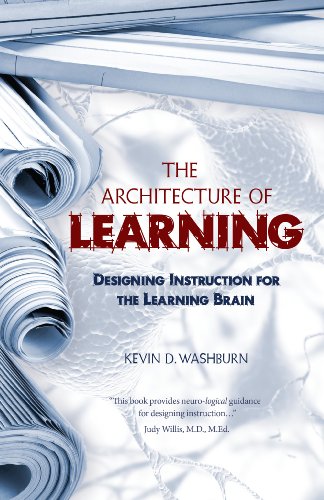

The Architecture of Learning : designing instruction for the learning brain. / Kevin D. Washburn. txt
Idioma: Inglés United States : Clerestory Press , 2010Edición: 1st edDescripción: viii, 286 p. ill. ; 22 cmTipo de contenido:- text
- unmediaded
- volume
- 9780984345908
- 370.15 22
- LB1060 W37 2010
| Imagen de cubierta | Tipo de ítem | Biblioteca actual | Biblioteca de origen | Colección | Ubicación en estantería | Signatura topográfica | Materiales especificados | Info Vol | URL | Copia número | Estado | Notas | Fecha de vencimiento | Código de barras | Reserva de ítems | Prioridad de la cola de reserva de ejemplar | Reservas para cursos | |
|---|---|---|---|---|---|---|---|---|---|---|---|---|---|---|---|---|---|---|
| Libro | CARIBET Biblioteca Arquitectura Colección General CARIBET | General LB1060 W37 2010 (Navegar estantería(Abre debajo)) | 1 | Disponible | 91000000046086 |
Descripciones mejoradas de Syndetics:
Become an Architect of Learning! (blueprints included). The brain constructs new learning, sorting and labeling new data, comparing it with prior experience, and using resulting understandings to interact with the environment. Written for teachers, educational leaders, and instructional designers, this guide presents tools for developing teaching that engages the student thinking needed to construct learning. With applied research from neuroscience and cognitive psychology, The Architecture of Learning introduces a series of blueprints that strategically direct a teacher s thinking and planning. The resulting instruction capitalizes on the brain s penchant for patterns and moves students from recognizing a reference point for constructing new understanding to using new learning to think about and act on the real world. The Architecture of Learning addresses: Understanding how students learn, building blocks of learning, subject matter types and focus processes of learning, aligning learning, teaching, and assessment, critical and creative thinking in teaching and learning, evaluating and revising instruction
Index
Bibliography
Contents:
Introduction: THE FOUNDATION --
Defining teacher and designing instruction 1 --
An author’s note 5 --
1 BUILDING BLOCKS :
Understanding how students learn 7 --
Learning’s building blocks 8 --
Experience 8 --
Comprehension 10 --
Elaboration 13 --
Application and intention 23 --
2 POWER TOOLS :
Learning’s four core processes 29 --
Experience: transforming raw data into reference points 29 --
Comprehension: transforming data into knowledge 31 --
Elaboration: transforming knowledge into understanding 34 --
Application: transforming knowledge into utility 27 --
Emotion: the propeller that drives learning 40 --
3 SUBJECT MATTER TYPES 1 :
Designing SKILL instruction 51 --
Discerning the difference: skills 52 --
Blueprint structure 59 --
Designing skill instruction: an example 61 --
Blueprint “rhythm” and flow 84 --
4 SUBJECT MATTER TYPES 2 :
Designing CONTENT instruction 87 --
Discerning the difference: content 87 --
The content blueprint 96 --
Blueprint “Rhythm” and flow 120 --
5 SUBJECT MATTER TYPES 3 :
Designing COMBINATION instruction 123 --
Discerning the difference: combination 124 --
Blueprint “Rhythm” and flow 150 --
Blueprints and curriculum 154 --
6 CREATING COHERENCE :
Aligning learning, teaching, and assessment 157 --
Assessment for learning: instructive feedback 159 --
Based on learning, revealed by teaching 163 --
Critical intersection EX-ex: the reference point 165 --
Critical intersection CO-co: the knowledge component 165 --
Critical intersection EL-el: the understanding component 167 --
Critical intersection AP-ap and IN-ap:
The utilization and integration components 169 --
Assessment of learning: summative assessment 171 --
Assessment for and of learning: rubrics and instructive feedback 174 --
7 MINDING THE INTERIOR :
Engaging thought to construct understanding 185 --
Thinking to learn; learning to think 186 --
Critical thinking and education 188 --
Critical thinking’s building blocks 191 --
Implications for learning 206 --
Level 1: Guiding critical thinking questions 208 --
Level 2: Designing direct critical thinking instruction 212 --
Level 3: Critical thinking through the strands 217 --
Level 4: Critical thinking as the Intention strand 218 -
Conclusion 222 --
8 EXPANDING THE VIEW :
Using creativity to complement learning 225 --
“Music o’er a frozen moat” 225 --
Creativity’s mysterious middle stage 228 --
Creativity’s connection to learning 231 --
Education and creativity 235 --
Creative learning 236 --
Creative teaching 239 --
Conclusion 243 --
9 ASSESSING THE STRUCTURE :
Evaluating and revising instruction 247 --
Revision tools 247 --
Accepting responsibility 257 --
Conclusion 259 --
Afterword: what about technology? 263 --
Notes 269 --
Index 279 --
The brain constructs new learning, sorting and labeling new data, comparing it with prior experience, and using resulting understandings to interact with the environment. Written for teachers, educational leaders, and instructional designers, this guide presents tools for developing teaching that engages the student thinking needed to construct learning. With applied research from neuroscience and cognitive psychology, The Architecture of Learning introduces a series of blueprints that strategically direct a teacher s thinking and planning. The resulting instruction capitalizes on the brain s penchant for patterns and moves students from recognizing a reference point for constructing new understanding to using new learning to think about and act on the real world. The Architecture of Learning addresses: Understanding how students learn, building blocks of learning, subject matter types and focus processes of learning, aligning learning, teaching, and assessment, critical and creative thinking in teaching and learning, and evaluating and revising instruction --