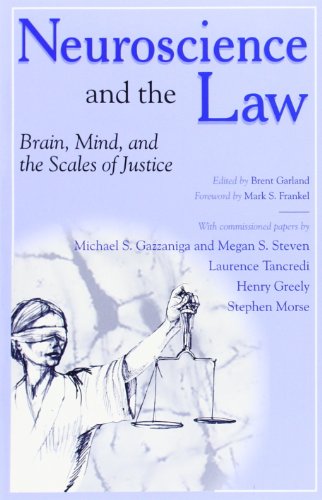
Imagen de portada de Amazon
Imagen de Amazon.com
Imagen de cubierta Syndetics
Portada de Syndetics
Imagen de OpenLibrary

Neuroscience and the law brain, mind, and the scales of justice edited by Brent Garland.

Colaborador(es): Detalles de publicación: New York Dana Press Washington, D.C. AAAS c2004.Descripción: xi, 229 p. ill. 22 cmISBN:
  • 1932594043 (pbk.)
Tema(s): Clasificación CDD:
  • 153 N4948 22
Clasificación LoC:
  • KF2910.N45 N48 2004
Contenidos:
Framing the issues -- Monitoring and imaging the brain -- Modifying the brain -- Crosscutting legal issues -- Future directions -- Free will in the Twenty-first Century : a discussion of neuroscience and the law / by Michael S. Gazzaniga and Megan S. Steven -- Neuroscience developments and the law / by Laurence R. Tancredi -- Prediction, litigation, privacy, and property : some possible legal and social implications of advances in neuroscience / by Henry T. Greely -- New neuroscience, old problems / by Stephen J. Morse.
Valoración
    Valoración media: 0.0 (0 votos)
Existencias
Imagen de cubierta Tipo de ítem Biblioteca actual Biblioteca de origen Colección Ubicación en estantería Signatura topográfica Materiales especificados Info Vol URL Copia número Estado Notas Fecha de vencimiento Código de barras Reserva de ítems Prioridad de la cola de reserva de ejemplar Reservas para cursos
Libro Biblioteca Encarnación Valdés Colección General bev 153 N4948 (Navegar estantería(Abre debajo)) Disponible 80000002439464
Total de reservas: 0

Descripciones mejoradas de Syndetics:

How can discoveries in neuroscience influence America's criminal justice system? Neuroscience and the Law examines the growing involvement of neuroscience in legal proceedings and considers how scientific advances challenge our existing concepts of justice. Based on an invitational meeting convened by the Dana Foundation and the American Association for the Advancement of Science, the book opens with the deliberations of the twenty-six scientists and legal scholars who attended the conference and concludes with the commissioned papers of four distinguished scholars in law and brain research.

Contributors:
Michael S. Gazzaniga
Henry T. Greeley
Laurence Tancredi
Stephen Morse

Includes bibliographical references and index.

"A report on an invitational meeting convened by the American Association for the Advancement of Science and the Dana Foundation."

Framing the issues -- Monitoring and imaging the brain -- Modifying the brain -- Crosscutting legal issues -- Future directions -- Free will in the Twenty-first Century : a discussion of neuroscience and the law / by Michael S. Gazzaniga and Megan S. Steven -- Neuroscience developments and the law / by Laurence R. Tancredi -- Prediction, litigation, privacy, and property : some possible legal and social implications of advances in neuroscience / by Henry T. Greely -- New neuroscience, old problems / by Stephen J. Morse.

Extracto provisto por Syndetics

From Chapter 1Framing the IssuesNeuroscience really, over the last 30 years, has just blossomed at every point, and each year brings a greater understanding of the mechanical way with which we perceive, we remember, we speak, we feel . . . It is that sense of understanding the brain that really brings us heretoday with force, and that [sense of understanding] is the one that we have to come to grips with.--Participant scientist at the meetingIt has been 14 years since President George H. W. Bush proclaimed the 1990s to be the Decade of the Brain, and now, in the new millennium, knowledge and applications resulting from increased emphasis on brain science are beginning to emerge. While advances in neuroscience continue at a rapid rate, their ethical and legal implications are only beginning to be considered. A recent article in the Economist made the point that the link between brain and behavior is much closer than the link between genes and behavior, yet the public debate about genetics research and its broad social implications far outweighs that given to neuroscience and technology.Even at the level of a "first glance," neuroscience raises numerous issues with respect to some of the core constructs of the law, such as competency, free will, and the genesis of violent behavior. For example, the discovery of a neurological predisposition to violence would pose a host of controversial questions, including whether "preemptive" treatment is desirable, whether we might "mark" the person for increased surveillance by authorities, whether there would be an increased risk for discrimination against such a person, and whether substantial changes might occur in how society approaches the punishment and rehabilitation of criminals.The question of how developments in neuroscience might interact with the law led AAAS and the Dana Foundation to convene a meeting with members drawn from both the legal and neuroscience communities. For a day and a half, lawyers, judges, law professors, philosophers, psychologists, psychiatrists, and neuroscientists engaged in a conversation focused on the relationship between neuroscience and law and sought to contribute to the larger public discourse by identifying some central issues and suggesting directions for future efforts.The 27 meeting participants discussed a broad range of topics, informed in part by the four commissioned papers that make up Part II of this book. Here, in Part I, we distill the key ideas and concerns that arose from the discussion. Each participant from neuroscience or the law entered the conversation as an expert in his or her own discipline. The group's task was to compare concerns in both fields, identify issues of interest, and begin to develop a way of thinking about them. This report does not attempt to pronounce a definitive set of findings in an area that is in great flux, but is instead an account of the issues and considerations that focused the meeting's firepower during the hours of discussion, along with some suggestions for further consideration.The four papers anchoring the dialogue and reprinted in Part II were written by three neuroscientists and two legal scholars, prominent in their respective fields. In "Free Will in the Twenty-first Century: A Discussion of Neuroscience and the Law," coauthors Michael Gazzaniga and Megan Steven present the philosophical arguments and neuroscientific findings addressing free will and legal responsibility. "Neuroscience Developments and the Law," by Laurence Tancredi, focuses primarily on issues of cognition and looks in detail at issues of competency, brain death, cognitive enhancement, and lie detection. "Prediction, Litigation, Privacy, and Property: Some Possible Legal and Social Implications of Advances in Neuroscience," by Henry Greely addresses the prediction of behavior, privacy concerns, patent and intellectual property issues, and uses of neuroscience in litigation. "New Neuroscience, Old Problems," by Stephen Morse examines a variety of issues, including free will and responsibility, the desirability and permissibility of enhancements of cognitive abilities that are within the normal range, informed consent, and the development of legal doctrine generally, and concludes with a brief examination of the admissibility of new neuroscientific evidence.The first problem in assessing the weight of neuroscience discoveries on the scales of justice is to answer the question of how to approach the relevant issues. A few fundamental points need to be considered.First, is neuroscience likely to actually impact the law? Developments in neuroscience may well have substantial impact on how the law views people and behavior, but the legal system should be able to assimilate and use even revolutionary science without upending its own fundamental structure. The legal system is generally robust and has withstood civil war, social strife, and a variety of other substantial challenges to existing law and legal assumptions. Therefore, the focus should be on a realistic assessment of the advances in neuroscience and their potential for good or ill effects in law, with less concern about paradigm-altering discoveries. (Also considered at the meeting, though to a much lesser extent, was how the law might impact neuroscience, which is briefly addressed in the report as well.)Second, how far ahead is it reasonable to look in trying to foresee discoveries and their legal implications? Much of the science is still in its nascent stages. A few areas are more fully developed and are more immediately relevant, and those areas are noted later in this report.Finally, given the breadth of topics addressed by both neuroscience and the law, what analytical framework for considering neuroscience developments in relation to the law might be helpful? Since neuroscience encompasses many fields (psychology, psychiatry, and psychopharmacology, among others) and addresses such far-ranging topics as how we perceive, speak, feel, and think, one of the most difficult aspects of addressing the topics is merely to find an organizing principle to discuss the science. As one participant noted, modern neuroscience provided "a host of findings, all over the place."The simplest approach is a two-prong classification. In one class are neuroscience findings and technologies related to monitoring and imaging the brain. Generally, "monitoring and imaging" includes the prediction of behavior, lie detection, and brain death, among other concepts. The other class consists of manipulations of the human brain and includes enhancement and pharmacological treatment of addiction. This distinction is the organizing principle used in this report. Additionally, from a legal perspective, a handful of general, crosscutting legal issues do not fit easily into this framework. Accordingly, they are explored separately. Excerpted from Neuroscience and the Law All rights reserved by the original copyright owners. Excerpts are provided for display purposes only and may not be reproduced, reprinted or distributed without the written permission of the publisher.
Compartir
logopucpr-y-vive

Contáctanos

¡Queremos saber de ti!

Tel. 787.841.2000 Ext. 1801

bibliotecavaldes@pucpr.edu

⁣Búscanos en las redes

© 2026 Desarrollado por Ignite Online • All Rights Reserved • Powered by Koha.