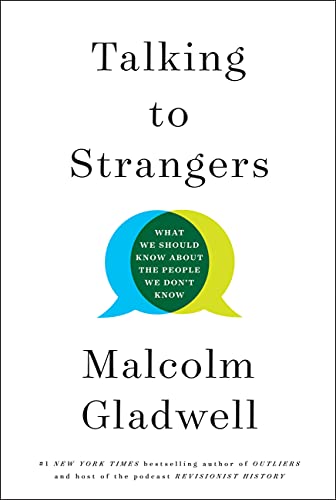

Talking to strangers : what we should know about the people we don't know / Malcolm Gladwell.
Idioma: Inglés Editor: New York, New York : Little, Brown and Company, 2019Descripción: xii, 386 pages : illustrations, maps ; 22 cmTipo de contenido:- text
- unmediated
- volume
- 9780316478526
- 0316478520
- What we should know about the people we don't know
- What we should know about the people we do not know
- 302 23
- HM1106 .G585 2019
| Imagen de cubierta | Tipo de ítem | Biblioteca actual | Biblioteca de origen | Colección | Ubicación en estantería | Signatura topográfica | Materiales especificados | Info Vol | URL | Copia número | Estado | Notas | Fecha de vencimiento | Código de barras | Reserva de ítems | Prioridad de la cola de reserva de ejemplar | Reservas para cursos | |
|---|---|---|---|---|---|---|---|---|---|---|---|---|---|---|---|---|---|---|
| Libro | Biblioteca Encarnación Valdés Colección General bev | 302 G543t (Navegar estantería(Abre debajo)) | Disponible | 80000002670175 |
Descripciones mejoradas de Syndetics:
Malcolm Gladwell, host of the podcast Revisionist History and author of the #1 New York Times bestseller Outliers , offers a powerful examination of our interactions with strangers--and why they often go wrong.
How did Fidel Castro fool the CIA for a generation? Why did Neville Chamberlain think he could trust Adolf Hitler? Why are campus sexual assaults on the rise? Do television sitcoms teach us something about the way we relate to one another that isn't true? Talking to Strangers is a classically Gladwellian intellectual adventure, a challenging and controversial excursion through history, psychology, and scandals taken straight from the news. He revisits the deceptions of Bernie Madoff, the trial of Amanda Knox, the suicide of Sylvia Plath, the Jerry Sandusky pedophilia scandal at Penn State University, and the death of Sandra Bland--throwing our understanding of these and other stories into doubt. Something is very wrong, Gladwell argues, with the tools and strategies we use to make sense of people we don't know. And because we don't know how to talk to strangers, we are inviting conflict and misunderstanding in ways that have a profound effect on our lives and our world. In his first book since his #1 bestseller David and Goliath, Malcolm Gladwell has written a gripping guidebook for troubled times.
A Best Book of the Year: The Financial Times, Bloomberg, Chicago Tribune, and Detroit Free Press
Includes bibliographical references (pages 349-379) and index.
Introduction : "Step out of the car!" -- Part I. Spies and diplomats : two puzzles. Fidel Castro's revenge ; Getting to know der Führer -- Part II. Default to truth. The queen of Cuba ; The holy fool ; Case study : The boy in the shower -- Part III. Transparency. The Friends fallacy ; A (short) explanation of the Amanda Knox case ; Case study : The fraternity party -- Part IV. Lessons. KSM : what happens when the stranger is a terrorist? -- Part V. Coupling. Sylvia Plath ; Case study : The Kansas City experiments ; Sandra Bland.
In this thoughtful treatise spurred by the 2015 death of African-American academic Sandra Bland in jail after a traffic stop, New Yorker writer Gladwell (The Tipping Point) aims to figure out the strategies people use to assess strangers-to "analyze, critique them, figure out where they came from, figure out how to fix them," in other words: to understand how to balance trust and safety. He uses a variety of examples from history and recent headlines to illustrate that people size up the motivations, emotions, and trustworthiness of those they don't know both wrongly and with misplaced confidence.
Reseñas proporcionadas por Syndetics
Library Journal Review
The prolific, best-selling Gladwell (David and Goliath; The Tipping Point) presents an intriguing analysis of what far too often goes wrong when strangers meet, diving deeply into relatively well-known controversial public incidents thoroughly covered by the mass media to cast doubt on how the general public has come to understand these events. The deceptions of Bernie Madoff, the trial of Amanda Knox, the suicide of Sylvia Plath, the Jerry Sandusky pedophilia scandal at Pennsylvania State University, and the death of Sandra Bland highlight the premise that ordinary tools and techniques used to make sense of people we don't know have failed society. The result of this failure is further conflict and misunderstanding that impact international relations and even threaten world order. Many of the examples exemplify how race, gender, age, language, country of origin, perceived threat, challenge to authority, contextual setting, and other variables can dominate impulsive behavior that shuns connections among people. VERDICT This work should stimulate further research that could serve as control for these variables and more directly link how the factor of strangeness might influence certain reactions, providing a valuable contribution to psychology and psychiatry collections in larger university libraries.--Dale Farris, Groves, TXPublishers Weekly Review
In this thoughtful treatise spurred by the 2015 death of African-American academic Sandra Bland in jail after a traffic stop, New Yorker writer Gladwell (The Tipping Point) aims to figure out the strategies people use to assess strangers-to "analyze [those strategies], critique them, figure out where they came from, figure out how to fix them," in other words: to understand how to balance trust and safety. He uses a variety of examples from history and recent headlines to illustrate that people size up the motivations, emotions, and trustworthiness of those they don't know both wrongly and with misplaced confidence. He relates, for example, the story of a whole cadre of American spies in Cuba who were carefully handpicked by American intelligence operatives, all of whom turned out to be pro-Castro double agents. Gladwell writes in his signature colorful, fluid, and accessible prose, though he occasionally fails to make fully clear the connection between a seemingly tangential topic such as suicide risk and the book's main questions. In addition to providing an analysis of human mental habits and interactions, Gladwell pleas for more thoughtful ways of behaving and advocates for people to embrace trust, rather than defaulting to distrust, and not to "blame the stranger." Readers will find this both fascinating and topical. Agent: Tina Bennett, William Morris Endeavor. (Sept.) © Copyright PWxyz, LLC. All rights reserved.Booklist Review
Like his New Yorker articles and previous books, Gladwell's newest is chock-full of gripping anecdotes from the recent and forgotten past, from Amanda Knox's overturned murder conviction to the double agents who sunk the CIA's spying efforts in 1980s Cuba. He uses these riveting stories to offer up bite-size observations about how we engage with strangers. For example, we think of ourselves as complex but of strangers as straightforward. Not so, Gladwell insists. The stranger is not easy; she is never as transparent as we believe. Gladwell's case studies are thrilling, but their relevance to everyday encounters is frequently obtuse, and the takeaways from them are often buried or provocative. Ultimately, Gladwell argues that it's essential to give strangers the benefit of the doubt, even in very different situations, such as when Penn State president Graham Spanier accepted reports of Jerry Sandusky's suspicious behavior with a minor as horseplay and when Texas state trooper Brian Encinia pulled Sandra Bland over after a minor traffic infraction. Readers may find that Gladwell's alluringly simple lesson dangerously oversimplifies power dynamics in twenty-first-century America.--Maggie Taft Copyright 2010 BooklistNotas de autor provistas por Syndetics
In 2005, Time named Malcolm Gladwell one of its 100 most influential people. He is the author of three books, each of which reached number one on the New York Times Best Seller list. They are: The Tipping Point, Blink, and Outliers. His fourth book, What the Dog Saw and Other Adventures was published in 2009.He is a is a British-born Canadian journalist and author. Gladwell was a reporter for the Washington Post from 1987 to 1996, working first as a science writer and then as New York City bureau chief. Since 1996, he has been a staff writer for The New Yorker. He graduated with a degree in history from the University of Toronto's Trinity College in 1984.
(Publisher Provided)