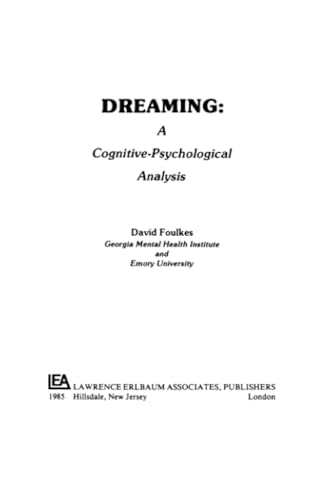
Imagen de portada de Amazon
Imagen de Amazon.com
Imagen de cubierta Syndetics
Portada de Syndetics
Imagen de OpenLibrary

Dreaming a cognitive-psychological analysis David Foulkes.

Por: Detalles de publicación: Hillsdale, N.J. L. Erlbaum Associates 1985.Descripción: viii, 221 p. 24 cmISBN:
  • 0898595533
Tema(s): Clasificación CDD:
  • 154.6/34 19
Clasificación LoC:
  • BF1078 .F618 1985
Valoración
    Valoración media: 0.0 (0 votos)
Existencias
Imagen de cubierta Tipo de ítem Biblioteca actual Biblioteca de origen Colección Ubicación en estantería Signatura topográfica Materiales especificados Info Vol URL Copia número Estado Notas Fecha de vencimiento Código de barras Reserva de ítems Prioridad de la cola de reserva de ejemplar Reservas para cursos
Libro Biblioteca Encarnación Valdés Colección General bev 154.634 F767d (Navegar estantería(Abre debajo)) Disponible 80000001072647
Total de reservas: 0

Descripciones mejoradas de Syndetics:

First published in 1985. Routledge is an imprint of Taylor & Francis, an informa company.

Includes bibliographies and indexes.

Reseñas proporcionadas por Syndetics

CHOICE Review

This work is highly recommended because it is the only book available in English to offer a theoretical model of dreaming as the development of higher thought processes. Relying on contemporary research in cognitive psychology, Foulkes discusses dreaming as an aspect of information processing, but manages to avoid the overly simplistic computer analogies offered by other theories. Instead he suggests a a developmental theory of dreaming involving consciousness development, language skills (particularly inner speech), and the ability to make mental representations. Soviet psychologist Lev Semenovich Vygotsky made essentially the same argument in 1932 in his untranslated lecture, ``The Development of Imagination in Children.'' Foulkes makes only a passing reference to Soviet psychology, which is peculiar, for such inquiry had a significant impact on American psycholinguistics, which Foulkes often cites. Foulkes too easily dismisses Freud's theory of repression, and his superficial treatment of Freud's mechanisms of dream-work is unjustified. Nevertheless, the book is a good attempt to apply contemporary cognitive psychology to the study of dreams. Recommended for upper-division undergraduates.-F. Smolucha, Moraine Valley Community College
Compartir
logopucpr-y-vive

Contáctanos

¡Queremos saber de ti!

Tel. 787.841.2000 Ext. 1801

bibliotecavaldes@pucpr.edu

⁣Búscanos en las redes

© 2026 Desarrollado por Ignite Online • All Rights Reserved • Powered by Koha.