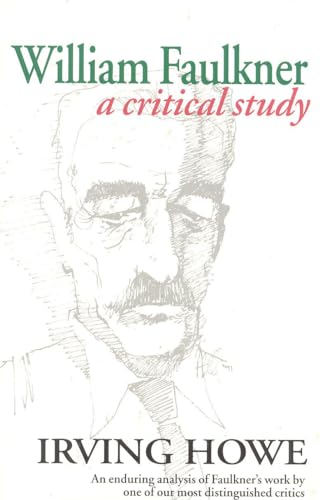

William Faulkner a critical study Irving Howe.
Detalles de publicación: New York Vintage Books 1952.Descripción: 299 pISBN:- 0929587693 (pbk. : alk. paper)
- 813/.52 20
- PS3511.A86 Z84 1952
| Imagen de cubierta | Tipo de ítem | Biblioteca actual | Biblioteca de origen | Colección | Ubicación en estantería | Signatura topográfica | Materiales especificados | Info Vol | URL | Copia número | Estado | Notas | Fecha de vencimiento | Código de barras | Reserva de ítems | Prioridad de la cola de reserva de ejemplar | Reservas para cursos | |
|---|---|---|---|---|---|---|---|---|---|---|---|---|---|---|---|---|---|---|
| Libro | Biblioteca Encarnación Valdés Colección General bev | 813 F263zhc2 (Navegar estantería(Abre debajo)) | Disponible | 80000000852437 |
Descripciones mejoradas de Syndetics:
In this fourth edition of his celebrated study of Faulkner, Irving Howe analyzes all of the great author's works, emphasizing the themes that run throughout the novels and stories. "The scheme of my book is simple," Mr. Howe writes. "First, I have tried to say what Faulkner's work is `about,' to report on the social and moral themes in his books; and then I have tried to analyze and evaluate the more important novels." Anyone who has enjoyed the special flavor of Faulkner's writing will appreciate Mr. Howe's careful analysis, and the student of twentieth-century American literature will gain new perspective and insight. Mr.Howe successfully portrays the intimate connection between Faulkner's fiction and the emotional and psychic history of the South without slighting the universality that makes him one of America's greatest writers. "Mr. Howe is a shrewd critic, and he writes of Faulkner's achievements as a practicing novelist with a wary respect. He has a good many observations to make that should help readers in going through the novels."-Alfred Kazin, New York Times .rs in going through the novels."-Alfred Kazin, New York Times .rs in going through the novels."-Alfred Kazin, New York Times .rs in going through the novels."-Alfred Kazin, New York Times .
Includes index.
Notas de autor provistas por Syndetics
Irving Howe was born in the Bronx, New York on June 11, 1920. He became a socialist at the age of 14. He graduated from City College in 1940. During World War II, he served in the Army. After the war, he began writing book reviews and essays for several magazines including Commentary, The Nation, and Partisan Review. For four years, he earned a living writing book reviews for Time magazine. He taught English at several colleges including Brandeis University, Stanford University, Hunter College, and City University, which he retired from in 1986.In 1954, he and a group of close friends founded the radical journal Dissent. He was the editor for nearly four decades. Also in the 1950's, he met a Yiddish poet named Eliezer Greenberg and the two began a long project to translate Yiddish prose and poetry into English, eventually publishing six collections of stories, essays, and poems.
He wrote several books including Decline of the New, Politics and the Novel, and an autobiography entitled A Margin of Hope. World of Our Fathers won the National Book Award in 1976. He wrote critical studies of William Faulkner and Sherwood Anderson and a biography of Leon Trotsky. He died of cardiovascular disease on May 5, 1993 at the age of 72.
(Bowker Author Biography)