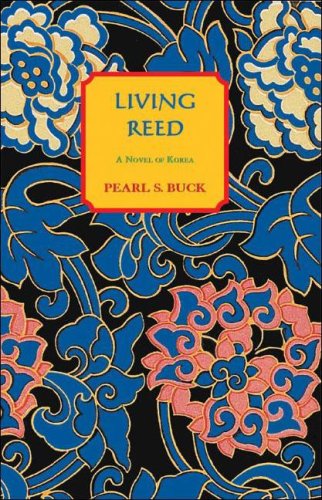

The living reed Pearl S. Buck.
Detalles de publicación: Mount Kisco, N.Y. Moyer Bell Ltd. [New York] Distributed by Rizzoli 1990.Descripción: 478 p. 21 cmISBN:- 1559210222
- 813/.52 20
- PS3503.U198 L58 1990
| Imagen de cubierta | Tipo de ítem | Biblioteca actual | Biblioteca de origen | Colección | Ubicación en estantería | Signatura topográfica | Materiales especificados | Info Vol | URL | Copia número | Estado | Notas | Fecha de vencimiento | Código de barras | Reserva de ítems | Prioridad de la cola de reserva de ejemplar | Reservas para cursos | |
|---|---|---|---|---|---|---|---|---|---|---|---|---|---|---|---|---|---|---|
| Libro | Biblioteca Encarnación Valdés Colección General bev | 813 B922l (Navegar estantería(Abre debajo)) | Disponible | 80000000834542 |
Descripciones mejoradas de Syndetics:
The Living Reed follows four generations of one family, the Kims, beginning with Il-han and his father, both advisors to the royal family in Korea. When Japan invades and the queen is killed, Il-han takes his family into hiding. In the ensuing years, he and his family take part in the secret war against the Japanese occupation. Pearl S. Buck's epic tells the history of Korea through the lives of one family. She paints an amazing portrait of the country, and makes us empathize with their struggle for sovereignty through her beautifully drawn characters.
Notas de autor provistas por Syndetics
Pearl S. Buck, June 26, 1892 - March 6, 1973 Pearl Sydenstricker Buck was an American author, best know for her novels about China. Buck was born on June 26, 1892, in Hillsboro, West Virginia, but as the daughter of Presbyterian missionaries she was taken to China in infancy. She received her early education in Shanghai, but returned to the United States to attend college, and graduated from Randolph-Macon Woman's College in Virginia in 1914. Buck became a university teacher there and married John Lossing Buck, an agricultural economist, in 1917.Buck and her husband both taught in China, and she published magazine articles about life there. Her first novel East Wind, West Wind was published in 1930. Buck achieved international success with The Good Earth, which won the Pulitzer Prize in 1932. This story of a Chinese peasant family's struggle for survival was later made into a MGM film.
Buck resigned from the Presbyterian Board of Foreign Missions after publishing an article that was critical of missionaries. She returned to the United States because of political unrest in China. Buck's novels during this period include Sons, A House Divided, and The Mother. She also wrote biographies of her father (Fighting Angel) and her mother (The Exile). She won the Nobel Prize for Literature in 1938.
During her career, Buck published over 70 books: novels, nonfiction, story collections, children's books, and translations from the Chinese. She also wrote under the pseudonym John Sedges.
In the United States, Buck was active in the civil rights and women's rights movements. In 1942 she founded the East and West Association to promote understanding between Asia and the West. In 1949, Buck established Welcome House, the first international interracial adoption agency. In 1964, she established the Pearl S. Buck foundation to sponsor support for Amerasian children who were not considered adoptable.
Pearl Buck died in Danbury, Vermont, on March 6, 1973.
(Bowker Author Biography)