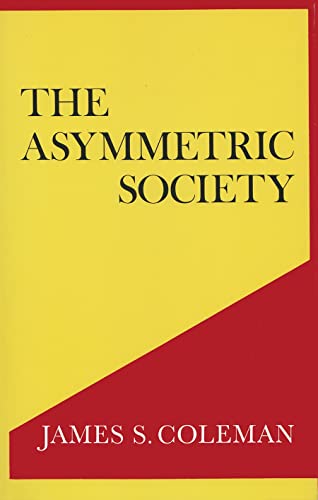

The asymmetric society James S. Coleman.
Series The Frank W. Abrams lecturesDetalles de publicación: Syracuse, N.Y. Syracuse University Press 1982.Edición: 1st edDescripción: xii, 191 p. 22 cmISBN:- 0815601727
- 0815601743 (pbk.)
- 305 19
| Imagen de cubierta | Tipo de ítem | Biblioteca actual | Biblioteca de origen | Colección | Ubicación en estantería | Signatura topográfica | Materiales especificados | Info Vol | URL | Copia número | Estado | Notas | Fecha de vencimiento | Código de barras | Reserva de ítems | Prioridad de la cola de reserva de ejemplar | Reservas para cursos | |
|---|---|---|---|---|---|---|---|---|---|---|---|---|---|---|---|---|---|---|
| Libro | Biblioteca de Derecho Mons. Fremiot Torres Oliver Colección General biblioteca derecho | HM 131 .C7419 (Navegar estantería(Abre debajo)) | Disponible | 70000000008396 |
Descripciones mejoradas de Syndetics:
Over the past hundred years changes in the structure of modern society have created an increasing asymmetry between individual persons and the corporate bodies with which they daily interact.
The rise of the e new 'corporate actors"-government, business corporations, trade unions, associations-and our coexistence with them as natural persons pose problems never before confronted. James Coleman explores the implication of our modern asymmetric society for decision involving rights and risks, child rearing and the flow of information. He examines how corporate actors come to gain their right from natural persons; how they come to
have life breathed into them; how their actions have serious economic and physical consequences for natural persons; and how reallocation of rights can be used to restrain their action .
Coleman concludes hi provocative essays with a look into the future. The modern corporate actor allow natural per on freedom unknown to our forefather but has also placed many of us in impersonal, often inhuman bureaucracies. Is the corporate actor the la t such social invention? Or i there the possibility of a more attractive future, following still further social and corporate evolution?
Includes index.
Bibliography: p. 179-183.
Notas de autor provistas por Syndetics
James S. Coleman is an American sociologist who has focused much of his work on mathematical sociology. His areas of interest have been social conflict, collective decision making, and the sociology of education. He received his Ph.D. from Columbia University in 1955 and taught at Johns Hopkins University.Coleman is best known for heading a commission charged by the federal government with investigating the lack of educational opportunities for minorities in public schools. The document produced by the commission, Equity of Educational Opportunity (1966), is better known as the Coleman Report. It indicated that student achievement has more to do with family background and peer environment than with school resources. The Coleman Report became the basis for the institution of student busing to achieve racial integration in public schools.
(Bowker Author Biography)