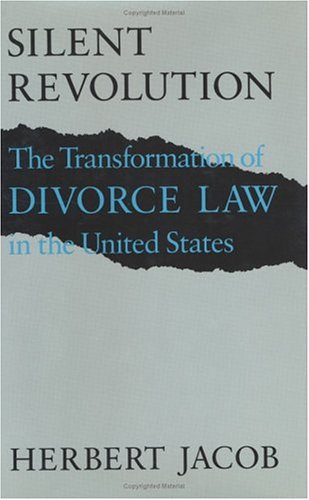

Silent revolution the transformation of divorce law in the United States Herbert Jacob.
Detalles de publicación: Chicago University of Chicago Press 1988.Descripción: x, 209 p. 23 cmISBN:- 0226389510
- KF535 .J33 1988
| Imagen de cubierta | Tipo de ítem | Biblioteca actual | Biblioteca de origen | Colección | Ubicación en estantería | Signatura topográfica | Materiales especificados | Info Vol | URL | Copia número | Estado | Notas | Fecha de vencimiento | Código de barras | Reserva de ítems | Prioridad de la cola de reserva de ejemplar | Reservas para cursos | |
|---|---|---|---|---|---|---|---|---|---|---|---|---|---|---|---|---|---|---|
| Libro | Biblioteca de Derecho Mons. Fremiot Torres Oliver Colección General biblioteca derecho | KF 535 .J33 1988 (Navegar estantería(Abre debajo)) | Disponible | 70000000390562 |
Descripciones mejoradas de Syndetics:
Conflict and controversy usually accompany major social changes in America. Such issues as civil rights, abortion, and the proposed Equal Rights Amendment provoke strong and divisive reactions, attract extensive media coverage, and generate heated legislative debate. Some theorists even claim that only mobilization and publicity can stimulate significant legislative change. How is it possible, then, that a wholesale revamping of American divorce law occurred with scarcely a whisper of controversy and without any national debate? This is the central question posed--and authoritatively answered--in Herbert Jacob's Silent Revolution.
Since 1966, divorce laws in the United States have undergone a radical transformation. No-fault divorce is now universally available. Alimony functions simply as a brief transitional payment to help a dependent spouse become independent. Most states divide assets at divorce according to a community property scheme, and, whenever possible, many courts prefer to award custody of children to the mother and the father jointly.
These changes in policy represent a profound departure from traditional American values, and yet the legislation by which they were enacted was treated as a technical correction of minor problems. No-fault divorce, for example, was a response to the increasing number of fraudulent divorce petitions. Since couples were often forced to manufacture the evidence of guilt that many states required, and since judges frequently looked the other way, legal reformers sought no more than to bring divorce statutes into line with current practice.
On the basis of such observations, Jacob formulates a new theory of routine--as opposed to conflictual--policy-making processes. Many potentially controversial policies--divorce law reforms among them--pass unnoticed in America because legislators treat them as matters of routine. Jacob's is indeed the most plausible account of the enormous number and steady flow of policy decisions made by state legislatures. It also explains why no attention was paid to the effect divorce reform would have on divorced women and their children, a subject that has become increasingly controversial and that, consequently, is not likely to be handled by the routine policy-making process in the future.
Includes index.
Bibliography: p. 177-205.
Tabla de contenidos provista por Syndetics
- Acknowledgments
- 1 Introduction: The Silent Revolution
- 2 Social Conditions and Family Change
- 3 Breaking the Logjam of Divorce Law Revision: New York
- 4 California's Bold Step
- 5 Nationalizing No-Fault Divorce: The NCCUSL
- 6 The Vagaries of Diffusion
- 7 The Transformation of Property at Divorce
- 8 What Should Happen to the Children?
- 9 The Consequences of Divorce Law Change
- 10 Routine Policy Making and Divorce Appendix
- Notes
- Index