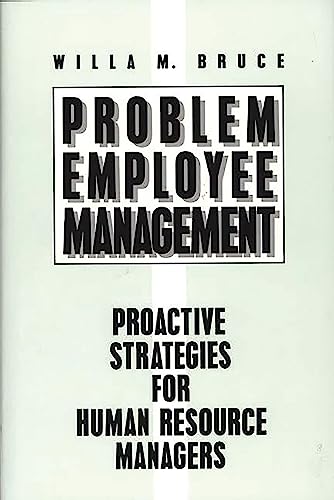

Problem employee management proactive strategies for human resource managers Willa M. Bruce.
Detalles de publicación: New York Quorum Books 1990.Descripción: ix, 212 p. ill. 24 cmISBN:- 0899305016 (lib. bdg. : alk. paper)
- 658.3/045 20
- HF5549.5.E42 B78 1990
| Imagen de cubierta | Tipo de ítem | Biblioteca actual | Biblioteca de origen | Colección | Ubicación en estantería | Signatura topográfica | Materiales especificados | Info Vol | URL | Copia número | Estado | Notas | Fecha de vencimiento | Código de barras | Reserva de ítems | Prioridad de la cola de reserva de ejemplar | Reservas para cursos | |
|---|---|---|---|---|---|---|---|---|---|---|---|---|---|---|---|---|---|---|
| Libro | Biblioteca Encarnación Valdés Colección General bev | 658.3043 B887p (Navegar estantería(Abre debajo)) | Disponible | 80000000761414 |
Descripciones mejoradas de Syndetics:
Written for human resources managers and executives, this book takes a pragmatic approach to a problem all organizations face, but is often neglected in management handbooks: what to do about the problem employee? As the author notes at the outset, problem employees constitute from ten to twenty percent of the workforce, yet usually require as much as eighty percent of a manager's time. This volume provides a practical guide on how to both reduce the numbers of problem employees in an organization and decrease the time required to manage them. Bruce calls for a proactive approach toward the problem employee and demonstrates field-tested methodologies for dealing with a variety of problem workplace behaviors. Particular emphasis is given to the techniques of Performance Monitoring, a technique based on Reality Therapy. Bruce also offers an extensive discussion of the advantages and limitations of Employee Assistance Programs and explains in detail legal issues associated with employee discharge for undesirable behavior.
The author begins by defining the problem employee and offering examples of typical problem employee response patterns. She goes on to offer a theoretical explanation of the causes of problem behavior in the workplace and demonstrates why traditional remedies generally do not improve performance. Two chapters introduce effective methods for dealing with the problem employee. Performance Monitoring is discussed in detail, as are methods for dealing with particular types of problem employees, such as substance abusers, those involved in family crises, and employees with health-related problems. Turning to situations that require outside help, Bruce provides a step-by-step procedure for both establishing an Employee Assistance Program and utilizing an existing one. Directions for training supervisors to handle problem employees are provided. Because the experience of managing a problem employee can be an extremely difficult one, Bruce provides a technique for helping the manager reduce stress, understand transition, and formulate a personal plan to survive the impact of the problem employee. Finally, Bruce explains the legal rights of the employee, the supervisor, and the organization, presents relevant court decisions, and shows the manager how to work within the law when employee discharge becomes the only option.
Includes bibliographical references and index.
Tabla de contenidos provista por Syndetics
- One Bad Apple Why Problems
- Develop Traditional Remedies and Why They Fail Performance Monitoring
- An Interpersonal Method That Does Work Other Methods for Dealing with the Problem
- Employee When the Methods Fail
- Get Outside Help Don't Become a Problem Too
- Help Yourself Legal Issues in Problem Employee Management
- Appendixes
- Index