Imagen de portada de Amazon
Imagen de Amazon.com
Imagen de cubierta Syndetics
Portada de Syndetics
Imagen de OpenLibrary

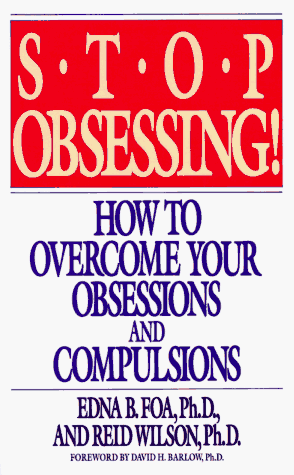
Stop obsessing! how to overcome your obsessions and compulsions Edna B. Foa, Reid Wilson.

Por: Colaborador(es): Detalles de publicación: New York Bantam Books 1992.Descripción: xvii, 247 p. 21 cmISBN:
  • 0553353500
Tema(s): Clasificación CDD:
  • 616.85/227 20
Clasificación LoC:
  • RC533 .F6 1992
Valoración
    Valoración media: 0.0 (0 votos)
Existencias
Imagen de cubierta Tipo de ítem Biblioteca actual Biblioteca de origen Colección Ubicación en estantería Signatura topográfica Materiales especificados Info Vol URL Copia número Estado Notas Fecha de vencimiento Código de barras Reserva de ítems Prioridad de la cola de reserva de ejemplar Reservas para cursos
Libro Biblioteca Encarnación Valdés Colección General bev 616.85227 F649s (Navegar estantería(Abre debajo)) Disponible 80000000362585
Total de reservas: 0

Descripciones mejoradas de Syndetics:

Regain control over your life. If you find yourself tormented by unwanted, disturbing thoughts or compelled to perform rigidly set action to reduce your stress, you may be one of the millions of Americans who suffer from obsessive-compulsive disorder (OCD). It may be as mild a doubting whether you tumed off the iron before leaving the house, or it may be as sever as disabling as washing your hands for hours each day. But whatever its degree, OCD is distressing, uncomfortable, and can disrupt your life or destroy your most important relationships. Until recently, OCD was considered to be almost untreatable using conventional forms of therapy. Now it is known to be a highly treatable disorder using behavior therapy. Drs. Foa and Wilson, internationally known authorities on the treatment of anxiety disorders, have developed a revolutionary self-help program that can help relieve crippling obsessions and compulsions. In Stop Obsessing! you will discover: A series of questionnaires to help you analyze the severity of your obsessions and compulsions. An initial self-help program to overcome milder symptoms and reduce more severe cases. The most effective way to help you let go of your obsessions and gain control over your compulsions. An intensive three-week program for anyone who spends more than two hours a day on obsessions or rituals. Expert guidance in determining whether you need the added help of a professional.Stop Obsessing! 's powerful and reliable techniques have helped thousands of patients with OCD reduce or eliminate unwanted thoughts and rituals. Today, you or someone you love can recover and lead a normal life, free of excessive fears and worries. So why wait?

920526

Includes bibliographical references (p. 235-236) and index.

Extracto provisto por Syndetics

Do You Have Obsessions or Compulsions? Most of us are familiar with how unpleasant worrying can be. Driving down the highway, heading to the beach for vacation, you think, Did I remember to unplug the iron? You reassure yourself that you did. Seconds later, though, the question returns, unabated. Did I really? Now the consequences rise to the surface of your mind. If I left it plugged in, it could overheat. It might fall on the floor and catch the rug on fire. Then the house would burn down! For minutes, no matter how hard you try, you cannot shake your uncertainty. Worries involve thoughts that produce distress and anxiety. But the specific uncomfortable thoughts involved in worrying change from one day to the next. If your boss passes you in the corridor without smiling at you, you may worry, "Maybe she's angry at me." You might even ruminate about it for several hours that day. But the next day you forget this worry and move on to another one. Obsessions, on the other hand, are relatively stable worries: The same thoughts, images, or impulses come again and again and are distressing, frightening, and often shame-producing. The individual's attempts to dismiss them are mostly unsuccessful. The content of obsessions varies from one individual to another. Some obsessions, like Fred's, are persistent worries about becoming sick. Others, like Paul's, are about neglecting one's responsibilities and thus causing harm: failing to turn off a stove burner and setting the house on fire, or forgetting to lock the house at night and having a burglar assault one's family. More severe forms of obsessions, like Robin's, are about contamination, such as contact with germs through picking up objects or touching someone. Still others involve concern about unwillingly committing violent acts, such as poisoning one's spouse or stabbing one's child. It is no surprise that most of us will seek ways to get relief from our worrying and obsessing, if only temporarily. We hope to undo the obsessions and prevent the terrible, feared consequences from occurring. Perhaps you are like some people who adopt certain behaviors or thoughts called compulsions, or rituals, to gain relief. Although such behaviors can be persistent, repetitious, unwanted, and hard to resist, they are the only way you've learned, so far, to control the worry. So each time the worries begin, you feel an urge to perform the ritual. Simply put, obsessions are thoughts or images that produce your distress; compulsions are any actions or thoughts that reduce this distress. We have illustrated this sequence in the diagram on page 5. For example, after Paul closes his front door, he begins to doubt whether he actually locked it. An unlocked door means that someone could walk in and steal the family possessions, or could be waiting to harm him or his children when returning home. To ensure his safety, he jiggles the locked doorknob four times before he walks away. Compulsions can be a simple nuisance like Paul's door checking or can be as devastating as Robin's hand washing. Other rituals include cleaning, touching, or checking objects, placing them in an exact order, and repeating actions, words, sentences, numbers, or prayers -- all meant to reduce distress. Obsessive-compulsive disorder, or OCD, is considered an anxiety disorder. This family of psychological problems includes people who experience general anxiety, phobias, and fears. In order to be diagnosed as having OCD you must have symptoms that fit the criteria of the American Psychiatric Association's Diagnostic and Statistical Manual of Mental Disorders; a mental-health professional can help you make this diagnosis. By this definition your obsessions or compulsions are severe enough to interfere with your daily social and work activities, as they do in Robin's case. For years mental-health experts have estimated that only 0.5 percent of the general population suffers from OCD. But on the basis of recent studies, this estimate has increased to about 2 percent. About five million people in the United States are now thought to suffer from OCD. Far more are thought to experience obsessive-compulsive symptoms but with less severity than those who meet the American Psychiatric Association's criteria for the disorder. The self-help techniques presented are designed to benefit you not only if you suffer from OCD, but also if you experience milder forms of compulsive rituals or if you are an excessive worrier. However, for simplicity, throughout the book all symptoms will be addressed as though they are severe enough to be diagnosed as OCD. Can Self-Help Work? Even though many people suffer from excessive worry, until recently we have not had specific programs to help the worriers of the world -- the same is true for those suffering from OCD. Most mental-health textbooks, even as late as the 1970s, described the chances for recovery from obsessive-compulsive disorder as poor. But during the last thirty years, many clinical researchers have been exploring the use of a new treatment, called cognitive-behavioral therapy, for a variety of psychological problems. Simply stated, this therapy consists of specific techniques that help people get rid of their unwanted images, thoughts, and beliefs as well as alleviate their compulsions. With the assistance of a mental-health professional, individuals identify their specific distressing thoughts and learn how to replace them with more supportive ones. They work directly on ways to stop becoming frightened by their mental images, and they learn to confront those situations they have avoided in the past. If you have OCD today, the chances are great that you can recover and lead a normal life again. With all the advances that have been made in cognitive-behavioral therapy, about 75 percent of people with severe OCD eventually return to their usual daily activities. Not all of them experience the total absence of OCD symptoms, but most feel that their lives have significantly improved after treatment and that improvement has been shown to hold over time. During cognitive-behavioral treatment, therapists guide patients through a structured, step-by-step program of practice. Over the past twenty years, therapists have reduced the time they work directly with OCD patients, while still maintaining satisfactory results. Research in England found that OCD sufferers who used written self-help instructions, with minimal professional guidance, were successful in reducing their obsessions and compulsions. We originally wrote this book to extend those efforts made in England, for we believe that many worriers and OCD sufferers can overcome their symptoms without direct assistance from a mental-health professional. Since we wrote our first edition of Stop Obsessing! in 1990, numerous research studies have confirmed that cognitive-behavioral therapy-using protocols similar to those in this book-is a highly successful treatment for obsessions and compulsions. If you experience moderate forms of obsessive worrying or compulsive behaviors, we expect that you will be able to improve by working with this book on your own. In order to benefit most from this self-help program, you might want to enlist the help of a supportive friend or family member. The decision of whether to choose the self-help program or to seek professional treatment should be based on the severity of your symptoms. If your obsessions are intense and frequent and your rituals are extensive, we advise you to seek the assistance of a mental-health professional specially trained to work with OCD. This individual can help you follow the self-help steps outlined in this book. In Chapter 3 a number of questions provided will help you decide whether to seek professional help. The Obsessive-Compulsive Inventory in the appendix will also be useful. Whether you work on your own or with a professional, you must consistently adhere to the program you select. Obsessions and compulsions are often intense and compelling, and your interventions must be just as powerful. If you practice halfheartedly or try your new skills infrequently, your chances to overcome your symptoms are slim. But if you persist daily with a well-structured program, you are likely to experience improvement within a few weeks. The most important thing for you to know at this point is that you can get better. Thousands of people have used cognitive-behavioral techniques to rid themselves of these problems. We will describe the ways you can overcome your symptoms and will guide you through the actual self-help process. We know how painful it can be for you to suffer these symptoms alone. Most people don't know anyone who openly discusses having obsessions or compulsions. Until recently, the stigma associated with being obsessive-compulsive was very strong. We wouldn't be surprised if you have not dared to discuss your problems with anyone, not even relatives or close friends. You need not suffer silently anymore. Find a supportive friend and tell him or her of your troubles. Then, take the next step beyond recognizing and admitting the nature of your problem, and start taking action to control it. This book will help you do that. It is more than hope that we extend to you here; we have mapped a road that you can take toward recovery. It is a road other sufferers have successfully followed. (Some of them will share their experiences with you in the last chapter.) Find your inner strength and then, step by step, take back control of your life. What Obsessive-Compulsive Symptoms Do You Have? On the following pages we define the seven most common types of obsessive-compulsive disorder. Read through these descriptions to see if any of them describe your symptoms. You will note that most types are labeled according to the ritual (such as checking, hoarding, or ordering). As we stated early, it is common for a person to engage in more than one type of ritual. Washers and Cleaners are consumed with obsessions about contamination by certain objects or situations. Examples are bodily secretions, germs, disease, and chemicals. To eliminate any possible contamination they will create one or more rituals, such as washing their hands excessively, taking long showers, or cleaning their house for hours. Sometimes the washing or cleaning is performed in order to prevent unwanted consequences, such as death or illness. Many times, however, it is intended to simply restore a sense of comfort. The washing and cleaning occur repetitively and vary in duration from as little as a half hour up to ten hours or more per day. The person will also go to great lengths to avoid contact with contaminants. He or she might close off certain rooms of the house or refuse to touch any household item that drops on the floor. Checkers are people who check excessively in order to prevent a certain "catastrophe" from occurring. Common concerns are checking the stove or electrical appliances to prevent fire, checking window and door locks to prevent burglary, and checking one's work to prevent mistakes and criticism. Usually such people will check an object once, then immediately doubt whether they completed the check properly, and have to check again. Some checkers remain stuck for hours in this frustrating cycle of checking, doubting, and checking again. To gain relief they sometimes require others to take responsibility for such tasks as locking the house when they go out. Repeaters are those who engage in repeating actions. Once a fearful thought comes into their mind, they feel compelled to repeat some action to keep that thought from coming true. So, like checkers, they aim to prevent or neutralize possible catastrophes. However, unlike checkers, repeaters cannot identify a logical connection between the obsession and the compulsion. In fact, a magical quality is often present in their thinking, such as the idea of preventing a spouse from dying by dressing and undressing repeatedly until the thought of the possible death stops. Orderers are people who require that things around them be arranged in certain rigid ways, including symmetrical patterns. For instance, they may require that they make the bed impeccably, without a single wrinkle. Or they might lay out their daily vitamins in a special design on the kitchen counter and rearrange that design each time they remove a pill. Orderers spend a great deal of time making sure things are in the "right place" and notice immediately when any pattern has been disrupted. Often they will become extremely upset if anyone else has rearranged their possessions. Usually orderers do not fear impending disaster. Rather, they are compelled to engage in the ritualistic action by a general sense of discomfort that arises when things are not presented "perfectly." Hoarders collect trivial objects and find it impossible to rid themselves of these possessions. A hoarder might walk the street and collect small pieces of paper, storing them at home in case he or she needs them sometime in the future. While others consider the collections to be useless, the hoarder deems them of great value. Some individuals will collect newspapers for decades in case they need a specific article. In severe cases, the person's entire house is so filled with such collections that additional space needs to be rented. Thinking Ritualizers usually enlist repetitive thoughts or images, called thinking compulsions, in order to counteract their anxiety-provoking thoughts or images, the obsessions. On the surface, thinking ritualizers may seem similar to pure obsessionals, since both have repetitive thoughts and no behavioral rituals. But the thoughts of pure obsessionals create anxiety and distress, while the thinking ritualizers have obsessions as well as thinking rituals that reduce the obsessional distress. The patterns of thinking ritualizers are similar to those of repeaters, but their focus is on repetitious ritualistic thoughts instead of behaviors. The most common rituals are praying, repeating certain words or phrases, and counting. Stewart, for example, believed that the number three would bring him bad luck and the number six was good luck. Whenever a thought that included the number three entered his mind, Stewart repeated the number six several times to prevent bad luck. Thinking ritualizers will also try to recall events in detail or repeat a mental list as a way to ensure safety. For instance, Dan, a sixty-seven-year-old, spent hours each day testing his memory by trying to remember unimportant events -- to convince himself that he was not developing Alzheimer's disease. Worriers and Pure Obsessionals experience repetitious negative thoughts that are uncontrollable and quite upsetting. However, unlike those with the other types of OCD, they do not engage in repetitious behaviors such as washing hands or checking door locks, nor do they have thinking compulsions such as praying or counting. Their worries can focus on the simplest everyday occurrences or on frightening, violent, even shameful thoughts. Common examples are dwelling on health-related problems or past traumatic events, or worrying about failing at some future task. Elise, who was mentioned in the introduction, spent hours each day worrying about losing all her savings in the market crash and being unable to educate her children. But she did not develop any compulsive behavior that could temporarily alleviate her distress. More severe examples include shameful images of inappropriate sexual behavior, or impulses to kill or hurt themselves or loved ones. For hours or sometimes days afterward the person may dwell on how these thoughts might come true. From the Trade Paperback edition. Excerpted from Stop Obsessing!: How to Overcome Your Obsessions and Compulsions by Reid Wilson, Edna B. Foa All rights reserved by the original copyright owners. Excerpts are provided for display purposes only and may not be reproduced, reprinted or distributed without the written permission of the publisher.

Notas de autor provistas por Syndetics

Edna B. Foa, Ph.D., is the predominant national figure in research with cognitive behavioral interventions for obsessive-compulsive disorder. Dr. Foa is professor of clinical psychology in the department of psychiatry, University of Pennsylvania School of Medicine, & Director of the Center for the Treatment & Study of Anxiety.

(Bowker Author Biography)

Compartir
logopucpr-y-vive

Contáctanos

¡Queremos saber de ti!

Tel. 787.841.2000 Ext. 1801

bibliotecavaldes@pucpr.edu

⁣Búscanos en las redes

© 2026 Desarrollado por Ignite Online • All Rights Reserved • Powered by Koha.