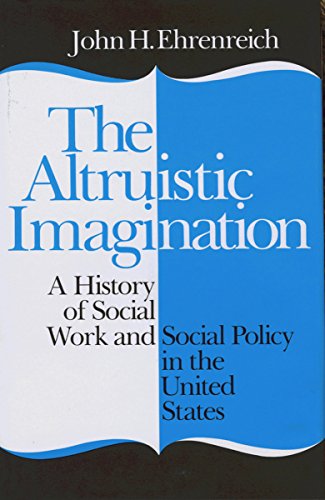

The altruistic imagination a history of social work and social policy in the United States John H. Ehrenreich.
Detalles de publicación: Ithaca Cornell University Press 1985.Descripción: 271 p. 24 cmISBN:- 0801417643 (alk. paper)
- 361.3/0973 19
- HV91 .E38 1985
| Imagen de cubierta | Tipo de ítem | Biblioteca actual | Biblioteca de origen | Colección | Ubicación en estantería | Signatura topográfica | Materiales especificados | Info Vol | URL | Copia número | Estado | Notas | Fecha de vencimiento | Código de barras | Reserva de ítems | Prioridad de la cola de reserva de ejemplar | Reservas para cursos | |
|---|---|---|---|---|---|---|---|---|---|---|---|---|---|---|---|---|---|---|
| Libro | Biblioteca Encarnación Valdés Colección General bev | 361.3 E33a (Navegar estantería(Abre debajo)) | Disponible | 80000000456494 |
Descripciones mejoradas de Syndetics:
Social work and social policy in the United States have always had a complex and troubled relationship. In The Altruistic Imagination , John H. Ehrenreich offers a critical interpretation of their intertwined histories, seeking to understand the problems that face these two vital institutions in American society.
Ehrenreich demonstrates that the emphasis of social work has always vacillated between individual treatment and social reform. Tracing this ever-changing focus from the Progressive Era, through the development of the welfare state, the New Deal, and the affluent 1950s and 1960s, into the administration of Ronald Reagan, he places the evolution of social work in the context of political, cultural, and ideological trends, noting the paradoxes inherent in the attempt to provide essential services and reflect at the same time the intentions of the state. He concludes by examining the turning point faced by the social work profession in the 1980s, indicated by a return to casework and a withdrawal from social policy concerns.
Includes index.
Bibliography: p. 234-264.
Reseñas proporcionadas por Syndetics
CHOICE Review
A scholarly, readable book on the history of social work and social policy in the US from the turn of the century to the present. Ehrenreich examines the ``tension between social policy and social work, between social reform and individual change, between explaining human misery in terms of the social environment and explaining it in terms of individual character flaws.'' In alternating chapters, the author discusses a particular social movement and then the struggle of social work to lead or adapt to that movement. Three major periods of social unrest are highlighted: the Progressive Era; the Great Depression and the New Deal; and the period encompassing the Civil Rights Movement, the War on Poverty, and the Great Society. Ehrenreich argues that social workers were leaders in the Progressive Era but were more likely to be nonleaders during the time of the New Deal and Great Society. Present social policy issues focus on inequities that stem from race, class, and gender; and social work practitioners are divided on issues of professionalism versus advocacy, on development of a knowledge base rather than commitment to the disadvantaged. This well-written and researched history places social work in the economic, political, and social environment of its time. Extensive footnotes, but no bibliography. For libraries serving social work programs and those with collections in sociology of occupations/professions. Upper-division undergraduates and above.-E.L. Pinner, University of ConnecticutNotas de autor provistas por Syndetics
John H. Ehrenreich is Professor of Psychology at SUNY College at Old Westbury. He is the author of The Humanitarian Companion and coauthor of Long March, Short Spring: The Student Uprising at Home and Abroad .