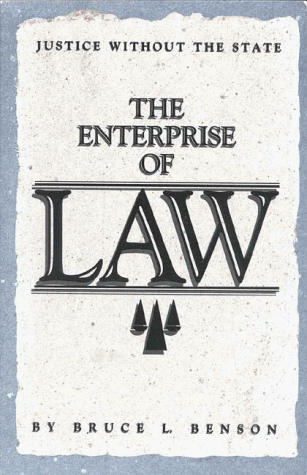
Imagen de portada de Amazon
Imagen de Amazon.com
Imagen de cubierta Syndetics
Portada de Syndetics
Imagen de OpenLibrary

The enterprise of law justice without the state by Bruce L. Benson.

Por: Detalles de publicación: San Francisco, Calif. Pacific Research Institute for Public Policy c1990.Descripción: viii, 397 p. ill. 24 cmISBN:
  • 0936488298
  • 0936488301 (pbk.)
Tema(s): Clasificación CDD:
  • 340/.11 20
Clasificación LoC:
  • KF382 .B46 1990
Valoración
    Valoración media: 0.0 (0 votos)
Existencias
Imagen de cubierta Tipo de ítem Biblioteca actual Biblioteca de origen Colección Ubicación en estantería Signatura topográfica Materiales especificados Info Vol URL Copia número Estado Notas Fecha de vencimiento Código de barras Reserva de ítems Prioridad de la cola de reserva de ejemplar Reservas para cursos
Libro Biblioteca de Derecho Mons. Fremiot Torres Oliver Colección General biblioteca derecho KF 382 .B46 1990 (Navegar estantería(Abre debajo)) Disponible 70000000024971
Total de reservas: 0

Descripciones mejoradas de Syndetics:

Published by Pacific Research Institute, 177 Post Street, San Francisco CA 94108. Annotation copyrighted by Book News, Inc., Portland, OR

Includes bibliographical references and index.

Reseñas proporcionadas por Syndetics

CHOICE Review

Benson (Florida State University) makes a provocative and readable but somewhat simplistic argument for the privatization of law in the US. Drawing on market economic theory, he contends that the US system of "authoritarian justice" is intended not to achieve the common good, but to satisfy interest group demands by promoting "involuntary transfers" of wealth. Dissatisfaction with the resulting waste and inefficiency, Benson says, drives people increasingly into the private sector for more effective law and justice. The detailed discussion of contract police and prison services and private courts is informative, although it may exaggerate both the extent and the efficacy of such arrangements. Benson's argument for the superiority of private over public mechanisms remains largely theoretical despite the inclusion of a large amount of illustrative data. An objective reader might well conclude that Benson makes a stronger case for supplementing public legal institutions than for displacing them. Because the book fails to address such crucial issues as the constitutional implications of privatization, it should be read as a compelling critique of the status quo rather than as a blueprint for reform. Undergraduate and graduate students. R. J. Maiman University of Southern Maine
Compartir
logopucpr-y-vive

Contáctanos

¡Queremos saber de ti!

Tel. 787.841.2000 Ext. 1801

bibliotecavaldes@pucpr.edu

⁣Búscanos en las redes

© 2026 Desarrollado por Ignite Online • All Rights Reserved • Powered by Koha.