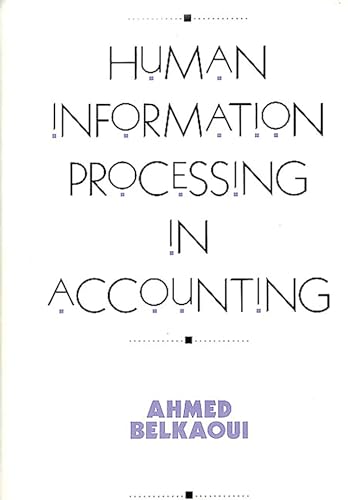

Human information processing in accounting Ahmed Belkaoui.
Detalles de publicación: New York Quorum Books 1989.Descripción: xii, 298 pISBN:- 0899303781 (lib. bdg. : alk. paper)
- 657/.01/9 19
- HF5630 .B438 1989
| Imagen de cubierta | Tipo de ítem | Biblioteca actual | Biblioteca de origen | Colección | Ubicación en estantería | Signatura topográfica | Materiales especificados | Info Vol | URL | Copia número | Estado | Notas | Fecha de vencimiento | Código de barras | Reserva de ítems | Prioridad de la cola de reserva de ejemplar | Reservas para cursos | |
|---|---|---|---|---|---|---|---|---|---|---|---|---|---|---|---|---|---|---|
| Libro | Biblioteca Encarnación Valdés Colección General bev | 657.019 B432h (Navegar estantería(Abre debajo)) | Disponible | 80000000735103 |
Descripciones mejoradas de Syndetics:
Ahmed Belkaoui focuses on the contributions human information processing research can make in the study of accounting decision-making. Both a review and synthesis of the current literature and a springboard for further research, Human Information Processing in Accounting explores the basic psychological concepts underlying human decision-making and their applications to accounting. As Belkaoui notes at the outset, accounting information is used primarily for decision-making. Human information processing in accounting is designed to understand, describe, evaluate, and--most importantly--improve the decision process used in an accounting or auditing context. Belkaoui's book provides accounting students and practitioners with the first comprehensive overview of the ways in which human information processing research has been used to study and enhance accounting decision-making.
Divided into six parts, the volume begins by examining the policy-capturing process and the Brunswick Lens model used in this type of research. Subsequent chapters address the models of risky choice used to predict or describe how individuals make these types of choices, the application of probability elicitation and revision to accounting research and practice, the heuristics and biases individuals use to reduce complex cognitive processes to simpler judgmental operations, and the application of cognitive science to accounting. A number of chapters include appendices illustrating the type of accounting studies that exist for each of the human information processing paradigms presented. Taken as a whole, Belkaoui's work represents a pioneering attempt to focus and organize the field of human information processing in accounting.
Includes index.
Bibliography: p.283-285.
Tabla de contenidos provista por Syndetics
- Preface
- The Lens Paradigm Lens Studies in Accounting
- Expected Utility Model and the Subjective
- Expected Utility Paradigm Probability
- Elicitation and Revision
- Heuristics and Biases Cognitive
- Science Research in Accounting
- Index