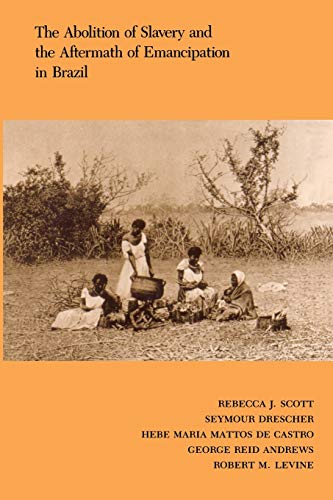

Abolition of slavery and the aftermath of emancipation in Brazil Rebecca J. Scott ... [et al.].
Detalles de publicación: Durham Duke University Press 1988.Descripción: vi, 173 p. 23 cmISBN:- 0822308886 (alk. paper)
- 326/.0981 19
- HT1128 .A63 1988
| Imagen de cubierta | Tipo de ítem | Biblioteca actual | Biblioteca de origen | Colección | Ubicación en estantería | Signatura topográfica | Materiales especificados | Info Vol | URL | Copia número | Estado | Notas | Fecha de vencimiento | Código de barras | Reserva de ítems | Prioridad de la cola de reserva de ejemplar | Reservas para cursos | |
|---|---|---|---|---|---|---|---|---|---|---|---|---|---|---|---|---|---|---|
| Libro | Biblioteca Encarnación Valdés Colección General bev | 326.0981 A154 (Navegar estantería(Abre debajo)) | Disponible | 80000000375843 |
Descripciones mejoradas de Syndetics:
In May 1888 the Brazilian parliament passed, and Princess Isabel (acting for her father, Emperor Pedro II) signed, the lei aurea, or Golden Law, providing for the total abolition of slavery. Brazil thereby became the last "civilized nation" to part with slavery as a legal institution. The freeing of slaves in Brazil, as in other countries, may not have fulfilled all the hopes for improvement it engendered, but the final act of abolition is certainly one of the defining landmarks of Brazilian history.
The articles presented here represent a broad scope of scholarly inquiry that covers developments across a wide canvas of Brazilian history and accentuates the importance of formal abolition as a watershed in that nation's development.
"The text of this book was originally published without the present introduction or the index as volume 68, number 3 (August 1988) of the Hispanic American historical review"--Verso of t.p.
Includes bibliographical references and index.
Tabla de contenidos provista por Syndetics
- A Note of introduction
- Exploring the Meaning of Freedom: Postemancipation Societies in Comparative Perspective
- Brazilian Abolition in Comparative Perspective
- Beyond Masters and Slaves: Subsistence Agriculture as Survival Strategy in Brazil during the Second Half of the Nineteenth Century
- Black and White Workers: Sao Paulo, Brazil, 1888-1938
- "Mud-Hut Jerusalem": Canudos Revisited
- Index
- Notes on the Contributors