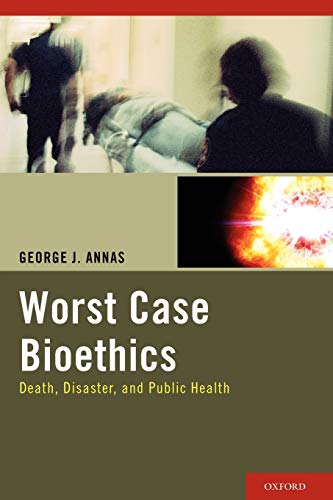
Imagen de portada de Amazon
Imagen de Amazon.com
Imagen de cubierta Syndetics
Portada de Syndetics
Imagen de OpenLibrary

Worst Case Bioethics: Death, Disaster and Public Health

Por: Oxford University Press 2010ISBN:
  • 9780199840717
Valoración
    Valoración media: 0.0 (0 votos)
No hay ítems correspondientes a este registro

Descripciones mejoradas de Syndetics:

In Worst Case Bioethics, George Annas employs contemporary disputes involving death and disaster to explore the radical changes underway in public health practice, the application of constitutional law to medicine, and human rights discourse to promote human health and wellbeing.

Tabla de contenidos provista por Syndetics

  • Introduction: Scared to Death by Worst Case Scenarios
  • Death and Disaster
  • 1 American Healthcare
  • 2 Bioterror and Bioart
  • 3 State of Emergency
  • 4 Licensed to Torture
  • 5 Hunger Strikes
  • 6 War
  • Death and the Constitution
  • 7 Cancer
  • 8 Drug Dealing Doctors
  • 9 Toxic Tinkering
  • 10 Abortion
  • 11 Culture of Death
  • 12 Patient Safety
  • Disaster and Human Rights
  • 13 Global Health
  • 14 The Statue of Security
  • 15 Pandemic Fear
  • 16 Bioidentifiers
  • 17 Genetic Genocide
  • Index

Reseñas proporcionadas por Syndetics

CHOICE Review

Post 9-11, bioethical considerations of worst case scenarios likely will focus on the moral propriety of actions deemed necessary to protect the welfare of a besieged nation's citizenry. One would expect a discussion on the ethics of torturing suspected terrorists, or reflections on the morally appropriate medical response to large-scale threats such as bioterrorism and pandemics. However, in a book entitled Worst Case Bioethics: Death, Disaster, and Public Health, one would not expect a discussion of the legal status of partial-birth abortions, medical marijuana, or the Terri Schiavo case. While these subjects are essential to any general discussion of bioethical issues, the devotion of one-third of a book dealing with disasters and public health to these topics seems excessive. Annas (Boston Univ.) includes a quite interesting discussion of whether force-feeding inmates participating in a hunger strike represents torture. Most impressive and enlightening is his argument in the final section about the dichotomy between safety and liberty in times of crises. He contends that democracies should not greatly infringe on the rights of citizens in the name of securing their safety because, ultimately, it is the former that helps facilitate the latter. Summing Up: Optional. Graduate students and above. B. J. Hall California State University, East Bay

Notas de autor provistas por Syndetics

George Annas is William Fairfield Warren Professor at Boston University and Chair of the Department of Health Law, Bioethics and Human Rights, Boston University School of Public Health. He is also Professor in the Boston University schools of Medicine and Law. He is the co-founder of Global Lawyers and Physicians, a transnational group that promotes human rights and health. He is a fellow of the American Association for the Advancement of Science, a member of the Institute of Medicine, and a member of the National Academies' Human Rights Committee.
Compartir
logopucpr-y-vive

Contáctanos

¡Queremos saber de ti!

Tel. 787.841.2000 Ext. 1801

bibliotecavaldes@pucpr.edu

⁣Búscanos en las redes

© 2026 Desarrollado por Ignite Online • All Rights Reserved • Powered by Koha.