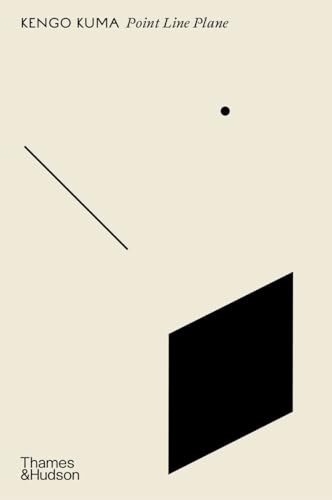

Point line plane / Kengo Kuma. txt
Editor: London : Thames & Hudson Ltd., 2024Descripción: 210 p. : ill. ; 23 cmTipo de contenido:- text
- unmediated
- volume
- 050002796X
- 9780500027967
- 23 720.92
- NA1559.K77 K86 2024
| Imagen de cubierta | Tipo de ítem | Biblioteca actual | Biblioteca de origen | Colección | Ubicación en estantería | Signatura topográfica | Materiales especificados | Info Vol | URL | Copia número | Estado | Notas | Fecha de vencimiento | Código de barras | Reserva de ítems | Prioridad de la cola de reserva de ejemplar | Reservas para cursos | |
|---|---|---|---|---|---|---|---|---|---|---|---|---|---|---|---|---|---|---|
| Libro Col. General CARIBET | CARIBET Biblioteca Arquitectura Colección General CARIBET | General NA1559.K77 K86 2024 (Navegar estantería(Abre debajo)) | 1 | Disponible | 91000000753590 |
Descripciones mejoradas de Syndetics:
A collection of writings that sets out Kengo Kuma's theories of architecture, but also a left field critique of where the architecture world finds itself today.
Kengo Kuma is one of Japan's leading architects and Professor Emeritus at the University of Tokyo. Widely known as a prolific writer and philosopher, he proposes architecture that opens up new relationships between nature, technology and human beings.
Through a series of thought-provoking essays, he unveils his vision of architecture as a dynamic interplay between tradition and innovation, critiquing the megastructures and capitalist influences of the 20th century and challenging readers to reconsider the role of architecture in shaping our world.
Drawing from diverse disciplines including art history, philosophy and literature, Kuma crafts a narrative that transcends the boundaries of traditional architectural theory, presenting a compelling manifesto for a new era of design - one that dismantles hard concrete volumes into points, lines and planes that celebrate the simplicity and sustainability of human connection.
Includes index.
08 Foreword --
A DISCOURSE ON METHOD --
12 The 20th Century: An Age of Volume --
15 Lines in Japanese Architecture and the Work of Mies vas der Rohe --
18 From Kandinsky’s Compositions to Gibson’s Particles --
21 Gibson and Particles --
23 Intellectualism vs Dada --
26 From Time as Motion to Time as Material --
29 From Additive Design to Computational Design --
33 Bruno Latour and the Chronophotographic Gun --
36 Architecture and Time --
38 Liberating Time from Motion --
40 Kandinsky’s Transcendence and Embedding of Dimensions --
43 New World Views and Effective Theories --
44 An Expanded, Multi- Layered World --
46 The Extra-Large Architecture of Finance Capitalism --
49 The Expansion of Architecture and the New Physics --
53 From an Evolutionary Model to a Multi- Layered Model --
55 Superstring Theory and Musical Architecture --
58 Deleuze and the Relativity of Matter --
POINT:
64 Big World, Little Pebbles --
66 From Greece to Rome --
67 The Seagram Building as an Aggregation of Points --
70 The Challenge of Points in the Design of Stone Plaza --
72 The Jump from Point to Volume --
76 The Blue Stone of Brunelleschi --
79 Brunelleschi’s Innovations with Points --
82 Brunelleschi’s Inductive Architecture --
85 Deductive and Inductive Architecture --
87 Plastic Tanks and Caddisflies --
91 Connecting Points with Liquid --
93 Metabolism and Points --
96 Stone Sliced Thinner than Wood --
98 Japanese and Chinese Roof Tiles --
101 Point Distribution and ageing --
104 Triangles as Versatile Point --
106 TSUMIKI: An Expandable System Modelled on Pine Branches --
109 Checkerboard Patterns as Points --
112 Railways Gravel as Free Points --
114 Checkerboard Patterns and Frugality --
115 Dispersal and the Sahara Desert --
LINE:
120 The Volumes of Le Corbusier and Mies --
124 Kenzo Tange’s Unaligned Lines --
127 From Line to Volume: The Degradation of Japanese Architecture --
130 Starting Out in a Wooden Hut --
132 The Lines of Gaudi --
134 Pointillism --
136 The Lines of the Tropical Rainforest --
138 The Lines of Modernism and the Lines of Japanese Architecture --
140 Disputes over Tradition and the Robust Lines of the Jomon Period --
142 The Movable Lines of Japanese Wood- Frame Construction --
144 Core Pressing and Surface Pressing --
147 The Fine Lines of Hiroshige --
151 An Architectural Sudden Shower --
155 The Line- Drawing Method and the V&A Dundee --
159 Living Lines and Dead Lines--
161 Lines and the Theory of Touch--
162 Lines Wandering Between Life and Death --
165 The Lines of Ultrafine Carbon Fibres --
167 Silk- Like Lines of the Tomioka Warehouse --
PLANE:
174 Rietveld vs De Klerk --
177 Rietveld vs Mies --
179 Discovering Bedouin Fabrics in the Sahara --
182 Semper vs Laugier --
185 A Fabric Tea Room in Frankfurt --
189 Frank Lloyd Wright’s Desert Encampment--
191 Fabric House in Taiki --
194 Casa Umbrella: Sheltering People in Emergencies --
197 Fuller’s Domes and the Democratization of Architecture --
200 Saving the World with Tensegrity --
203 Cells and Tensegrity --
206 Hojo an, Eight Centuries On --
212 Index --
215 Picture Credits--
"Ostensibly a collection of writing that sets out Kengo Kuma's theories of architecture, but also an antivolume, antimegastructure, and in some sense anticapitalist, left-field critique of where the architecture world finds itself today. Point Line Plane is architectural theory, but written as narrative, full of intriguing vignettes, such as the fact that in Ancient Rome windows were fitted with slices of marble because glass was so expensive. It's written in a very Japanese form: a series of mini essays that circle around a theme and is aimed at a highly literate audience. Seventy-two related essays across four sections set out Kuma's rejection of the architecture of volume and mass that categorized the twentieth century in favor of a more ad hoc architecture that can be easily disassembled and, by drawing on tried and tested practices of the past, touch the earth more lightly. 72 black-and-white illustrations." -- Amazon
Tabla de contenidos provista por Syndetics
- Foreword(8)
- A Discourse on Method
- The 20th Century: An Age of Volume(12)
- Lines in Japanese Architecture and the Work of Mies van der Rohe(15)
- From Kandinsky's Compositions to Gibson's Particles(18)
- Gibson and Particles(21)
- Intellectualism vs Dada(23)
- From Time as Motion to Time as Material(26)
- From Additive Design to Computational Design(29)
- Bruno Latourand the Chronophotographic Gun(33)
- Architecture and Time(36)
- Liberating Time from Motion(38)
- Kandinsky's Transcendence and Embedding of Dimensions(40)
- New World Views and Effective Theories(43)
- An Expanded, Multi-Layered World(44)
- The Extra Large Architecture of Finance Capitalism(46)
- The Expansion of Architecture and the New Physics(49)
- From an Evolutionary Model to a Multi-Layered Model(53)
- Superstring Theory and Musical Architecture(55)
- Deleuze and the Relativity of Matter(58)