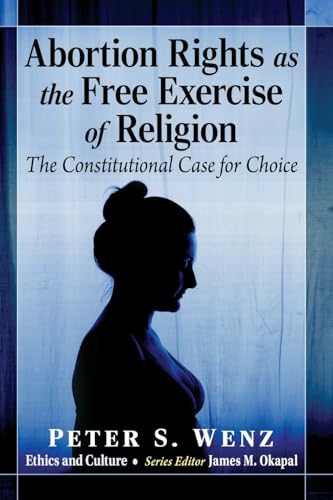

Abortion Rights as the Free Exercise of Religion : The Constitutional Case for Choice / Peter S. Wenz, Ethics and Culture Series Editor James M. Okapal.
Series Ethics and CultureEditor: Jefferson, North Carolina : McFarland & Company, Inc., [©2025]Descripción: viii, 223 pages ; 23 cmTipo de contenido:- text
- unmediated
- volume
- 9781476696904
- Abortion Rights as the Free Exercise of Religion [Title of spine]
- HQ 767.5.U5 W458 2025
| Imagen de cubierta | Tipo de ítem | Biblioteca actual | Biblioteca de origen | Colección | Ubicación en estantería | Signatura topográfica | Materiales especificados | Info Vol | URL | Copia número | Estado | Notas | Fecha de vencimiento | Código de barras | Reserva de ítems | Prioridad de la cola de reserva de ejemplar | Reservas para cursos | |
|---|---|---|---|---|---|---|---|---|---|---|---|---|---|---|---|---|---|---|
| Libro | Biblioteca de Derecho Mons. Fremiot Torres Oliver Colección General biblioteca derecho | HQ 767.5.U5 W458 2025 (Navegar estantería(Abre debajo)) | c. 1 | Disponible | 70000000906518 |
Descripciones mejoradas de Syndetics:
This book is the first to analyze Supreme Court decisions related to religious freedom and abortion rights, showing that the Court gives women a religious right to abortions, at least during the first half of pregnancy. The Court considers any sincerely claimed religious belief to be worthy of accommodation if it causes no great harm. Therefore, a woman who claims that having a child would interfere with work dedicated to God's glory should receive an accommodation that exempts her from state laws restricting abortion, as that is the kind of relief accorded by the Court to others seeking religious exemptions from generally applicable laws and other rules.
The Court cannot claim in this case that abortion causes great harm, because it maintains even in its most recent abortion decision that it is neutral on the question of when the unborn attains a right to life, and loss of the unborn's life is the central harm claimed by others regarding abortion. The book argues that 21 weeks of gestation is the earliest point at which a right to life can be attributed to the fetus on a scientific basis.
Front cover image: © Zhuravlev Andrey / Shutterstock
Includes bibliographical references and index.
How to Interpret the Constitution -- Historical Background -- Critique of the Wall of Separation -- The Growth of Free Exercise -- From Free Exercise to Abortion Rights .
""This book is the first to analyze Supreme Court decisions in two distinct areas-religious freedom and abortion rights-to show that the Court gives women a religious right to abortions, at least during the first half of pregnancy. The Court now considers any sincerely claimed religious belief to be worthy of accommodation if that causes no great harm. Therefore, a woman who claims that having a child would interfere with work dedicated to God's glory should receive an accommodation that exempts her from state laws that restrict abortion, as that is the kind of relief that the Court has accorded others seeking religious exemptions from generally applicable laws and other rules The Court cannot claim in this case that great harm is caused by abortion, because it maintains even in its most recent abortion decision that it is completely neutral on the question of when the unborn attains a right to life, and loss of the unborn's life is the central harm that others claim abortion entails. The book argues that 21 weeks of gestation is the earliest point at which a right to life can be attributed to the fetus on a scientific basis."-Provided by publisher"-- Provided by publisher.
Tabla de contenidos provista por Syndetics
- Acknowledgments(vi)
- Preface(1)
- Introduction(3)
- Part I How to Interpret the Constitution
- 1 The Promise of Originalism(19)
- 2 The Limits of Originalism(28)
- 3 Pluralism and Evolving Doctrines(45)
- Part II Historical Background
- 4 Religious Persecution and War(57)
- 5 The Separation of Church and State(70)
- Part III Critique of the Wall of Separation
- 6 A Wall of Separation Would Harm Society(83)
- 7 A Wall of Separation Conflicts with Free Exercise(93)
- Part IV The Growth of Free Exercise
- 8 Free Exercise Under Assault(103)
- 9 The Rise of Free Exercise in School Funding(113)
- 10 Prayers on the 50-Yard Line(122)
- 11 Free Exercise in the Current Court(134)
- Part V From Free Exercise to Abortion Rights
- 12 Lack of Convincing Evidence Makes Beliefs Religious(149)
- 13 Idiosyncratic and Irrational Religious Beliefs(161)
- 14 The Unborn's Right to Life Is a Religious Matter(168)
- 15 The Free-Exercise Right to Abortion(176)
- Addendum for Legal Scholars(185)
- Chapter Notes(195)
- Bibliography(207)
- Index(215)