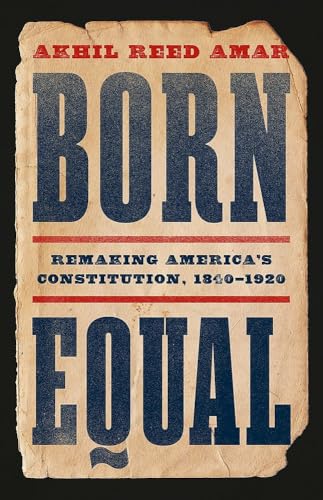

Born Equal : Remaking America's Constitution, 1840-1920 / Akhil Reed Amar.
Editor: New York : Basic Books, ©2025Edición: First editionDescripción: viii, 726 pages ; ilustration ; 24 cmTipo de contenido:- text
- unmediated
- volume
- 9781541605190
- KF 4541 .A877 2025
| Imagen de cubierta | Tipo de ítem | Biblioteca actual | Biblioteca de origen | Colección | Ubicación en estantería | Signatura topográfica | Materiales especificados | Info Vol | URL | Copia número | Estado | Notas | Fecha de vencimiento | Código de barras | Reserva de ítems | Prioridad de la cola de reserva de ejemplar | Reservas para cursos | |
|---|---|---|---|---|---|---|---|---|---|---|---|---|---|---|---|---|---|---|
| Libro | Biblioteca de Derecho Mons. Fremiot Torres Oliver Colección General biblioteca derecho | KF 4541 .A877 2025 (Navegar estantería(Abre debajo)) | c. 1 | Disponible | 70000000906504 |
Descripciones mejoradas de Syndetics:
From "o ne of our most prodigious constitutional scholars " (Jonathan Eig), the definitive history of how the ideal of birth equality reshaped the American Constitution, from antebellum debates over slavery and secession, to the Civil War and emancipation, to women's suffrage
In 1840, millions of Black Americans groaned in the chains of slavery. By 1920, millions of American men and women of every race had won the vote.
In Born Equal , the prizewinning constitutional historian Akhil Reed Amar recounts the dramatic constitutional debates that unfolded across these eight decades, when four glorious amendments abolished slavery, secured Black and female citizenship, and extended suffrage regardless of race or gender. At the heart of this era was the epic and ever-evolving idea that all Americans are created equal. The promise of birth equality sat at the base of the 1776 Declaration of Independence. But in the nineteenth century, remarkable American women and men--especially Elizabeth Cady Stanton, Frederick Douglass, Harriet Beecher Stowe, and Abraham Lincoln--elaborated a new vision of what this ideal demanded. Their debates played out from Seneca Falls to the halls of Congress, from Bleeding Kansas to Gettysburg, from Ford's Theater to the White House gates, ultimately transforming the nation and the world.
An ambitious narrative history and a penetrating work of legal and political analysis, Born Equal is a vital new portrait of America's winding road toward equality.
Includes bibliographical references and index.
Pre-war -- War's eve -- Civil War -- Post war -- World war.
"In Born Equal, the prizewinning constitutional historian Akhil Reed Amar recounts the dramatic constitutional debates that unfolded across these eight decades, when four glorious amendments abolished slavery, secured Black and female citizenship, and extended suffrage regardless of race or gender. At the heart of this era was the epic and ever-evolving idea that all Americans are created equal. The promise of birth equality sat at the base of the 1776 Declaration of Independence. But in the nineteenth century, remarkable American women and men-especially Elizabeth Cady Stanton, Frederick Douglass, Harriet Beecher Stowe, and Abraham Lincoln-elaborated a new vision of what this ideal demanded. Their debates played out from Seneca Falls to the halls of Congress, from Bloody Kansas to Gettysburg, from Ford's Theater to the White House gates, ultimately transforming the nation and the world"-- Provided by publisher.
Tabla de contenidos provista por Syndetics
- Introduction(1)
- Part I Pre-War
- 1 London(19)
- 2 Philadelphia(39)
- 3 Seneca Falls(77)
- 4 Braintree and Capitol Hill(101)
- 5 Capitol Hill and Braintree(135)
- 6 Buffalo(159)
- 7 Texas and California(199)
- 8 New England and Kentucky(231)
- 9 Peoria(271)
- Part II War's Eve
- 10 Ostend, Springfield, and Freeport(313)
- 11 Cincinnati, New York City, and Chicago(363)
- 12 Charleston(377)
- Part III Civil War
- 13 Washington City, Antietam, Gettysburg, and Atlanta(413)
- 14 Ford's Theatre(477)
- Part IV Post-War
- 15 Pennsylvania Avenue(501)
- 16 Grasslands and the Southland(551)
- Part V World War
- 17 Wyoming, Ohio, and Tennessee(587)
- Postscript(611)
- Acknowledgments(627)
- Illustration Credits(631)
- Notes(635)
- Index(707)
Reseñas proporcionadas por Syndetics
Publishers Weekly Review
In this sprawling account, legal scholar Amar (The Words That Made Us) tracks the evolution of constitutional rights from the heights of "slavocracy" in the 1840s and '50s through women winning the right to vote in 1920. This 80-year shift, he argues, from mass subjugation to nearly universal enfranchisement (excluding Native Americans, an issue Amar also explores), was propelled partly by key writers, artists, and politicians deeply engaged in debates about constitutional rights--among them Elizabeth Cady Stanton, Frederick Douglass, Harriet Beecher Stowe, and Abraham Lincoln. Amar's focus on individuals allows him to craft a history that is attuned both the social movements and material conditions leading to societal change as well as the powerful influence wielded by committed intellectuals; much of the book traces how pro-equality thinkers were continually advancing their positions into more radical territory by forming their own "originalist" interpretations of the Constitution to battle "slavocrats" like John C. Calhoun and Jefferson Davis. The main goal of Amar's narrative is to reclaim originalism as just as useful and inherent to liberalism as it is to conservatism, which lay readers may find a bit idiosyncratic and wearisome as Amar constantly returns to it. Still, it's an elegantly written and thorough survey of America's second founding. (Sept.)CHOICE Review
Amid charges that the Trump administration is flaunting constitutional norms and undermining American democracy, Born Equal joins a growing array of scholarship debating how democratic the Constitution is and its suitability for framing a pluralistic society. With this middle volume of a three-part history, Amar (law, Yale Univ.) forcefully argues a powerful but controversial thesis: that US founding documents, including nonlegal writings such as the Declaration, and the Founding Fathers (some more than others) laid an egalitarian foundation and that originalism offers progressive principles for understanding our basic law. Centering on human enslavement and Lincoln's "originalism," Amar delves engrossingly into the politics of geography, whereas Joseph Fishkin and William Forbath, in The Anti-Oligarchy Constitution (2024), highlight political economy. Both constitutional histories agree that constitutional politics have played a major role in American public debates, but Amar's conception prioritizes liberal equality, whereas Fishkin and Forbath maintain that the core democratic tradition is civic republicanism, with its egalitarian rather than conservative definition of liberty. The book's length presents a barrier to casual readers, but it is compensated for by wonderfully rich historical detail and often fascinating stories and personal profiles that accompany its provocative arguments. Summing Up: Highly recommended. General readers through faculty; professionals. --Augustus B. Cochran, emeritus, Agnes Scott CollegeNotas de autor provistas por Syndetics
Akhil Reed Amar is the Sterling Professor of Law and Political Science at Yale University and the author of several books on constitutional law and history, including America's Constitution: A Biography and The Words That Made Us . He lives in Woodbridge, Connecticut.Haga clic en una imagen para verla en el visor de imágenes