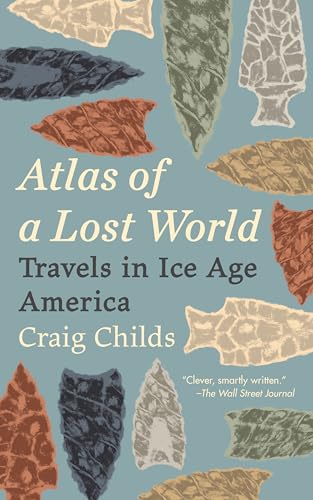

Atlas of a Lost World / Craig Childs.
Editor: Random House Inc, 2019ISBN:- 9780345806314
- 034580631X
- 551.7/92 23/eng/20230216
Descripciones mejoradas de Syndetics:
The first people in the New World were few, their encampments fleeting. On a side of the planet no human had ever seen, different groups arrived from different directions, and not all at the same time. The land they reached was fully inhabited by megafauna-mastodons, giant bears, mammoths, saber-toothed cats, enormous bison, and sloths that stood one story tall. These Ice Age explorers, hunters, and families were wildly outnumbered and many would themselves have been prey to the much larger animals.
In Atlas of a Lost World , Craig Childs blends science and personal narrative to upend our notions of where these people came from and who they were. How they got here, persevered, and ultimately thrived is a story that resonates from the Pleistocene to our modern era, and reveals how much has changed since the time of mammoth hunters, and how little. Through it, readers will see the Ice Age, and their own age, in a whole new light.
Tabla de contenidos provista por Syndetics
- Prologue(p. xi)
- 1 Land Bridge: Date Unknown(p. 3)
- 2 Inner Beringia: 25,000 Years Ago(p. 15)
- 3 House of Ice: 20,000 Years Ago(p. 33)
- 4 The Long Coast: 17,000 Years Ago(p. 62)
- 5 Playground of Giants: 45,000 to 15,000 Years Ago(p. 101)
- 6 Emergence: 16,000 to 14,000 Years Ago(p. 112)
- 7 A Dangerous Eden: 14,500 Years Ago(p. 127)
- 8 Cult of the Fluted Point: 13,500 Years Ago(p. 166)
- 9 The Last Mammoth Hunt: 13,000 to 12,000 Years Ago(p. 176)
- 10 American Babylon: 12,800 to 11,800 Years Ago(p. 205)
- 11 The Party at the Beginning of the World: 11,000 Years Ago(p. 214)
- Epilogue(p. 234)
- Acknowledgments(p. 239)
- Notes(p. 241)
- Selected Bibliography(p. 245)
- Index(p. 259)
Extracto provisto por Syndetics
Reseñas proporcionadas por Syndetics
Library Journal Review
In his latest work, Childs (The Apocalyptic Planet; House of Rain) visits key archaeological sites in North America in an attempt to understand how humans first arrived and expanded across the Americas. Childs explores sites associated with the Bering Land Bridge, which permitted, many experts contend, people from Asia to cross into what is now Alaska. He also investigates how evidence of Solutrean physical culture from prehistoric Europe is littered throughout North America and thus offers an alternate and possibly coinciding theory of an Atlantic crossing. While these theories of migration have existed and been debated for decades, what draws readers in is Childs's approach of actually going to the sites and speaking with researchers. His visit to a modern-day flintknapper in Utah reveals the humanity that went into producing a useful projectile point. Included are imaginative re-creations of the daunting challenges the first arrivals faced, in the form of a frigid and inhospitable climate paired with rapacious megafauna. VERDICT A very engaging read that allows readers a real glimpse into the prehistoric world; Childs ably transforms archaeological theories into relatable concepts.-Brian Renvall, Mesalands Community Coll., Tucumcari, NM © Copyright 2018. Library Journals LLC, a wholly owned subsidiary of Media Source, Inc. No redistribution permitted.Publishers Weekly Review
In this captivating travelogue, Childs (Apocalyptic Planet) trods the late Ice Age with the first migrants to the Americas-adventurous and canny explorers who traveled amid disappearing glaciers and "a cycle of animals of all sizes from voles and falcons to some of the largest mammals seen in human evolution." The first human inhabitants of North America likely crossed a land bridge from Siberia to Alaska some 30,000 years ago, and Childs follows their path down the coast of California, across to Texas, and Colorado, and as far as Florida. The migrants not only left their tools and weapons of survival behind, but mysteries, too: "How [the first people] got to Florida no one knows," whether they came down the Atlantic coast or "somehow across the Pacific," he writes. Childs's walk-in-their-shoes account takes on pinpointing "the world's most contentious prehistoric problems"-how and where humans came to the Americas. The evidence suggests, however, they "came along multiple routes and at different times, before, during, and after the height of the Ice Age," he writes. With simple, beautiful sketches by fellow traveler Gilman, Childs's account will fire the imagination of ordinary readers as well as anthropologists and prehistorians. (May) © Copyright PWxyz, LLC. All rights reserved.Booklist Review
*Starred Review* Childs (Apocalyptic Planet, 2012) takes readers on a scintillating dual journey through the geography of modern and Ice Age America in this survey of some of the lands reached by the first voyagers across the Bering Sea Ice Bridge. With fully half the book set in Alaska, Childs provides a fascinating mash-up of scientific history and present-day travelogue as he journeys across the state's various regions, surveying the land; visiting with scientists and Native scholars; and seeking out the place where anthropology, archaeology, and cultural history meet. While exploring the American West and ultimately embarking on a trip in a north Florida swamp, Childs maintains a self-deprecating humor and a boundless enthusiasm for his subject that makes this narrative an unexpected page-turner. His curiosity is infectious, and the lessons he learns about how Ice Age people lived, what we can learn from them, and who they became resonate with serious staying power. These first people, Tlingit writer Ernestine Hayes tells him, were not becoming Americans, but becoming Tlingit, becoming Navajo, becoming Lakota. Childs has found history deeper than politics, and in rich, evocative prose, he makes it startlingly relevant to readers. A science title with broad and enduring appeal.--Mondor, Colleen Copyright 2018 BooklistNotas de autor provistas por Syndetics
Craig Childs is a river guide, a field instructor in natural history, an adventurer, & a writer. His other books include "Crossing Paths: Uncommon Encounters with Animals in the Wild" (Sasquatch). He camps in the backcountry of the American West at least nine months of the year, usually living in the back of his truck, out of a river vessel, or from his backpack. He hasn't had a phone in ten years.(Bowker Author Biography)