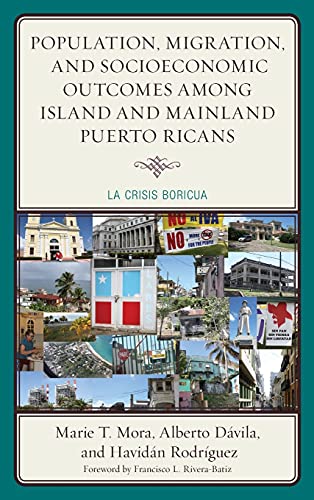

Population, Migration, and Socioeconomic Outcomes among Island and Mainland Puerto Ricans : La Crisis Boricua / Marie T. Mora, Alberto Dávila and Hávidan Rodríguez ; foreword by Francisco L. Rivera-Batiz.
Editor: Lanham, Maryland : Lexington Books, [2018]Descripción: xxiv, 217 pages : illustrations ; 24 cmTipo de contenido:- text
- unmediated
- volume
- 1498516866
- 9781498516860
- 338.97295 23
- F1976.4 .M67 2018
| Imagen de cubierta | Tipo de ítem | Biblioteca actual | Biblioteca de origen | Colección | Ubicación en estantería | Signatura topográfica | Materiales especificados | Info Vol | URL | Copia número | Estado | Notas | Fecha de vencimiento | Código de barras | Reserva de ítems | Prioridad de la cola de reserva de ejemplar | Reservas para cursos | |
|---|---|---|---|---|---|---|---|---|---|---|---|---|---|---|---|---|---|---|
| Libro mb | Biblioteca de Mayagüez Sala de Referencia mb | F1976.4 .M67 2018 (Navegar estantería(Abre debajo)) | c. 1 | Disponible | 52000003299320 |
Descripciones mejoradas de Syndetics:
At the landmark centennial anniversary of the 1917 Jones-Shafroth Act, which granted Puerto Ricans U.S. citizenship, the island confronts an unfolding humanitarian crisis initially triggered by an acute economic crisis surging since 2006. Analyzing large datasets such as the American Community Survey and the Puerto Rican Community Survey, this book represents the first comprehensive analysis of the socioeconomic and demographic consequences of "La Crisis Boricua" for Puerto Ricans on the island and mainland, including massive net outmigration from the island on a scale not seen for sixty years; a shrinking and rapidly aging population; a shut-down of high-tech industries; a significant loss in public and private sector jobs; a deteriorating infrastructure; higher sales taxes than any of the states; $74 billion in public debt plus another $49 billion in unfunded pension obligations; and defaults on payments to bondholders. This book also discusses how the socioeconomic and demographic outcomes differ among stateside Puerto Ricans, including recent migrants, in traditional settlement areas such as New York versus those in newer settlement areas such as Florida and Texas. Florida is now home to 1.1 million Puerto Ricans (essentially the same number as those living in New York) and received a full third of the migrants from the island to mainland during this time. Scholars interested in the transition of migrants into their receiving communities (regardless of the Puerto Rican case) will also find this book to be of interest, particularly with respect to the comparative analyses on earnings, the likelihood of being impoverished, and self-employment.
Includes bibliographical references (page 195-204) and index.
Foreword / Francisco L. Rivera-Batiz -- The elusive American dream: La Crisis Boricua in perspective -- The growth and emergence of the Puerto Rican "Nation": Economic development, mass migration, and popualation composition -- 2006: The Year of the Perfect Storm and the Onset of La Crisis Boricua -- On the Recent Puerto Rican Migrants -- Migration and Changes in the Settlement Patterns of Puerto Ricans -- How Were Puerto Ricans Faring in the New Settlements versus Traditional Areas -- The Role of Gender on Puerto Rican Social Mobility Outcomes -- Shaping the Business and Political Landscape on the Mainland -- The Continued Evolution of Politics and Socioeconomic Processes and Policies: Puerto Rico in the Twenty-first st Century -- Appendix A: Major datasets employed and details on selected variables -- Appendix B: Empirical methodology and selected estimation details -- Appendix C: About the book cover.
At the landmark centennial anniversary of the 1917 Jones-Shafroth Act, which granted Puerto Ricans U.S. citizenship, the island confronts an unfolding humanitarian crisis initially triggered by an acute economic crisis surging since 2006. Analyzing large datasets such as the American Community Survey and the Puerto Rican Community Survey, this book represents the first comprehensive analysis of the socioeconomic and demographic consequences of “La Crisis Boricua” for Puerto Ricans on the island and mainland, including massive net outmigration from the island on a scale not seen for sixty years; a shrinking and rapidly aging population; a shut-down of high-tech industries; a significant loss in public and private sector jobs; a deteriorating infrastructure; higher sales taxes than any of the states; $74 billion in public debt plus another $49 billion in unfunded pension obligations; and defaults on payments to bondholders. This book also discusses how the socioeconomic and demographic outcomes differ among stateside Puerto Ricans, including recent migrants, in traditional settlement areas such as New York versus those in newer settlement areas such as Florida and Texas. Florida is now home to 1.1 million Puerto Ricans (essentially the same number as those living in New York) and received a full third of the migrants from the island to mainland during this time. Scholars interested in the transition of migrants into their receiving communities (regardless of the Puerto Rican case) will also find this book to be of interest, particularly with respect to the comparative analyses on earnings, the likelihood of being impoverished, and self-employment.
Notas de autor provistas por Syndetics
Marie T. Mora is professor of economics and associate vice provost for faculty diversity at the University of Texas Rio Grande Valley.
Alberto Dávila is professor of economics and associate dean for administration, graduate studies and research at the Robert C. Vackar College of Business & Entrepreneurship at the University of Texas Rio Grande Valley.
Havidán Rodríguez is professor and president of the University at Albany, State University of New York.